

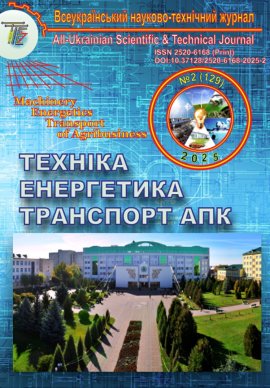
Issue №: 2 (129)
The journal solves the problems of creation and improvement of machinery and technologies for agriculture: 131 - Applied Mechanics, 132 - Materials Science, 133 - Industrial Engineering, 141 - Power Engineering, Electrical Engineering and Electromechanics, 208 - Agricultural Engineering.
ANALYSIS OF METHODS AND MEANS OF DRYING OF AGRICULTURAL MATERIALS
Dmytro BORYSIUK – Candidate of Technical Sciences, Associate Professor of the department of automobiles and transport management of Vinnytsia National Technical University (21021, Vinnytsia, Politechnichna st., 7, e-mail: bddv@ukr.net, https://orcid.org/0000-0001-8572-6959).
Yuriy IVANOV – Candidate of Technical Sciences, Associate Professor, Associate Professor of the Department of Automation and Intellectual Information Technologies of Vinnytsia National Technical University (21021, Vinnytsia, Khmelnytske Shosse, 95, e-mail: Yura881990@i.ua, 0000-0003-2125-1004).
Vitaliy OGNEVYY – Candidate of Economic Sciences, Associate Professor of the department of automobiles and transport management of Vinnytsia National Technical University (21021, Vinnytsia, Politechnichna st., 7, e-mail: bddv@ukr.net, https://orcid.org/0000-0001-8334-6709).
Igor TVERDOKHLIB – Candidate of Technical Sciences, Associate Professor, Associate Professor of the department of general technical disciplines and occupational safety, Vinnytsia National Agrarian University (21008, Vinniytsia, st. Sonyachna 3, VNAU, 21008, e-mail: igor_tverdokhlib@yahoo.com, https://orcid.org/0000-0003-1350-3232).
Most agricultural materials contain a significant amount of water, which is part of plant tissues and is their necessary component. However, excess water reduces the nutritional value of agricultural materials, increases storage and transportation costs, and can cause spoilage due to the activity of various microorganisms. Every year, Ukraine harvests a significant harvest of vegetables, fruits, and berries. But no more than 65% of the grown crop reaches the consumer. For long-term preservation of fruit and vegetable raw materials and other agricultural materials, special processing is necessary to prevent their spoilage. One type of such processing is drying.
Preserving products by drying is one of the methods known since ancient times. There are many agricultural products in which drying occurs spontaneously in nature. In modern conditions, mechanization and intensive use of energy in the food and agricultural industries are also applied to drying processes. In the shortest terms, the drying process can be defined as the removal of water from solids.
An analysis of methods and means of drying of agricultural materials and their classification for further implementation in practice of the most energy-efficient drying method is carried out in this article. The analysis of existing methods and means of drying of agricultural materials made it possible to identify the shortcomings of the drying process, which in the future will allow developing promising ways of improved drying technology.
Considering that the development of technical solutions aimed at intensification and energy saving of the drying technological process is an urgent scientific and technical task of the agro-industrial production sector in Ukraine, based on the generalization of literature data, the co-authors of the article developed two ways to intensify the drying process of agricultural materials: improving the means of drying of agricultural materials and improving the methods of drying of agricultural materials.
1. Zabrodotska, L.Yu., & Kirchuk, R.V. (2013). Research and improvement of the process of drying a heap of grass seeds [Monograph]. Lutsk: Editorial Department of LNTU. [in Ukrainian].
2. Didukh, V.F. (2002). Increasing the efficiency of drying of agricultural materials [Monograph]. Lutsk: Editorial Department of LDTU. [in Ukrainian].
3. Shalugin, V.S., & Shmandiy, V.M. (2008). Processes and apparatuses of industrial technologies. Kyiv: Center for Educational Literature. [in Ukrainian].
4. Tsurkan, O.V. (2022). Substantiation of a rational method and equipment for drying high-moisture seeds of melon crops. Bulletin of the Khmelnytsky National University, Series: Technical Sciences, 1(305), 240–246. DOI: https://doi.org/10.31891/2307-5732-2022-305-1-240-246 [in Ukrainian].
5. Rutkevych, V.S., & Didyk, A.M. (2023). Review of methods and means for drying walnuts in the shell. Bulletin of the Khmelnytsky National University, Series: Technical Sciences, 1(317), 230–236. DOI: https://doi.org/10.31891/2307-5732-2023-317-1-230-236 [in Ukrainian].
6. Kotov, B., Spirin, A., Kalinichenko, R., Bandura, V., Polievoda, Y., & Tverdokhlib, I. (2019). Determination of parameters and modes of new heliocollector constructions for drying grain and vegetable raw material by active ventilation. Research in Agricultural Engineering, 65(1), 20–24. DOI: https://doi.org/10.17221/73/2017-RAE [in English].
7. Kalinichenko, R.A. (2005). Energy-saving modes of drying and active ventilation of grain during storage in farm conditions [Author’s abstract of PhD dissertation 05.09.16.]. Glevakha. [in Ukrainian].
8. Lisetskyi, V.O. (2003). Increasing the efficiency of grain drying in periodic dryers [Author’s abstract of PhD dissertation 05.05.11.]. Glevakha. [in Ukrainian].
9. Didukh, V.F. (2003). Scientific and technological foundations of mechanized drying of heterogeneous materials [Doctoral dissertation 05.05.11.]. Lutsk. [in Ukrainian].
10. Spirin, A., Kupchuk, I., Tverdokhlib, I., Polievoda, Y., Kovalova, K., & Dmytrenko, V. (2022). Substantiation of modes of drying alfalfa pulp by active ventilation in a laboratory electric dryer. Przegląd Elektrotechniczny, 98(5), 11–15. DOI: https://doi.org/10.15199/48.2022.05.02 [in English].
11. Snezhkin, Y.F., Paziuk, V.M., Petrova, Zh.O., & Tokarchuk, O.A. (2020). Determination of the energy-efficient modes for barley seeds drying. INMATEH – Agricultural Engineering, 61(2), 183–192. DOI: https://doi.org/10.35633/inmateh-61-20 [in English].
12. Paziuk, V., Vyshnevskiy, V., Tokarchuk, O., & Kupchuk, I. (2021). Substantiation of the energy-efficient schedules of drying grain seeds. Bulletin of the Transilvania University of Brasov, Series II: Forestry, Wood Industry, Agricultural Food Engineering, 14(63)(2), 137–146. DOI: https://doi.org/10.31926/but.fwiafe.2021.14.63.2.13 [in English].
13. Bandura, V., Yaroshenko, L., Fialkovska, L., Kondratyuk, D., Palamarchuk, V., & Paladiichuk, Y. (2021). Case study: Dynamics of sunflower seed movement in the vibrating tray of the infrared dryer and its influence on the drying process. Agraarteadus, 32(2), 204–213. DOI: https://doi.org/10.15159/jas.21.24 [in English].
14. Tsurkan, O., Prysiazhniuk, D., Spirin, A., Borysiuk, D., & Tverdokhlib, I. (2022). Research of the process of vibroozone drying of grain. Przegląd Elektrotechniczny, 98(12), 329–333. DOI: https://doi.org/10.15199/48.2022.12.76 [in English].
15. Zozulyak, I.A. (2020). Substantiation of the structural and technological parameters of an infrared vibration dryer. Engineering, Energy, Transport of the Agricultural Complex, 4(111), 29–34. DOI: https://doi.org/10.37128/2520-6168-2020-1-9 [in Ukrainian].
16. Yaroshenko, L.V. (2020). Substantiation of the design and technological parameters of a vibration dryer for grain and vegetable seed for experimental and breeding stations. Vibrations in Engineering and Technologies, 1(96), 71–81. DOI: https://doi.org/10.37128/2306-8744-2020-1-8 [in Ukrainian].
17. Tverdokhlib, I.V., Spirin, A.V., & Tsurkan, O.V. (2021). Determination of thermophysical characteristics of vibration drying objects. Vibrations in Engineering and Technologies, 3(102), 100–108. DOI: https://doi.org/10.37128/2306-8744-2021-3-11 [in Ukrainian].
18. Voznyak, O.M., & Babyn, I.A. (2022). Automated system for drying sugar pulp. Engineering, Energy, Transport of the Agricultural Complex, 1(116), 65–76. DOI: https://doi.org/10.37128/2520-6168-2022-1-8 [in Ukrainian].
19. Prysyazhnyuk, D.V. (2022). Research on the energy efficiency of drying grain raw materials using a vibration-zoning complex. Vibrations in Engineering and Technologies, 1(104), 117–123. DOI: https://doi.org/10.37128/2306-8744-2022-1-14 [in Ukrainian].
20. Yaropud, V.M., Lavreniuk, P.P. (2023). Ways to improve the design of a convective walnut dryer. Engineering, Energy, Transport of the Agricultural Complex, 1(120), 120–131. DOI: https://doi.org/10.37128/2520-6168-2023-1-14 [in Ukrainian].
21. Babyn, I. A., Burlaka, S. A., & Kholodyuk, O. V. (2023). Efficiency of using a belt dryer. Bulletin of Khmelnytsky National University, Series: Technical Sciences, 1(5 [325]), 26–29. DOI: https://doi.org/10.31891/2307-5732-2023-325-5-26-29 [in Ukrainian].
22. Cook, E.M., DuMont, H.D. (1991). Process drying practice. Elsevier. [in English].
23. Brooker, D.B., Bakker-Arkema, F.W., Hall, C.W. (1992). Drying and storage of grains and oilseeds. Springer Science & Business Media. [in English].
24. Bala, B.K. (2016). Drying and storage of cereal grains. John Wiley & Sons. [in English].
25. Bandura, V.M., Popyak, O.G. (2019). Technological processes of soybean drying. Engineering, Energy, Transport of the Agricultural Complex, (2 [105]), 52–58. DOI: https://doi.org/10.37128/2520-6168-2019-2-7 [in Ukrainian].
26. Spirin, A.V., Tverdokhlib, I.V., Kupchuk, I.M., Poberezhets, Y.M. (2021). Justification of energy-efficient modes of the drying process of products of fractional processing of alfalfa. Engineering, Energy, Transport of the Agricultural Complex, 2(113), 142–151. DOI: https://doi.org/10.37128/2520-6168-2021-2-15 [in Ukrainian].
27. Stankevych, G.M., Strakhova, T.V., Borta, A.V. (2021). Grain drying. Municipal Enterprise “Odesa City Printing House.” [in Ukrainian].
28. Borysyuk, D.V., Spirin, A.V., Prysyazhnyuk, D.V., Tverdokhlib, I.V. (2023). Research of the process of vibro-ozone drying of grain and energy parameters of the installation for its implementation. Scientific Works of VNTU, (2), 1–16. DOI: https://doi.org/10.31649/2307-5376-2023-2-56-71 [in Ukrainian].
29. Tsurkan, O., Prysiazhniuk, D., Spirin, A., Borysiuk, D., Tverdokhlib, I., Hrushetskyi, S. (2023). Research of the energy parameters of the vibro-ozonation complex. Przegląd Elektrotechniczny, (6), 39–44. https://doi.org/10.15199/48.2023.06.08. [in English].
About the journal
G8 – Materials Science
G9 – Applied Mechanics
G10 – Metallurgy
G11 – Mechanical Engineering (by specializations)
The journal "Engineering, Energy, Transport AIC" is indexed according to the following databases and catalogs:


The All-Ukrainian scientific journal “Technology, energy, agriculture transport AIC” is an open-access scientific publication that publishes the results of original research, theoretical and applied developments, as well as scientific papers in the fields of engineering sciences, energy systems, and transport technologies of the agro-industrial complex.
The main objective of the scientific journal “Technology, energy, agriculture transport AIC” is to disseminate the results of modern scientific research and to promote the development of technical, energy, and transport solutions for the agro-industrial complex through the publication of scientific materials characterized by scientific novelty and practical significance in the field of design and modernization of machinery, equipment, and technologies.
The journal’s activities are focused on supporting the development of engineering science, stimulating the implementation of innovative approaches into industrial practice, as well as ensuring effective exchange of scientific achievements among researchers, educators, engineers, and other specialists in relevant fields.
Objectives of the Journal
To achieve its defined objective, the journal ensures the implementation of the following key tasks:
· publication of the results of fundamental and applied research covering the fields of applied mechanics, mechanical engineering, materials science, energy systems, electrical engineering, electromechanics, and transport systems of the agro-industrial sector;
· promotion of the implementation of advanced technical and technological developments aimed at improving the efficiency of machinery, equipment, and production processes;
· creation of conditions for active scientific exchange among research institutions, higher education institutions, industrial enterprises, and other interested organizations;
· support for the development of interdisciplinary research and expansion of cooperation among specialists in various fields of science and technology;
· promotion of the improvement of the scientific and technical level of research related to the design, modernization, and operation of technical equipment used in agro-industrial production;
· dissemination of information on modern achievements in science and technology and the implementation of innovative technologies in the fields of technical support, energy, and transport;
· development of a scientific information environment that facilitates effective scientific communication and the integration of national research into the international scientific community.
Publication frequency: 4 issues per year
Languages of publication: Ukrainian, English
Editor-in-Chief: Vitalii YAROPUD
State Registration: Decision of the National Council of Ukraine on Television and Radio Broadcasting № 1337 and № 1180. Media Identifier: R30-05173
EDRPOU Code: 00497236
Publisher ROR: https://ror.org/05m3ysc06
Publisher DOI prefix: 10.37128 ISSN (print): 2520-6168
The scientific journal is included in Category “B” of the List of Scientific Professional Publications of Ukraine in which the results of dissertation research for obtaining the degrees of Doctor and Candidate of Sciences may be published in the following specialties: G8 – Materials Science; G9 – Applied Mechanics; G10 – Metallurgy; G11 – Mechanical Engineering (by specializations). (Order of the Ministry of Education and Science of Ukraine dated June 11, 2026 №928
Technology, energy, agriculture transport AIC is a scholarly professional journal with a long-standing history and stable academic tradition, reflecting the evolution of engineering and technical sciences within the agro-industrial sector of Ukraine.
The journal was founded in 1997 under the title Bulletin of Vinnytsia State Agricultural Institute. According to the Resolution of the Presidium of the Higher Attestation Commission of Ukraine dated September 11, 1997, the publication obtained the status of a professional scientific journal, which enabled the publication of the main results of doctoral and candidate dissertations in technical sciences. From its inception, the journal positioned itself as an academic platform for addressing current issues of mechanization, electrification, and technical support of agricultural production. During 2001–2014, the journal was published under the title Proceedings of Vinnytsia National Agrarian University. Series: Technical Sciences (State Registration Certificate of Print Media KV No. 16644-5116 PR dated April 30, 2010). Throughout this period, a systematic approach to the selection and peer review of scientific manuscripts was established, the thematic scope of publications was expanded, and continuity of scientific directions as well as the development of sectoral engineering schools was ensured. Since 2015, the journal has been published under its current title, Technology, energy, agriculture transport AIC (State Registration Certificate No. 21906-11806 R dated March 12, 2016). The change of title reflected the expansion of the journal’s thematic coverage and its orientation toward interdisciplinary research in mechanical engineering, energy systems, electrical engineering, transport technologies, automation, and digital solutions for the agro-industrial complex.
