

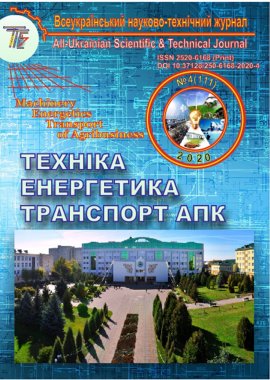
Issue №: 4(111)
The journal solves the problems of creation and improvement of machinery and technologies for agriculture: 131 - Applied Mechanics, 132 - Materials Science, 133 - Industrial Engineering, 141 - Power Engineering, Electrical Engineering and Electromechanics, 208 - Agricultural Engineering.
ANALYSIS OF THE POWER BALANCE OF THE TECHNOLOGICAL SYSTEM FOR GRINDING AGRICULTURAL PLANT WASTE
Ihor Kupchuk – Ph.D, Senior Lecturer of the Department of General Technical Disciplines and Labor Protection of Vinnytsia National Agrarian University (3, Sonychna St., Vinnytsia, 21008, Ukraine, +380978173992, kupchuk.igor@i.ua, http://orcid.org/0000-0002-2973-6914).
Oleksii Tokarchuk – PhD, Associate Professor of the Department of “Technological Processes and Equipment of Processing and Food Productions” of the Vinnytsia National Agrarian University (3, Solnyshchaya St., Vinnytsia, 21008, Ukraine, e-mail: tokarchuk@vsau.vin.ua ).
Volodymyr Hontar – postgraduate in specialty 133 «Sectoral Mechanical Engineering» of Vinnytsia National Agrarian University (3, Sonychna St., Vinnytsia, 21008, Ukraine, +380683260329, bulbashka31@gmail.com).
Andrii Didyk – Master's student majoring in 208 “Agroengineering” of Vinnytsia National Agrarian University (3, Sonychna St., Vinnytsia, 21008, Ukraine, +380972830537, anddidyk99@gmail.com).
Despite some decisions approved by the Government of Ukraine to address the problems of efficient and environmentally sound solid waste management, in particular those that accumulate as a result of economic activity of the agro-industrial complex of the state, their practical implementation of measures declared by the Government is currently low. levels. Among a number of deterrents, the main ones include: lack of centralized recycling facilities and economically accessible for small facilities technical and technological base of waste processing, ineffective environmental control and the necessary management practices.
However, vegetable waste is not always used, although it is a valuable raw material that can be used as a raw material for the production of fuel pellets, which will significantly reduce the energy dependence of the enterprise. An integral part of the technological cycle of processing plant residues into fuel briquettes is the preparation of biomass for briquetting in order to ensure the required particle size.
Given the strategic importance of the formation of material and technical base to ensure highly efficient processing of agricultural waste of plant origin, as well as high energy consumption, which marks the traditional preparation of biomass for briquetting, there is a need for research to solve the problem of energy efficient grinding of structurally heterogeneous materials. high moisture content, which determines the relevance of the article. Thus, in order to achieve high efficiency of the process of grinding waste of plant origin, promising ways to reduce the energy consumption of this process based on the energy balance of the vibratory crusher rotor type and analysis of relationships between elements of the structural block diagram of the energy balance of the technological system "Vibration-rotor crusher - the processed environment ".
[1] Matus, S.A., Levina, H.M., Karpiuk, T.S. & Denishchik, O.Yu. (2018-2019). Analitychnyi zvit. «Bazove doslidzhennia stanu ta napriamiv rozvytku ekolohichnoi polityky Ukrainy ta perspektyv posylennia uchasti orhanizatsii hromadianskoho suspilstva u rozrobtsi ta vprovadzhenni polityk, druzhnikh do dovkillia (period 2018-sichen 2019)» [Analytical report «Basic study of the state and directions of development of environmental policy of Ukraine and prospective increase in the participation of civil society organizations in the development and implementation of public policy to the environment (period 2018-January 2019)»]. Kyiv : Pidhotovleno na zamovlennia Mizhnarodnoho fondu «Vidrodzhennia». 117 p. [in Ukrainian].
[2] Uhoda pro asotsiatsiiu mizh Ukrainoiu, z odniiei storony, ta Yevropeiskym Soiuzom, Yevropeiskym Spivtovarystvom z atomnoi enerhii i yikhnimy derzhavamy-chlenamy, z inshoi storony, vid 27.06.2014 r. (ratyfikovana iz Zaiavoiu Zakonom Ukrainy vid 16.09.2014 r. № 1678- VII) [Association Agreement between Ukraine, of the one part, and the European Union, the European Atomic Energy Community and their Member States, of the other part, of June 27, 2014 (ratified by the Declaration of the Law of Ukraine of September 16, 2014) № 1678- VII)]. zakon2.rada.gov.ua. Retrieved from http://zakon2.rada.gov.ua/laws/show /984_011/paran81#n81 [in Ukrainian].
[3] Rozporiadzhennia Kabinetu Ministriv Ukrainy vid 08.11.2017 r. № 820-r. «Natsionalna stratehiia upravlinnia vidkhodamy v Ukraini do 2030 roku» [Order of the Cabinet of Ministers of Ukraine dated November 8, 2017 № 820-r. «National Waste Management Strategy in Ukraine until 2030»]. zakon.rada.gov.ua. Retrieved from https://zakon.rada.gov.ua/laws/show/820-2017-%D1%80 80 [in Ukrainian].
[4] Tymchak, V. S. (2016). Efektyvnist innovatsii kompleksnoho vykorystannia vidkhodiv kharchovoi promyslovosti [Efficiency of innovations of complex use of food industry:]. Candidate’s thesis. Zhytomyr : ZhNAU. 227 p. . [in Ukrainian].
[5] Kupchuk, I.M. (2017). Obgruntuvannia tekhnolohichnoi skhemy ta konstruktyvnoi realizatsii vibratsiinoho podribnennia syrovyny spyrtovoho vyrobnytstva [Substantiation of the technological scheme and constructive realization of vibration crushing of raw materials of alcohol production]. Candidate’s thesis. Vinnytsia : VNAU 227 p. [ in Ukrainian].
[6] Kupchuk, I.M., Solona, O.V., Derevenko, I.A. & Tverdokhlib, I.V. (2018). Verification of the mathematical model of the energy consumption drive for vibrating disc crusher. Inmateh – Agricultural Engineering, 55, 111-118 [in English].
[7] Nanka, O.V. (2015). Napriamky pidvyshchennia efektyvnosti protsesu podribnennia zernovykh kormiv. Konstruiuvannia, vyrobnytstvo, ekspluatatsiia silskohospodarskykh mashyn [Directions for improving the efficiency of the process of grinding grain feed]. Konstruiuvannia, vyrobnytstvo, ekspluatatsiia silskohospodarskykh mashyn – Design, manufacture, operation of agricultural machinery, 2, 152-157 [in Ukrainian].
[8] Nanka, O.V & Boiko, I.H. (2012). Shliakhy znyzhennia enerhoiemnosti podribnennia zernovykh kormiv ta pidvyshchennia yakosti podribnennia [Ways to reduce the energy consumption of grinding grain feed and improve the quality of grinding]. Tekhnolohiia vyrobnytstva i pererobky produktsii tvarynnytstva. Zbirnyk naukovykh prats BNAU – Technology of production and processing of livestock products. Collection of scientific works of BNAU, 7, 55-58 [in Ukrainian].
[9] Hunko, I.V., Halushchak, O.O. & Kravets, S.M. (2019). Analiz tekhnolohichnykh system. Obgruntuvannia inzhenernykh rishen: navch. posib [Analysis of technological systems. Substantiation of engineering decisions : textbook]. Vinnytsia : VNAU. 216 p. ISBN 966-8271-77-7. [In Ukrainian].
[10] Kosse, V. & Mathew, J. (2017). Design of hammer mills for optimum performance. Proceeding of the Institution of Mechanical Engineers, 215, 87-94 [in English].
About the journal
G8 – Materials Science
G9 – Applied Mechanics
G10 – Metallurgy
G11 – Mechanical Engineering (by specializations)
The journal "Engineering, Energy, Transport AIC" is indexed according to the following databases and catalogs:


The All-Ukrainian scientific journal “Technology, energy, agriculture transport AIC” is an open-access scientific publication that publishes the results of original research, theoretical and applied developments, as well as scientific papers in the fields of engineering sciences, energy systems, and transport technologies of the agro-industrial complex.
The main objective of the scientific journal “Technology, energy, agriculture transport AIC” is to disseminate the results of modern scientific research and to promote the development of technical, energy, and transport solutions for the agro-industrial complex through the publication of scientific materials characterized by scientific novelty and practical significance in the field of design and modernization of machinery, equipment, and technologies.
The journal’s activities are focused on supporting the development of engineering science, stimulating the implementation of innovative approaches into industrial practice, as well as ensuring effective exchange of scientific achievements among researchers, educators, engineers, and other specialists in relevant fields.
Objectives of the Journal
To achieve its defined objective, the journal ensures the implementation of the following key tasks:
· publication of the results of fundamental and applied research covering the fields of applied mechanics, mechanical engineering, materials science, energy systems, electrical engineering, electromechanics, and transport systems of the agro-industrial sector;
· promotion of the implementation of advanced technical and technological developments aimed at improving the efficiency of machinery, equipment, and production processes;
· creation of conditions for active scientific exchange among research institutions, higher education institutions, industrial enterprises, and other interested organizations;
· support for the development of interdisciplinary research and expansion of cooperation among specialists in various fields of science and technology;
· promotion of the improvement of the scientific and technical level of research related to the design, modernization, and operation of technical equipment used in agro-industrial production;
· dissemination of information on modern achievements in science and technology and the implementation of innovative technologies in the fields of technical support, energy, and transport;
· development of a scientific information environment that facilitates effective scientific communication and the integration of national research into the international scientific community.
Publication frequency: 4 issues per year
Languages of publication: Ukrainian, English
Editor-in-Chief: Vitalii YAROPUD
State Registration: Decision of the National Council of Ukraine on Television and Radio Broadcasting № 1337 and № 1180. Media Identifier: R30-05173
EDRPOU Code: 00497236
Publisher ROR: https://ror.org/05m3ysc06
Publisher DOI prefix: 10.37128 ISSN (print): 2520-6168
The scientific journal is included in Category “B” of the List of Scientific Professional Publications of Ukraine in which the results of dissertation research for obtaining the degrees of Doctor and Candidate of Sciences may be published in the following specialties: G8 – Materials Science; G9 – Applied Mechanics; G10 – Metallurgy; G11 – Mechanical Engineering (by specializations). (Order of the Ministry of Education and Science of Ukraine dated June 11, 2026 №928
Technology, energy, agriculture transport AIC is a scholarly professional journal with a long-standing history and stable academic tradition, reflecting the evolution of engineering and technical sciences within the agro-industrial sector of Ukraine.
The journal was founded in 1997 under the title Bulletin of Vinnytsia State Agricultural Institute. According to the Resolution of the Presidium of the Higher Attestation Commission of Ukraine dated September 11, 1997, the publication obtained the status of a professional scientific journal, which enabled the publication of the main results of doctoral and candidate dissertations in technical sciences. From its inception, the journal positioned itself as an academic platform for addressing current issues of mechanization, electrification, and technical support of agricultural production. During 2001–2014, the journal was published under the title Proceedings of Vinnytsia National Agrarian University. Series: Technical Sciences (State Registration Certificate of Print Media KV No. 16644-5116 PR dated April 30, 2010). Throughout this period, a systematic approach to the selection and peer review of scientific manuscripts was established, the thematic scope of publications was expanded, and continuity of scientific directions as well as the development of sectoral engineering schools was ensured. Since 2015, the journal has been published under its current title, Technology, energy, agriculture transport AIC (State Registration Certificate No. 21906-11806 R dated March 12, 2016). The change of title reflected the expansion of the journal’s thematic coverage and its orientation toward interdisciplinary research in mechanical engineering, energy systems, electrical engineering, transport technologies, automation, and digital solutions for the agro-industrial complex.
