

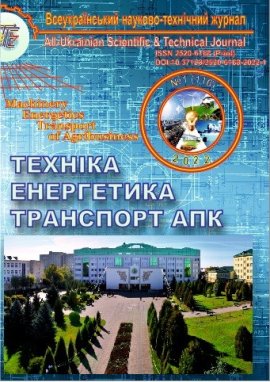
Issue №: 1(116)
The journal solves the problems of creation and improvement of machinery and technologies for agriculture: 131 - Applied Mechanics, 132 - Materials Science, 133 - Industrial Engineering, 141 - Power Engineering, Electrical Engineering and Electromechanics, 208 - Agricultural Engineering.
BACKGROUND FOR BUILDING A MATHEMATICAL MODEL OF THE PUMPKIN SEEDS FILTER DRYING PROCESS
Oleh Tsurkan – doctor of technical sciences, associate professor of the Department of technological processes and equipment of processing and food industries of Faculty of Engineering and Technology of Vinnytsia National Agrarian University, director of Separated structural unit «Ladyzhyn Professional College of Vinnytsia National Agrarian University» (5, P. Kravchyka St., Ladyzhyn, Vinnytsia region, 24321, Ukraine, e-mail tsurkan_ov76@ukr.net. https://orcid.org/0000-0002-7218-0026).
The main objective reason for holding back the spread of such a valuable crop as pumpkin is the lack of high-quality sowing material. This is due to the imperfection of technologies for post-harvest processing of seed products, namely drying and, to a lesser extent, the separation process. The successful implementation of the drying process depends on many factors, including the properties of the material and the methods and means of implementing the process.
To create a mathematical model of the drying process for high-moisture pumpkin seeds, it is necessary to conduct a detailed review of the methods for presenting the theoretical foundations of the task. The layer of pumpkin seeds has increased cohesive and adhesive properties, a tendency to create conglomerates, sticking to the working bodies of machines. To minimize the negative effect of the physical properties of pumpkin seeds on the course of the drying process, it is advisable to apply a vibration action that increases the difference in the layer, which prevents the seeds from sticking to the working bodies. Another feature of pumpkin seeds, which complicates their successful drying, is their high initial moisture content (about 50%). Therefore, in order to reduce energy consumption at the first stage, it is advisable to remove free unbound surface moisture by the method of filtration drying. In the design practice of filtration drying, four main physical and mathematical models of filtration are used. The main disadvantage of these models is the uncertainty of individual values, in particular, the diameter of the capillaries, since a real porous medium consists of pores of different diameters and shapes. The use of vibration action significantly intensifies the filtration drying process.
[1] Tsurkan, O.V. (2021). Analiz vibratsiinykh tekhnichnykh zasobiv dlia sushinnia nasinnia harbuza. Vibratsii v tekhnitsi ta tekhnolohiiakh. 4 (103). 5–14. [in Ukrainian].
[2] Das, I., Bal, S., Kumar Das, S. (2010). Simultaneous parboiling and drying of paddy using infrared energy: vibration aided infrared drying system: monograph. Saarbrucken. [in English].
[3] Tsurkan, O.V., Herasymov, O.O., Rymar, T.I. (2014). Hidrodynamika protsesu filtratsiinoho znevodnennia svizheochyshchenoho nasinnia harbuza z vibratsiinoiu aktyvatsiieiu. Vibratsii v tekhnitsi ta tekhnolohiiakh. 2 (74). 138-144. [in Ukrainian].
[4] Tsurkan, O.V., Spirin, A.V., Tverdokhlib, I.V. (2021). Vyznachennia teplofizychnykh kharakterystyk obiektiv vibratsiinoho sushinnia. Vibratsii v tekhnitsi ta tekhnolohiiakh. 3(102). 100-108. [in Ukrainian].
[5] Khanyk, Ya.M., Kovalchuk, O.V., Khanyk, A.Ia. (2007). Filtratsiine sushinnia yak enerhozberezhnyi metod znevodnennia materialiv. Visnyk Vinnytskoho politekhnichnoho instytutu. 4. 79–82. [in Ukrainian].
[6] Murkes, J., Carlsson, C. (1989). Crossflow Filtration: Theory and Practice. New York. [in English].
[7] Atamaniuk, V.M., Humnytskyi, Ya.M. (2013). Naukovi osnovy filtratsiinoho sushinnia dyspersnykh materialiv: monohrafiia. Lviv. [in Ukrainian].
[8] Palamarchuk, I.P., Tsurkan, O.V., Zozuliak, O.V. (2012). Intensyfikatsiia protsesiv sushinnia nasinnia za rakhunok vykorystannia vibratsiinoho ta elektroosmotychnoho efektiv. Vibratsii v tekhnitsi ta tekhnolohiiakh. 1 (65). 110–114. [in Ukrainian].
[9] Potapov, V.A., Yakushenko, E.N., Gricenko, O.Yu. (2017). Fil'tracionnaya sushka pri povyshennom davlenii. Naukovі pracі ONAKHT. 47(2). 134–137. [in Ukrainian].
About the journal
G8 – Materials Science
G9 – Applied Mechanics
G10 – Metallurgy
G11 – Mechanical Engineering (by specializations)
The journal "Engineering, Energy, Transport AIC" is indexed according to the following databases and catalogs:


The All-Ukrainian scientific journal “Technology, energy, agriculture transport AIC” is an open-access scientific publication that publishes the results of original research, theoretical and applied developments, as well as scientific papers in the fields of engineering sciences, energy systems, and transport technologies of the agro-industrial complex.
The main objective of the scientific journal “Technology, energy, agriculture transport AIC” is to disseminate the results of modern scientific research and to promote the development of technical, energy, and transport solutions for the agro-industrial complex through the publication of scientific materials characterized by scientific novelty and practical significance in the field of design and modernization of machinery, equipment, and technologies.
The journal’s activities are focused on supporting the development of engineering science, stimulating the implementation of innovative approaches into industrial practice, as well as ensuring effective exchange of scientific achievements among researchers, educators, engineers, and other specialists in relevant fields.
Objectives of the Journal
To achieve its defined objective, the journal ensures the implementation of the following key tasks:
· publication of the results of fundamental and applied research covering the fields of applied mechanics, mechanical engineering, materials science, energy systems, electrical engineering, electromechanics, and transport systems of the agro-industrial sector;
· promotion of the implementation of advanced technical and technological developments aimed at improving the efficiency of machinery, equipment, and production processes;
· creation of conditions for active scientific exchange among research institutions, higher education institutions, industrial enterprises, and other interested organizations;
· support for the development of interdisciplinary research and expansion of cooperation among specialists in various fields of science and technology;
· promotion of the improvement of the scientific and technical level of research related to the design, modernization, and operation of technical equipment used in agro-industrial production;
· dissemination of information on modern achievements in science and technology and the implementation of innovative technologies in the fields of technical support, energy, and transport;
· development of a scientific information environment that facilitates effective scientific communication and the integration of national research into the international scientific community.
Publication frequency: 4 issues per year
Languages of publication: Ukrainian, English
Editor-in-Chief: Vitalii YAROPUD
State Registration: Decision of the National Council of Ukraine on Television and Radio Broadcasting № 1337 and № 1180. Media Identifier: R30-05173
EDRPOU Code: 00497236
Publisher ROR: https://ror.org/05m3ysc06
Publisher DOI prefix: 10.37128 ISSN (print): 2520-6168
The scientific journal is included in Category “B” of the List of Scientific Professional Publications of Ukraine in which the results of dissertation research for obtaining the degrees of Doctor and Candidate of Sciences may be published in the following specialties: G8 – Materials Science; G9 – Applied Mechanics; G10 – Metallurgy; G11 – Mechanical Engineering (by specializations). (Order of the Ministry of Education and Science of Ukraine dated June 11, 2026 №928
Technology, energy, agriculture transport AIC is a scholarly professional journal with a long-standing history and stable academic tradition, reflecting the evolution of engineering and technical sciences within the agro-industrial sector of Ukraine.
The journal was founded in 1997 under the title Bulletin of Vinnytsia State Agricultural Institute. According to the Resolution of the Presidium of the Higher Attestation Commission of Ukraine dated September 11, 1997, the publication obtained the status of a professional scientific journal, which enabled the publication of the main results of doctoral and candidate dissertations in technical sciences. From its inception, the journal positioned itself as an academic platform for addressing current issues of mechanization, electrification, and technical support of agricultural production. During 2001–2014, the journal was published under the title Proceedings of Vinnytsia National Agrarian University. Series: Technical Sciences (State Registration Certificate of Print Media KV No. 16644-5116 PR dated April 30, 2010). Throughout this period, a systematic approach to the selection and peer review of scientific manuscripts was established, the thematic scope of publications was expanded, and continuity of scientific directions as well as the development of sectoral engineering schools was ensured. Since 2015, the journal has been published under its current title, Technology, energy, agriculture transport AIC (State Registration Certificate No. 21906-11806 R dated March 12, 2016). The change of title reflected the expansion of the journal’s thematic coverage and its orientation toward interdisciplinary research in mechanical engineering, energy systems, electrical engineering, transport technologies, automation, and digital solutions for the agro-industrial complex.
