

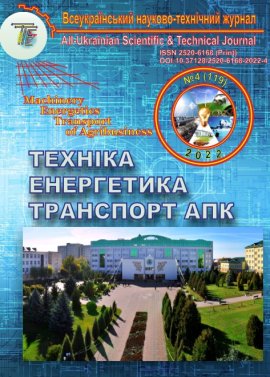
Issue №: 4(119)
The journal solves the problems of creation and improvement of machinery and technologies for agriculture: 131 - Applied Mechanics, 132 - Materials Science, 133 - Industrial Engineering, 141 - Power Engineering, Electrical Engineering and Electromechanics, 208 - Agricultural Engineering.
CONTROL OF ASYNCHRONOUS AC ELECTRIC MOTOR ACCORDING TO THE PRINCIPLE OF CONSTANT V/F AND CONVENTIONAL PWM CONTROL
Oleksandr Voznyak – сandidate of Science (Engineering), Associate Professor of the Department of Electric Power Engineering, Electrical Engineering and Electromechanics of Vinnitsa National Agrarian University (3 Soniachna St., Vinnitsa, 21008, Ukraine, email: alex.voz1966@gmail.com, https://orcid.org/0000-0002-0986-6869).
Andrii Shtuts – Assistant Professor, Department of Electric Power Engineering, Electrical Engineering and Electromechanics, Vinnitsa National Agrarian University (3, Solnechna str., Vinnitsa, 21008, Ukraine, email: shtuts1989@gmail.com , https://orcid.org/0000-0002-4242-2100).
The principle of operation of any automatic control system is to detect deviations of regulated values from set values and to form influences on the control process to eliminate these deviations. Often, a variable value whose value must be maintained constantly or changed according to the desired law is called a controlled value (coordinate). It is customary to call the required value of the regulated value (coordinate) set, and the actual value - current. The difference between the setpoint and the actual value is a deviation or error signal. A set of devices that affect the object of control, maintaining the current value of the controlled quantity (coordinate) equal to the given one, is called an automatic regulator or a dynamic system.
The influence of the regulator on the object with the aim of bringing the current value of the controlled value closer to the set value (or adding the desired properties to the closed system) is called the control influence, and the set of devices and physical environments through which the control influence acts on the controlled value is called the control channel.
The control process carried out by the regulator manifests itself in a change in the set value of the regulated quantity or a deviation of at least one of the unregulated quantities that affect the regulated one through feedback circuits. A change in the set value of an adjustable quantity is called a controlling or internal setting influence, and a change in unregulated quantities is called an external disturbance. The principle of deviation control is to compare the set value of the regulated value (setting) with its current value. In this case, the error signal Δ is used to create such a regulatory influence on the control object that this error, regardless of the reasons that caused it, does not go beyond the permissible values.
In order to protect the environment and reduce the effect of greenhouse gas emissions, regulations are being introduced all over the world that require manufacturers of household electrical equipment and industrial enterprises to produce products that use electricity more economically. Most often, this can be achieved by effectively controlling the speed of the electric motor. This is the reason why consumer appliance developers and semiconductor suppliers are now interested in developing low-cost and economical adjustable actuators.
[1] Vozniak, O.M., Shtuts, A.A., Kolisnyk, M.A. (2021). Suchasni systemy elektropryvodiv. Teoriia ta praktyka. Vol. 1. Navchalnyi posibnyk. Vinnytsia: TOV "TVORY". [in Ukranian].
[2] Vydmysh, A.A., Yaroshenko, L.V. (2020). Fundamentals of electric drive. Theory and practice. Part textbook. Vinnytsia: VNAU. [in Ukranian].
[3] Vozniak, O.M., Shtuts, A.A. (2020). Rozrakhunok nestandartnykh W-parametriv chotyrypoliusnyka na bipoliarnomu tranzystori. Tekhnika, enerhetyka, transport APK, 2 (109). 122–128. [in Ukranian].
[4] Vidmish, A.A., Shtuc, A.A. (2021). Doslіdzhennja dinamіchnih harakteristik zamknenoї sistemi elektroprivoda gravіtacіjnogo betonozmіshuvacha shljahom komp’juternogo modeljuvannja. Vіsnik HNU. Serіja: Tehnіchnі nauki, 1 (293). 113–125. [in Ukranian].
[5] Stadnik, M.I., Vydmysh, A.A., Shtucz, A.A., Kolisnyk, M.A. (2020). Intelektualni systemy v elektroenergetyci. Teoriya ta praktyka: navch. posib. Vinnycya: TOV "TVORY`". [in Ukranian].
[6] Grabko, V.V., Rozvodyuk, M.P., Levitsky, S.M., Kazak, M.A. (2007). Experimental studies of electric machines. Part III. Asynchronous machines. Textbook. Vinnytsia: VNTU. [in Ukranian].
[7] Popovich, M.G., Kovalchuk, A.V. (1997). Theory of automatic control. Kyiv: Libid. [in Ukranian].
[8] Cherny, A.P., Lugovoy, A.V., Rodkin, D.Yu., Sisyuk, A.V. (2001). Modeling of electromechanical systems: textbook. Kremenchug. [in Ukranian].
[9] Frequency converter. Catalog of Altivar 28 by Schneider electric. URL: http://files.imcsYs.com/se/Q2cat_atv.28.pdf [in Ukranian].
[10] Shtuts, A., Kolisnyk, M., Yavdyk, V. (2018). Improvement of processes of rolling stamping on the basis of investigation of technological parameters on the mechanics of workpieces formation. MOTROL. Commission of Motorization and Energetics in Agriculture. 19–25. [in English].
About the journal
G8 – Materials Science
G9 – Applied Mechanics
G10 – Metallurgy
G11 – Mechanical Engineering (by specializations)
The journal "Engineering, Energy, Transport AIC" is indexed according to the following databases and catalogs:


The All-Ukrainian scientific journal “Technology, energy, agriculture transport AIC” is an open-access scientific publication that publishes the results of original research, theoretical and applied developments, as well as scientific papers in the fields of engineering sciences, energy systems, and transport technologies of the agro-industrial complex.
The main objective of the scientific journal “Technology, energy, agriculture transport AIC” is to disseminate the results of modern scientific research and to promote the development of technical, energy, and transport solutions for the agro-industrial complex through the publication of scientific materials characterized by scientific novelty and practical significance in the field of design and modernization of machinery, equipment, and technologies.
The journal’s activities are focused on supporting the development of engineering science, stimulating the implementation of innovative approaches into industrial practice, as well as ensuring effective exchange of scientific achievements among researchers, educators, engineers, and other specialists in relevant fields.
Objectives of the Journal
To achieve its defined objective, the journal ensures the implementation of the following key tasks:
· publication of the results of fundamental and applied research covering the fields of applied mechanics, mechanical engineering, materials science, energy systems, electrical engineering, electromechanics, and transport systems of the agro-industrial sector;
· promotion of the implementation of advanced technical and technological developments aimed at improving the efficiency of machinery, equipment, and production processes;
· creation of conditions for active scientific exchange among research institutions, higher education institutions, industrial enterprises, and other interested organizations;
· support for the development of interdisciplinary research and expansion of cooperation among specialists in various fields of science and technology;
· promotion of the improvement of the scientific and technical level of research related to the design, modernization, and operation of technical equipment used in agro-industrial production;
· dissemination of information on modern achievements in science and technology and the implementation of innovative technologies in the fields of technical support, energy, and transport;
· development of a scientific information environment that facilitates effective scientific communication and the integration of national research into the international scientific community.
Publication frequency: 4 issues per year
Languages of publication: Ukrainian, English
Editor-in-Chief: Vitalii YAROPUD
State Registration: Decision of the National Council of Ukraine on Television and Radio Broadcasting № 1337 and № 1180. Media Identifier: R30-05173
EDRPOU Code: 00497236
Publisher ROR: https://ror.org/05m3ysc06
Publisher DOI prefix: 10.37128 ISSN (print): 2520-6168
The scientific journal is included in Category “B” of the List of Scientific Professional Publications of Ukraine in which the results of dissertation research for obtaining the degrees of Doctor and Candidate of Sciences may be published in the following specialties: G8 – Materials Science; G9 – Applied Mechanics; G10 – Metallurgy; G11 – Mechanical Engineering (by specializations). (Order of the Ministry of Education and Science of Ukraine dated June 11, 2026 №928
Technology, energy, agriculture transport AIC is a scholarly professional journal with a long-standing history and stable academic tradition, reflecting the evolution of engineering and technical sciences within the agro-industrial sector of Ukraine.
The journal was founded in 1997 under the title Bulletin of Vinnytsia State Agricultural Institute. According to the Resolution of the Presidium of the Higher Attestation Commission of Ukraine dated September 11, 1997, the publication obtained the status of a professional scientific journal, which enabled the publication of the main results of doctoral and candidate dissertations in technical sciences. From its inception, the journal positioned itself as an academic platform for addressing current issues of mechanization, electrification, and technical support of agricultural production. During 2001–2014, the journal was published under the title Proceedings of Vinnytsia National Agrarian University. Series: Technical Sciences (State Registration Certificate of Print Media KV No. 16644-5116 PR dated April 30, 2010). Throughout this period, a systematic approach to the selection and peer review of scientific manuscripts was established, the thematic scope of publications was expanded, and continuity of scientific directions as well as the development of sectoral engineering schools was ensured. Since 2015, the journal has been published under its current title, Technology, energy, agriculture transport AIC (State Registration Certificate No. 21906-11806 R dated March 12, 2016). The change of title reflected the expansion of the journal’s thematic coverage and its orientation toward interdisciplinary research in mechanical engineering, energy systems, electrical engineering, transport technologies, automation, and digital solutions for the agro-industrial complex.
