

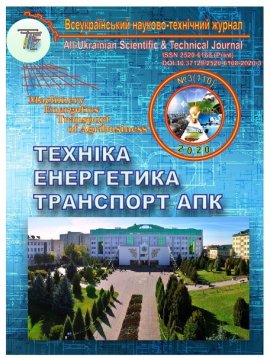
Issue №: 3(110)
Тематика журналу: 131 - Прикладна механіка, 132 - Матеріалознавство, 133 - Галузеве машинобудування, 141 - Електроенергетика, електротехніка та електромеханіка, 208 - Агроінженерія.
CULTIVATOR DEVELOPMENT FOR NEW SOIL PROCESSING TECHNOLOGIES
Leonid Sereda – PhD, Professor of the Department of Agroengineering and technical service, Vinnytsia National Agrarian University (3, Sunny St., Vinnytsia, 21008, Ukraine, e-mail: leonidsereda@vsau.vin.ua).
Ludmila Shvets – PhD, Associate Professor of the Department of “Agroengineering and technical service” of Vinnytsia National Agrarian University (3, Sunny St., Vinnytsia, 21008, Ukraine, e-mail: shlv0505@i.ua).
Oleksandr Shvets – student, Vinnytsia National Agrarian University (Sunny str., 3, Vinnytsia, Ukraine, 21008, e-mail: shlv0505@i.ua).
Most scientists in the field of agronomy, especially abroad, with the emergence of the latest technologies No-till and Strip-till, called them revolutionary in crop production, yes, along with economic indicators, these technologies retain the fertile potential of the soil. This is achieved through less soil damage due to the minimum number of technological operations, as well as the obligatory cover of the field with plant residues after harvesting. American scientists have shown that with the correct application of these technologies, the main indicator of soil quality - humus does not decrease, but on the contrary - increases. This article analyzes the work of Strip-till units in Ukraine and proposes a KFG-3,6 soil tillage unit developed by scientists from the Department of Agroengineering and Technical Services.
The main means that can prevent the loss of fertility of the earth is the introduction of energy saving and fertile technologies. The factors of soil injury and maximum cover of soil with plant residues were laid. The most well-known technologies are the technologies, quite widespread in the USA and Canada, where more than 50% of the land is cultivated, and also in Argentina where they make more than 50%. In Europe, countries such as Germany, France and the UK will cultivate about 10% of land, and in Ukraine will cultivate consist - only 5%.
Strip-till technology came to Europe from the United States, where its No-till technology predecessor. At present, almost half of the largest corn crop in the United States is owned by Strip-till.
No-till and Strip-till technologies are widely used in crop production. The main argument is to maintain fertility through compulsory soil cover. The Department of Agroengineering and Technical Service of the Vinnytsia NAU has for many years taught a course of lectures for masters on low-cost and environmentally promising technologies in crop production. Manufacturers of Kalina-Agromash agricultural machinery in Vinnytsia region are interested in developing a modernized KFG-3,6 cultivator for Strip-till technology, which is partially covered in this article.
[1] Salo, V. M., Leshchenko, S. M., Luzan, P. G., Machok, Y. V., Bogatyrev, D. V. (2016). Machines for tillage and fertilizing. Tutorial for students of agricultural specialties. X. : Machulin. [in Ukrainian].
[2] Shvets, L. V., Paladiychuk, Y. B., Trukhanskaya, O. O. (2019). Technical service in agrarian and industrial complex. Volume I. Tutorial. Vinnytsia National Agrarian University. [in Ukrainian].
[3] Siwowski, Tomasz I, Zyltowski, Piotr I. (2012). Strengthening bridges with prestressed CFRP strips. Selekted Scientifik Papers: journal of Civil Engineering. Vol. 7 Issue 1, P. 79–86. [in English].
[4] Wendel, C. H. (2013). 150 Years of JI Case. Krause Publications. [in English].
[5] Wade, T., Claassen, R., Wallander, S. (2015). Conservation-Practice Adoption Rates Vary Widely by Crop and Region EIB-147, U.S. Department of Agriculture, Economic Research Service. [in English].
[6] URL : https://aggeek.net/ru-blog/chto-takoe-strip-till-plyusy-i-minusy-schadyaschej-obrabotki-pochvy (data zvernennia 01.09.2020)
[7] Mursch, B. (2007). Untersuchungen an einer Bodefaraze. «Landtechnische Forchung», bd. 7, H. 4. S. 93–98. [in English].
[8] Sohne W, Thiel R. (2007). Technische Probleme bei Bondenfrasen. «Grundlagen der Landtechnik», H. 9, 112-136p. [in English].
[9] Chatkin N. (2008). Kinematics and dynamics of rotary soil working bodies. Kiev: Harvest, 316s. [in Ukrainian].
[10] Sereda, L. P, Trukhanska, O. O, Shvets, L. V. (2019). Development and research of a soil-tillage machine for strip-till technology with active milling working bodies. All-Ukrainian Journal of Vibration in Engineering and Technology Vinnitsa, VNAU, Issue 4 (95). 79–86. [in Ukrainian].
[11] Pogorilets, O., Volyanskiy, M., Voytyuk, V., Pastushenko, S., (2004). Hydraulic drive for agricultural machinery: Educational edition. K .: Higher education. [in Ukrainian].
About the journal
G8 – Materials Science
G9 – Applied Mechanics
G10 – Metallurgy
G11 – Mechanical Engineering (by specializations)
The journal "Engineering, Energy, Transport AIC" is indexed according to the following databases and catalogs:


The All-Ukrainian scientific journal “Technology, energy, agriculture transport AIC” is an open-access scientific publication that publishes the results of original research, theoretical and applied developments, as well as scientific papers in the fields of engineering sciences, energy systems, and transport technologies of the agro-industrial complex.
The main objective of the scientific journal “Technology, energy, agriculture transport AIC” is to disseminate the results of modern scientific research and to promote the development of technical, energy, and transport solutions for the agro-industrial complex through the publication of scientific materials characterized by scientific novelty and practical significance in the field of design and modernization of machinery, equipment, and technologies.
The journal’s activities are focused on supporting the development of engineering science, stimulating the implementation of innovative approaches into industrial practice, as well as ensuring effective exchange of scientific achievements among researchers, educators, engineers, and other specialists in relevant fields.
Objectives of the Journal
To achieve its defined objective, the journal ensures the implementation of the following key tasks:
· publication of the results of fundamental and applied research covering the fields of applied mechanics, mechanical engineering, materials science, energy systems, electrical engineering, electromechanics, and transport systems of the agro-industrial sector;
· promotion of the implementation of advanced technical and technological developments aimed at improving the efficiency of machinery, equipment, and production processes;
· creation of conditions for active scientific exchange among research institutions, higher education institutions, industrial enterprises, and other interested organizations;
· support for the development of interdisciplinary research and expansion of cooperation among specialists in various fields of science and technology;
· promotion of the improvement of the scientific and technical level of research related to the design, modernization, and operation of technical equipment used in agro-industrial production;
· dissemination of information on modern achievements in science and technology and the implementation of innovative technologies in the fields of technical support, energy, and transport;
· development of a scientific information environment that facilitates effective scientific communication and the integration of national research into the international scientific community.
Publication frequency: 4 issues per year
Languages of publication: Ukrainian, English
Editor-in-Chief: Vitalii YAROPUD
State Registration: Decision of the National Council of Ukraine on Television and Radio Broadcasting № 1337 and № 1180. Media Identifier: R30-05173
EDRPOU Code: 00497236
Publisher ROR: https://ror.org/05m3ysc06
Publisher DOI prefix: 10.37128 ISSN (print): 2520-6168
The scientific journal is included in Category “B” of the List of Scientific Professional Publications of Ukraine in which the results of dissertation research for obtaining the degrees of Doctor and Candidate of Sciences may be published in the following specialties: G8 – Materials Science; G9 – Applied Mechanics; G10 – Metallurgy; G11 – Mechanical Engineering (by specializations). (Order of the Ministry of Education and Science of Ukraine dated June 11, 2026 №928
Technology, energy, agriculture transport AIC is a scholarly professional journal with a long-standing history and stable academic tradition, reflecting the evolution of engineering and technical sciences within the agro-industrial sector of Ukraine.
The journal was founded in 1997 under the title Bulletin of Vinnytsia State Agricultural Institute. According to the Resolution of the Presidium of the Higher Attestation Commission of Ukraine dated September 11, 1997, the publication obtained the status of a professional scientific journal, which enabled the publication of the main results of doctoral and candidate dissertations in technical sciences. From its inception, the journal positioned itself as an academic platform for addressing current issues of mechanization, electrification, and technical support of agricultural production. During 2001–2014, the journal was published under the title Proceedings of Vinnytsia National Agrarian University. Series: Technical Sciences (State Registration Certificate of Print Media KV No. 16644-5116 PR dated April 30, 2010). Throughout this period, a systematic approach to the selection and peer review of scientific manuscripts was established, the thematic scope of publications was expanded, and continuity of scientific directions as well as the development of sectoral engineering schools was ensured. Since 2015, the journal has been published under its current title, Technology, energy, agriculture transport AIC (State Registration Certificate No. 21906-11806 R dated March 12, 2016). The change of title reflected the expansion of the journal’s thematic coverage and its orientation toward interdisciplinary research in mechanical engineering, energy systems, electrical engineering, transport technologies, automation, and digital solutions for the agro-industrial complex.
