

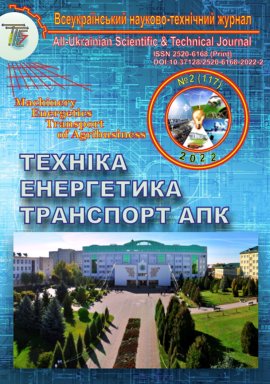
Issue №: 2(117)
The journal solves the problems of creation and improvement of machinery and technologies for agriculture: 131 - Applied Mechanics, 132 - Materials Science, 133 - Industrial Engineering, 141 - Power Engineering, Electrical Engineering and Electromechanics, 208 - Agricultural Engineering.
DETERMINATION OF OPTIMAL DESIGN AND WORKING PARAMETERS OF A VIBRO-PRESS FOR DEHYDRATION OF DAMP DISPERSIVE WASTES OF FOOD INDUSTRY
Ivan Sevostianov – Doctor of Technical Sciences, Full Professor of the Department of “Technological Processes and Equipment of Processing and Food Productions” of Vinnytsia National Agrarian University (3 Solnechnaya St, Vinnytsia, 21008, Ukraine, e-mail: ivansev70@gmail.com, https://orcid.org/0000-0001-8965-9810).
Vibro-pressing equipment its one from most effective kinds of machines for dehydration of damp dispersive wastes of food industry (alcoholic bard, beer pellets, beet press, coffee and barley slime) for their further using as valuable additives to agricultural fodders or as fuel. In comparison with other equipment for mechanical dehydration (hydraulic, belt and screw presses, centrifuges) vibro-presses with hydraulic pulse, unbalanced or electromagnetic drive provide the same or higher productivity (20 ÷ 25 t / h) and energy efficiency (2,7 ÷ 3,2 kW / t) under lower final humidity of processed wastes (20 ÷ 25% against 70 – 76% - in case of realization of other mechanical methods). The last advantage allows do not conduct an additional drying of the wastes and that provides significant decrease of general power consuming of the working process. For provision of high efficiency parameters of the vibro-blowing dehydration there is need to provide optimal values of working and design parameters of the equipment for their realization. There are several approaches for research of the vibro-press equipment. The approaches that realized with help of differential equations of movement of the machine’s executive elements or differential equations of balances their energy provide high accuracy of calculations but because of complexity of these equations they are unsuitable for creation of a method of engineering design calculation of the machines. In the article are proposed algebraic equations and formulas for definition of optimal parameters of the vibro-pressing equipment for dehydration of damp dispersive wastes of food industry for realization of given parameters of efficiency and with consideration of initial and final physical-mechanical characteristics of the processed waste. There are conducted calculated diagrams of these parameters.
[1] Sevostianov, I.V. (2020). Tekhnolohiia ta obladnannia dlia vibroudarnoho znevodnennia volohykh dyspersnykh materialiv : monohrafiia [Technology and equipment for vibro-blowing dehydration of damp dispersive materials : monograph]. Vinnytsia: VNAU. [in Ukrainian].
[2] Iskovych-Lototskyi, R.D. (2006). Osnovy teorii rozrahunku processive ta obladnannya dlya vibroudarnoho pressuvannya. Monografiya [Foudations of calculation theory and elaboration of processes and equipment for vibro-blowing pressing. Monograph]. Vinnytsia: UNIVERSUM-Vinnytsia [in Ukrainian].
[3] Iskovych-Lototskyi, R.D., Obertyh, R.R., Sevostianov, I.V. (2006). Processy ta obladnannya vibraciynyh i vibroudarnyh technologyi. Monografiya [Processes and equipment of vibration and vibro-blowing technologies. Monograph]. Vinnytsia: UNIVERSUM-Vinnytsia. [in Ukrainian].
[4] Cherevko, O.I., Poperechny, A.M. (2014). Procesy i aparaty harchovyh vyrobnycztv [Processes and apparatuses of food productions]. Harkiv: Svit Knyg. [in Ukrainian].
[5] Zamitsky, O.V., Bondar, N.V., Kradozhon, S.O. (2022). Laboratorni doslidjennya kombinovanoho metody znevodnennya vnutrishnimy djerelamy teploty v umovah electrichnoho nagrivu [Laboratory researches of a combined method of dehydration with using of internal sources of heat in conditions of electric heating]. Visnyk Vinnytskogo Politechnichnoho Institutu, 1. [in Ukrainian].
[6] Snezhkin, Yu. F., Shapar, R. O. (2020). Energoefektyvne obladnannya dlya znevodnennya termolabilnyh materialiv [Energy efficient equipment for dehydration of thermolabile materials]. Teplofizika ta Teploenergetika, 42(2), 5–17. [in Ukrainian].
[7] Gosovsky, R. (2018). Zakonomirnosti filtratsiinoho sushinnia orhanichnoi syrovyny dlia vyhotovlennia alternatyvnoho palyva [Regularities of filtering drying of organic raw materials for manufacturing of alternative fuel]. Dissertation of candidate of technical sciences. Lviv: National University “Lvivska Politehnica” [in Ukrainian].
[8] Artyuhova, N.O. (2015). Sushinnya dispersnyh materialiv u bagatostupenevyh polychnyh aparatah z aktyvnym gidrodynamichnym rezhimom [Drying of dispersion materials in multi-stepped shelved apparatuses with active hydrodynamic regime]. Dissertation of candidate of technical sciences. Sumy: Sumy State University. [in Ukrainian].
[9] Sevostianov, I.V. Polishchuk, O.V., Slabkyi, A.V. (2015). Rozrobka ta doslidzhennia ustanovky dlia dvokomponentnoho vibroudarnoho znevodnennia vidkhodiv kharchovykh vyrobnytstv [Elaboration and research of installation for two-component vibro-blowing dehydration of food productions waste], Vostochno-evropeiskyi zhurnal peredovykh tekhnolohyi, 5/7 (77), 40–46 [in Ukrainian].
[10] Sevostianov, I.V., Lutsyk, V.L. (2017). Ustanovka dlia bahatostadiinoho znevodnennia vidkhodiv kharchovykh vyrobnytstv [Installation for multistage dehydration of food productions waste]. Visnyk mashynobuduvannia ta transportu, 1, 105–113 [in Ukrainian].
[11] Sevostianov, I., Ivanchuck, Ya. Kravets, S. (2020). Elaboration and researches of highly effective installation for vibro-blowing dehydration of dispersive waste of food productions. Tekhnika, enerhetyka, transport APС, 3 (110), 24–33. [in English].
[12] Sevostianov, I.V. (2021). Processy ta obladnannia dlia vibroudarnoho filtruvannia volohykh dyspersnykh seredovisch : monohrafiia [Processes and equipment for vibro-blowing filtering of damp dispersive mediums : monograph]. Vinnytsia: VNAU. [in Ukrainian].
[13] Haidamaka, A.V. (2020). Detali mashyn. Osnovy teorii ta rozrakhunkiv [Details of machines. Foundations of the theory and calculations]. Kharkiv : NTU «KhPI» [in Ukrainian].
About the journal
G8 – Materials Science
G9 – Applied Mechanics
G10 – Metallurgy
G11 – Mechanical Engineering (by specializations)
The journal "Engineering, Energy, Transport AIC" is indexed according to the following databases and catalogs:


The All-Ukrainian scientific journal “Technology, energy, agriculture transport AIC” is an open-access scientific publication that publishes the results of original research, theoretical and applied developments, as well as scientific papers in the fields of engineering sciences, energy systems, and transport technologies of the agro-industrial complex.
The main objective of the scientific journal “Technology, energy, agriculture transport AIC” is to disseminate the results of modern scientific research and to promote the development of technical, energy, and transport solutions for the agro-industrial complex through the publication of scientific materials characterized by scientific novelty and practical significance in the field of design and modernization of machinery, equipment, and technologies.
The journal’s activities are focused on supporting the development of engineering science, stimulating the implementation of innovative approaches into industrial practice, as well as ensuring effective exchange of scientific achievements among researchers, educators, engineers, and other specialists in relevant fields.
Objectives of the Journal
To achieve its defined objective, the journal ensures the implementation of the following key tasks:
· publication of the results of fundamental and applied research covering the fields of applied mechanics, mechanical engineering, materials science, energy systems, electrical engineering, electromechanics, and transport systems of the agro-industrial sector;
· promotion of the implementation of advanced technical and technological developments aimed at improving the efficiency of machinery, equipment, and production processes;
· creation of conditions for active scientific exchange among research institutions, higher education institutions, industrial enterprises, and other interested organizations;
· support for the development of interdisciplinary research and expansion of cooperation among specialists in various fields of science and technology;
· promotion of the improvement of the scientific and technical level of research related to the design, modernization, and operation of technical equipment used in agro-industrial production;
· dissemination of information on modern achievements in science and technology and the implementation of innovative technologies in the fields of technical support, energy, and transport;
· development of a scientific information environment that facilitates effective scientific communication and the integration of national research into the international scientific community.
Publication frequency: 4 issues per year
Languages of publication: Ukrainian, English
Editor-in-Chief: Vitalii YAROPUD
State Registration: Decision of the National Council of Ukraine on Television and Radio Broadcasting № 1337 and № 1180. Media Identifier: R30-05173
EDRPOU Code: 00497236
Publisher ROR: https://ror.org/05m3ysc06
Publisher DOI prefix: 10.37128 ISSN (print): 2520-6168
The scientific journal is included in Category “B” of the List of Scientific Professional Publications of Ukraine in which the results of dissertation research for obtaining the degrees of Doctor and Candidate of Sciences may be published in the following specialties: G8 – Materials Science; G9 – Applied Mechanics; G10 – Metallurgy; G11 – Mechanical Engineering (by specializations). (Order of the Ministry of Education and Science of Ukraine dated June 11, 2026 №928
Technology, energy, agriculture transport AIC is a scholarly professional journal with a long-standing history and stable academic tradition, reflecting the evolution of engineering and technical sciences within the agro-industrial sector of Ukraine.
The journal was founded in 1997 under the title Bulletin of Vinnytsia State Agricultural Institute. According to the Resolution of the Presidium of the Higher Attestation Commission of Ukraine dated September 11, 1997, the publication obtained the status of a professional scientific journal, which enabled the publication of the main results of doctoral and candidate dissertations in technical sciences. From its inception, the journal positioned itself as an academic platform for addressing current issues of mechanization, electrification, and technical support of agricultural production. During 2001–2014, the journal was published under the title Proceedings of Vinnytsia National Agrarian University. Series: Technical Sciences (State Registration Certificate of Print Media KV No. 16644-5116 PR dated April 30, 2010). Throughout this period, a systematic approach to the selection and peer review of scientific manuscripts was established, the thematic scope of publications was expanded, and continuity of scientific directions as well as the development of sectoral engineering schools was ensured. Since 2015, the journal has been published under its current title, Technology, energy, agriculture transport AIC (State Registration Certificate No. 21906-11806 R dated March 12, 2016). The change of title reflected the expansion of the journal’s thematic coverage and its orientation toward interdisciplinary research in mechanical engineering, energy systems, electrical engineering, transport technologies, automation, and digital solutions for the agro-industrial complex.
