

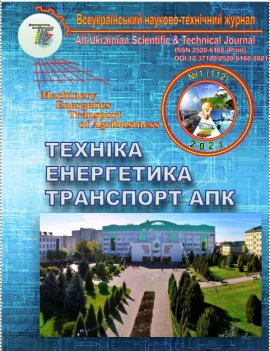
Issue №: 1(112)
The journal solves the problems of creation and improvement of machinery and technologies for agriculture: 131 - Applied Mechanics, 132 - Materials Science, 133 - Industrial Engineering, 141 - Power Engineering, Electrical Engineering and Electromechanics, 208 - Agricultural Engineering.
DEVELOPMENT OF A DEVICE FOR MILLING TILLAGE WITH SIMULTANEOUS APPLICATION OF FERTILIZERS
Leonid Sereda – PhD, Professor of the Department of Agroengineering and technical service, Vinnytsia National Agrarian University (3, Sunny St., Vinnytsia, 21008, Ukraine, +380674726202, e-mail: leonidsereda@vsau.vin.ua, https://orcid.org/0000-0003-0866-2503).
Kupchuk Ihor – Ph.D, Senior Lecturer of the Department of General Technical Disciplines and Labor Protection of Vinnytsia National Agrarian University (3, Sonychna St., Vinnytsia, 21008, Ukraine, +380978173992, kupchuk.igor@i.ua, http://orcid.org/0000-0002-2973-6914).
Kovalchuk Dmytro – Master's student majoring in 208 “Agroengineering” Faculty of Engineering and Technology of Vinnytsia National Agrarian University (3, Sonychna St., Vinnytsia, 21008, Ukraine, +380937622253, e-mail: dimasikkovalchyk2008@gmail.com).
Zamrii Mykhailo – Master's student majoring in 208 of Agroengineering, Faculty of Engineering and Technology of Vinnytsia National Agrarian University (str. Sonyachna, 3, Vinnytsia, 21008, Ukraine, +380984491815, e-mail: zamrij99@gmail.com).
In all developed countries of the world there is a search for new technological methods of tillage, aimed at protecting it from erosion, preserving and increasing fertility, reducing costs. The main means that can prevent the loss of soil fertility is the introduction of energy-saving and fertility-saving technologies. The factors of soil trauma and the maximum coverage of the soil with plant residues are laid down. The most well-known technologies are technologies that are quite common in the United States and Canada, where more than 50% of the land is cultivated, as well as in Argentina, where they account for more than 50%. In Europe, countries such as Germany, France and the United Kingdom will cultivate about 10% of the land, and in Ukraine - only about 5%.
The functionality of machines is expanding, the design is becoming more complicated, their weight is increasing. In all developed countries of the world there is a search for new technological methods of tillage, aimed at protecting it from erosion, preserving and increasing fertility, reducing costs. Various methods of minimizing tillage are widely implemented, as well as the partial replacement of dump plowing with dumpless tillage, research and practical actions aimed at finding effective, alternative, modern tillage technologies to maintain and increase the fertility of the land, which articles.
Thus, in order to preserve the soil fertility of the lands of Ukraine, theoretical studies of modern tillage technologies were conducted and the authors proposed the design features of the device for strip or continuous tillage with simultaneous application of fertilizers prior to design and design, the main results of which are presented in articles.
[1] No-till: dostoinstva i nedostatki sistemyi obrabotki pochvyi [No-till: advantages and disadvantages of the tillage system]. aggeek.net. Retrieved from https://aggeek.net/ru-blog/no-till-dostoinstva-i-nedostatki-sistemy-obrabotki-pochvy [In Russian].
[2] Ievtushenko, V. (2012). Strip-Till v Ukraini [Strip-Till in Ukraine]. The Ukrainian Farmer, 9, 99–100 [In Ukrainian].
[3] Shustik, L. & Hromadska, V. (2018). Zastosuvannia smuhovoho obrobitku v malykh ta serednikh hospodarstvakh [Application of strip tillage in small and medium farms]. Ahrarna tekhnika ta obladnannia – Agricultural machinery and equipment, 1, 56–60 [In Ukrainian].
[4] Kozishkurt, S. M. & Savchuk, N. V. (2017). Osnovni prychyny pohirshennia gruntovo-ekolohichnykh umov meliorovanykh zemel [The main reasons for the deterioration of soil and ecological conditions of reclaimed lands]. Zroshuvane zemlerobstvo: sohodennia, problemy, perspektyvy – Irrigated agriculture: present, problems, prospects : Proceedings of regional science internet conference (pp. 104–106). Dnipro : DDAEU [In Ukrainian].
[5] Krachok, L. I. (2013). Novitni tekhnolohii v silskomu hospodarstvi: problemy i perspektyvy vprovadzhennia [The latest technologies in agriculture: problems and prospects for implementation]. Stalyi rozvytok ekonomiky – Sustainable economic development, 3, 224–231 [In Ukrainian].
[6] Krotinov, O. (2008). No-till: perevahy i pytannia bez vidpovidi [No-till: advantages and unanswered questions]. Fermer – Farmer, 8, 12–19 [In Ukrainian].
[7] Porivniannia system obrobitku gruntu [Comparison of tillage systems]. vnis.com.ua. Retrieved from http://vnis.com.ua/useful-information/advice-to-the-agronomist/Porivnyannya-system-obrobitkugruntu %E2%80%93perevahy-ta-nedoliky/ [In Ukrainian].
[8] Pro zberezhennia ta vidtvorennia rodiuchosti gruntiv. Informatsiino-analitychni materialy shchodo naukovoho obgruntuvannia zakhodiv iz zberezhennia ta vidtvorennia rodiuchosti gruntiv. Natsionalna akademiia ahrarnykh nauk Ukrainy [On preservation and reproduction of soil fertility. Information and analytical materials on the scientific substantiation of measures to preserve and restore soil fertility. National Academy of Agrarian Sciences of Ukraine]. www.coop-union.org.ua. Retrieved from http://www.coop-union.org.ua/?p=8963 [In Ukrainian].
[9] Sereda. L.P., Shvets, L.V. & Trukhanska, O.O. (2019). Vnesennia orhanichnykh ridynnykh dobryv v umovakh fermerskykh hospodarstv [Application of organic liquid fertilizers in the conditions of farms]. Tekhnika, enerhetyka, transport APK – Engineering, Energy, Transport AIC, 2 (105), 25–30. DOI: 10.37128/2520-6168-2019-2-4 [In Ukrainian].
[10] Sereda, L. P. (2019). Tekhnolohiia Strip-till v roslynnytstvi [Strip-till technology in crop production]. Suchasni problemy zemlerobskoi mekhaniky – Modern problems of agricultural mechanics : Proceedings of the XX international scientific conference dedicated to the 119th anniversary of the birth of Academician P.M. Vasylenko (pp. 70–74). Mykolaiv : MNAU [In Ukrainian].
[11] Sereda, L.P., Trukhanska, O.O. & Shvets, L.V. (2019). Rozrobka i doslidzhennia gruntoobrobnoi mashyny dlia tekhnolohii strip-till z aktyvnymy frezernymy robochymy orhanamy [Development and research of a tillage machine for strip-till technology with active milling working bodies]. Vibratsii v tekhnitsi ta tekhnolohiiakh – Vibrations in engineering and technology, 4 (95), 108–118. DOI: 10.37128/2306-8744-2019-4-8 [In Ukrainian].
[12] Sistema nulevoy obrabotki pochvyi ili «No-Till» tehnologiya [Zero tillage system or "No-Till" technology]. agrostory.com. Retrieved from https://agrostory.com/info-centre/knowledge-lab/sistema-nulevoy-obrabotki-pochvy-ili-no-till-tekhnologiya/ [In Russian].
[13] Stan ukrainskykh gruntiv [Condition of Ukrainian soils]. superagronom.com. Retrieved from https://superagronom.com/news/9421-stan-ukrayinskih-gruntiv-staye-problemoyu-ekologichnoyi-bezpeki-krayini [In Ukrainian].
[14] Shustik, L. (2016). Stryp-till u malykh i serednikh hospodarstvakh Ukrainy: perspektyvy rozvytku i vprovadzhennia [Strip-till in small and medium-sized farms of Ukraine: prospects for development and implementation]. Propozytsiia – Proposition, 7(8), 168–172 [In Ukrainian].
[15] Suchasna tekhnika ta tekhnolohii [Modern machinery and technology]. klyuch.com.ua. Retrieved from https://klyuch.com.ua/articles/economy/suchasna-tekhnika-ta-tekhnologiyi//articles/economy/suchasna-tekhnika-ta-tekhnologiyi/ [In Ukrainian].
[16] Tehnologiya polosnoy obrabotki pochvyi «Strip-Till» [Strip-Till technology]. agrostory.com. Retrieved from https://agrostory.com/info-centre/knowledge-lab/tekhnologiya-polosnoy-obrabotki-pochvy-strip-till/? sphrase_id=1135601 [In Russian].
[17] Shatrov, R. (2017). Perevahy ta nedoliky smuhovoi tekhnolohii [Advantages and disadvantages of band technology]. Ahrobiznes sohodni – Agribusiness today, 19, 46–48 [In Ukrainian].
[18] Shustik, L., Hromadska, V., Marynina, L., Nehuliaieva, N., & Suprun, V. (2017). Shliakhy realizatsii tekhnolohii smuhovoho obrobitku gruntu v malykh i serednikh hospodarstvakh [Ways of realization of technologies of strip tillage in small and average farms]. Tekhnika i tekhnolohii APK – Machinery and technologies of agro-industrial complex, 11, 16–20 [In Ukrainian].
About the journal
G8 – Materials Science
G9 – Applied Mechanics
G10 – Metallurgy
G11 – Mechanical Engineering (by specializations)
The journal "Engineering, Energy, Transport AIC" is indexed according to the following databases and catalogs:


The All-Ukrainian scientific journal “Technology, energy, agriculture transport AIC” is an open-access scientific publication that publishes the results of original research, theoretical and applied developments, as well as scientific papers in the fields of engineering sciences, energy systems, and transport technologies of the agro-industrial complex.
The main objective of the scientific journal “Technology, energy, agriculture transport AIC” is to disseminate the results of modern scientific research and to promote the development of technical, energy, and transport solutions for the agro-industrial complex through the publication of scientific materials characterized by scientific novelty and practical significance in the field of design and modernization of machinery, equipment, and technologies.
The journal’s activities are focused on supporting the development of engineering science, stimulating the implementation of innovative approaches into industrial practice, as well as ensuring effective exchange of scientific achievements among researchers, educators, engineers, and other specialists in relevant fields.
Objectives of the Journal
To achieve its defined objective, the journal ensures the implementation of the following key tasks:
· publication of the results of fundamental and applied research covering the fields of applied mechanics, mechanical engineering, materials science, energy systems, electrical engineering, electromechanics, and transport systems of the agro-industrial sector;
· promotion of the implementation of advanced technical and technological developments aimed at improving the efficiency of machinery, equipment, and production processes;
· creation of conditions for active scientific exchange among research institutions, higher education institutions, industrial enterprises, and other interested organizations;
· support for the development of interdisciplinary research and expansion of cooperation among specialists in various fields of science and technology;
· promotion of the improvement of the scientific and technical level of research related to the design, modernization, and operation of technical equipment used in agro-industrial production;
· dissemination of information on modern achievements in science and technology and the implementation of innovative technologies in the fields of technical support, energy, and transport;
· development of a scientific information environment that facilitates effective scientific communication and the integration of national research into the international scientific community.
Publication frequency: 4 issues per year
Languages of publication: Ukrainian, English
Editor-in-Chief: Vitalii YAROPUD
State Registration: Decision of the National Council of Ukraine on Television and Radio Broadcasting № 1337 and № 1180. Media Identifier: R30-05173
EDRPOU Code: 00497236
Publisher ROR: https://ror.org/05m3ysc06
Publisher DOI prefix: 10.37128 ISSN (print): 2520-6168
The scientific journal is included in Category “B” of the List of Scientific Professional Publications of Ukraine in which the results of dissertation research for obtaining the degrees of Doctor and Candidate of Sciences may be published in the following specialties: G8 – Materials Science; G9 – Applied Mechanics; G10 – Metallurgy; G11 – Mechanical Engineering (by specializations). (Order of the Ministry of Education and Science of Ukraine dated June 11, 2026 №928
Technology, energy, agriculture transport AIC is a scholarly professional journal with a long-standing history and stable academic tradition, reflecting the evolution of engineering and technical sciences within the agro-industrial sector of Ukraine.
The journal was founded in 1997 under the title Bulletin of Vinnytsia State Agricultural Institute. According to the Resolution of the Presidium of the Higher Attestation Commission of Ukraine dated September 11, 1997, the publication obtained the status of a professional scientific journal, which enabled the publication of the main results of doctoral and candidate dissertations in technical sciences. From its inception, the journal positioned itself as an academic platform for addressing current issues of mechanization, electrification, and technical support of agricultural production. During 2001–2014, the journal was published under the title Proceedings of Vinnytsia National Agrarian University. Series: Technical Sciences (State Registration Certificate of Print Media KV No. 16644-5116 PR dated April 30, 2010). Throughout this period, a systematic approach to the selection and peer review of scientific manuscripts was established, the thematic scope of publications was expanded, and continuity of scientific directions as well as the development of sectoral engineering schools was ensured. Since 2015, the journal has been published under its current title, Technology, energy, agriculture transport AIC (State Registration Certificate No. 21906-11806 R dated March 12, 2016). The change of title reflected the expansion of the journal’s thematic coverage and its orientation toward interdisciplinary research in mechanical engineering, energy systems, electrical engineering, transport technologies, automation, and digital solutions for the agro-industrial complex.
