

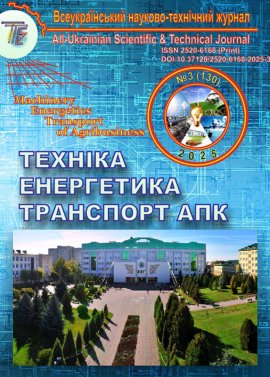
Issue №: 3 (130)
The journal solves the problems of creation and improvement of machinery and technologies for agriculture: 131 - Applied Mechanics, 132 - Materials Science, 133 - Industrial Engineering, 141 - Power Engineering, Electrical Engineering and Electromechanics, 208 - Agricultural Engineering
DIGITAL TWINS IN ENERGY: INFORMATION TECHNOLOGIES IN MANAGEMENT SYSTEMS AND THEIR IMPACT ON RESOURCE SAVING
Volodymyr MYKHALEVYCH – Doctor of Technical Sciences, Full Professor, Department of Electric Power Engineering, Electrical Engineering and Electromechanics, Vinnitsa National Agrarian University (3 Solnechna St., Vinnitsa, 21008, e-mail: mykhalevych@vntu.edu.ua, https://orcid.org/0000-0003-1557-7331)
Mykola KOLISNYK – Doctor of Philosophy in Materials Science, Senior Lecturer Department of Electric Power Engineering, Electrical Engineering and Electromechanics, Vinnitsa National Agrarian University (3, Solnechna str., Vinnitsa, 21008, Ukraine, email: kolisnik30@gmail.com, https://orcid.org/0000-0001-5502-6556).
Leonid YAROSHENKO – Candidate of technical sciences, associate professor of the Department of Electric Power Engineering, Electrical Engineering and Electromechanics, Vinnitsa National Agrarian University (3, Solnechna str., Vinnitsa, 21008, Ukraine, email: volvinlv@gmail.com, https://orcid.org/0000-0002-0261-006X).
Anatolii SLOBODYANYK – Candidate of Technical Sciences, Associate Professor, Department of Mathematics, Physics and Computer Technologies, Vinnitsa National Agrarian University (3, Solnechna str., Vinnitsa, 21008, Ukraine, email: slobodaniktola7@gmail.com, https://orcid.org/0009-0006-2157-8188).
The article presents the results of a comprehensive study on the implementation of digital twins in control systems for energy facilities using modern hardware and software complexes. Special attention is devoted to analyzing various approaches to building integrated models that combine real physical processes with their virtual analogs in a unified cyber-physical environment. The rationale for selecting the technological base for the development of digital twins in automation systems is provided, focusing on the use of SIMATIC S7-300 programmable logic controllers, Siemens Micromaster 440 frequency converters, and the PROFIBUS industrial communication interface. Such a configuration ensures reliable two-way data exchange between virtual and physical components and enables real-time synchronization of operational parameters.
The principles of two-way synchronization between the digital twin and the physical object in real time are described in detail. Examples of hardware–software integration between PLCs, HMI panels, and communication modules are presented, illustrating the bidirectional flow of information and control signals. The requirements for the mathematical model of the energy process are defined, and a method for its implementation based on dq-coordinate transformation is proposed. This mathematical model allows accurate representation of the electromagnetic and mechanical behavior of an asynchronous motor under variable operating conditions, providing a realistic simulation environment for testing control algorithms before they are applied to the physical system.
The main stages of constructing a digital twin are outlined, including the development of the structural scheme of the control system, description of physical interconnections, selection of model parameters, and formulation of control algorithms. Special emphasis is placed on ensuring data consistency between the simulation environment and the real system, which is achieved through continuous information exchange via industrial networks such as PROFIBUS and MPI. The digital twin architecture developed in this study supports cyclic data updating with minimal delay, ensuring the stability of real-time control processes and the reliability of feedback loops.
The research also explores the practical use of digital twins to improve the operational efficiency of energy systems. It demonstrates their potential for real-time equipment diagnostics, prediction of failure conditions, and optimization of maintenance schedules. A specific example of implementing a digital twin in the control process of an asynchronous electric drive with frequency regulation is presented, highlighting the benefits of predictive monitoring, virtual commissioning, and parameter optimization. The study proves that digital twins can significantly enhance energy efficiency by 10–15%, reduce downtime by up to 30%, and increase the overall reliability and transparency of energy management systems.
The obtained results confirm that the integration of digital twin technology into control systems for energy facilities substantially improves regulation accuracy, reduces maintenance time, and provides a means for real-time visualization and data archiving. Furthermore, the proposed approach lays the groundwork for developing the next generation of intelligent energy systems that combine simulation, data analytics, and automation into a single adaptive framework. Such systems represent an essential step toward the realization of Smart Energy and Industry 4.0 paradigms, where each component of the infrastructure is represented by a dynamic, self-updating virtual counterpart.
1. Grieves, M. (2015). Digital twin: Manufacturing excellence through virtual factory replication (pp. 30–65). CIMdata. [in English].
2. Tao, F., Zhang, H., Liu, A., & Nee, A. Y. C. (2019). Digital twin in industry: State-of-the-art. Advanced Engineering Informatics, 39, 101–124. DOI: https://doi.org/10.1016/j.aei.2019.01.001. [in English].
3. Fuller, A., Fan, Z., Day, C., & Barlow, C. (2020). Digital twin: Enabling technologies, challenges and open research. IEEE Access, 8, 108952–108971. DOI: https://doi.org/10.1109/ACCESS.2020.2998358. [in English].
4. Qi, Q., & Tao, F. (2018). Digital twin and big data towards smart manufacturing and Industry 4.0: 360-degree comparison. Complex & Intelligent Systems, 4(1), 1–13. DOI: https://doi.org/10.1007/s40747-017-0070-0. [in English].
5. Kritzinger, W., Karner, M., Traar, G., Henjes, J., & Sihn, W. (2018). Digital twin in manufacturing: A categorical literature review and classification. IFAC-PapersOnLine, 51(11), 1016–1022. DOI: https://doi.org/10.1016/j.ifacol.2018.08.474. [in English].
6. Parlikad, A. K., & McFarlane, D. C. (2020). Digital twins: Clarity on concept and future research directions. IEEE Access, 8, 171749–171758. DOI: https://doi.org/10.1109/ACCESS.2020.3025381. [in English].
7. Rasheed, A., San, O., & Kvamsdal, T. (2020). Digital twin: Values, challenges and enablers from a modeling perspective. IEEE Access, 8, 21980–22012. DOI: https://doi.org/10.1109/ACCESS.2020.2970143. [in English].
8. Glaessgen, E., & Stargel, D. (2012). The digital twin paradigm for future NASA and U.S. Air Force vehicles. In Proceedings of the 53rd AIAA/ASME/ASCE/AHS/ASC Structures, Structural Dynamics, and Materials Conference (Paper AIAA 2012-1818). AIAA. DOI: https://doi.org/10.2514/6.2012-1818. [in English].
9. Leng, J., Zhang, H., Yan, D., Liu, Q., Zhang, D., & Zhao, R. (2019). Digital twin-driven manufacturing cyber-physical system for parallel controlling of smart workshop. Journal of Ambient Intelligence and Humanized Computing, 10(3), 1155–1166. DOI: https://doi.org/10.1007/s12652-018-0881-5. [in English].
10. Madni, A. M., Madni, C. C., & Lucero, S. M. (2019). Leveraging digital twin technology in model-based systems engineering. Systems, 7(1), Article 7. DOI: https://doi.org/10.3390/systems7010007. [in English].
11. International Electrotechnical Commission. (2015–2020). IEC 62541 series: OPC Unified Architecture. IEC. [in English].
12. International Organization for Standardization. (2021). ISO 23247-1:2021 Automation systems and integration–Digital twin framework for manufacturing–Part 1: Overview and general principles. ISO. [in English].
13. International Electrotechnical Commission. (2017–2019). IEC 61158 series: Industrial communication networks–Fieldbus specifications. IEC. [in English].
14. International Electrotechnical Commission. (2019). IEC 61784-2:2019 Industrial communication networks–Profiles–Part 2: Additional fieldbus profiles for real-time networks based on ISO/IEC 8802-3. IEC. [in English].
15. PROFIBUS & PROFINET International. (2019). PROFIdrive–Profile drive technology (Version 4.2). PI. [in English].
16. Siemens AG. (2018). MICROMASTER 440–Operating instructions (List manual). Siemens AG. [in English].
17. Siemens AG. (2019). SIMATIC S7-300, CPU 31xC and CPU 31x: Technical data. Siemens AG. [in English].
18. Siemens AG. (2020). WinCC flexible 2008: System manual/Configuration manual (Reprint of 2011 ed.). Siemens AG. [in English].
About the journal
G8 – Materials Science
G9 – Applied Mechanics
G10 – Metallurgy
G11 – Mechanical Engineering (by specializations)
The journal "Engineering, Energy, Transport AIC" is indexed according to the following databases and catalogs:


The All-Ukrainian scientific journal “Technology, energy, agriculture transport AIC” is an open-access scientific publication that publishes the results of original research, theoretical and applied developments, as well as scientific papers in the fields of engineering sciences, energy systems, and transport technologies of the agro-industrial complex.
The main objective of the scientific journal “Technology, energy, agriculture transport AIC” is to disseminate the results of modern scientific research and to promote the development of technical, energy, and transport solutions for the agro-industrial complex through the publication of scientific materials characterized by scientific novelty and practical significance in the field of design and modernization of machinery, equipment, and technologies.
The journal’s activities are focused on supporting the development of engineering science, stimulating the implementation of innovative approaches into industrial practice, as well as ensuring effective exchange of scientific achievements among researchers, educators, engineers, and other specialists in relevant fields.
Objectives of the Journal
To achieve its defined objective, the journal ensures the implementation of the following key tasks:
· publication of the results of fundamental and applied research covering the fields of applied mechanics, mechanical engineering, materials science, energy systems, electrical engineering, electromechanics, and transport systems of the agro-industrial sector;
· promotion of the implementation of advanced technical and technological developments aimed at improving the efficiency of machinery, equipment, and production processes;
· creation of conditions for active scientific exchange among research institutions, higher education institutions, industrial enterprises, and other interested organizations;
· support for the development of interdisciplinary research and expansion of cooperation among specialists in various fields of science and technology;
· promotion of the improvement of the scientific and technical level of research related to the design, modernization, and operation of technical equipment used in agro-industrial production;
· dissemination of information on modern achievements in science and technology and the implementation of innovative technologies in the fields of technical support, energy, and transport;
· development of a scientific information environment that facilitates effective scientific communication and the integration of national research into the international scientific community.
Publication frequency: 4 issues per year
Languages of publication: Ukrainian, English
Editor-in-Chief: Vitalii YAROPUD
State Registration: Decision of the National Council of Ukraine on Television and Radio Broadcasting № 1337 and № 1180. Media Identifier: R30-05173
EDRPOU Code: 00497236
Publisher ROR: https://ror.org/05m3ysc06
Publisher DOI prefix: 10.37128 ISSN (print): 2520-6168
The scientific journal is included in Category “B” of the List of Scientific Professional Publications of Ukraine in which the results of dissertation research for obtaining the degrees of Doctor and Candidate of Sciences may be published in the following specialties: G8 – Materials Science; G9 – Applied Mechanics; G10 – Metallurgy; G11 – Mechanical Engineering (by specializations). (Order of the Ministry of Education and Science of Ukraine dated June 11, 2026 №928
Technology, energy, agriculture transport AIC is a scholarly professional journal with a long-standing history and stable academic tradition, reflecting the evolution of engineering and technical sciences within the agro-industrial sector of Ukraine.
The journal was founded in 1997 under the title Bulletin of Vinnytsia State Agricultural Institute. According to the Resolution of the Presidium of the Higher Attestation Commission of Ukraine dated September 11, 1997, the publication obtained the status of a professional scientific journal, which enabled the publication of the main results of doctoral and candidate dissertations in technical sciences. From its inception, the journal positioned itself as an academic platform for addressing current issues of mechanization, electrification, and technical support of agricultural production. During 2001–2014, the journal was published under the title Proceedings of Vinnytsia National Agrarian University. Series: Technical Sciences (State Registration Certificate of Print Media KV No. 16644-5116 PR dated April 30, 2010). Throughout this period, a systematic approach to the selection and peer review of scientific manuscripts was established, the thematic scope of publications was expanded, and continuity of scientific directions as well as the development of sectoral engineering schools was ensured. Since 2015, the journal has been published under its current title, Technology, energy, agriculture transport AIC (State Registration Certificate No. 21906-11806 R dated March 12, 2016). The change of title reflected the expansion of the journal’s thematic coverage and its orientation toward interdisciplinary research in mechanical engineering, energy systems, electrical engineering, transport technologies, automation, and digital solutions for the agro-industrial complex.
