

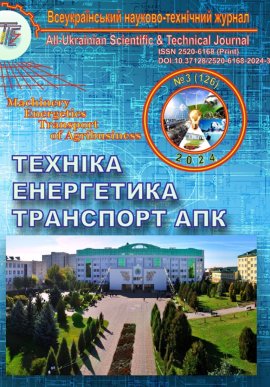
Issue №: 3 (126)
The journal solves the problems of creation and improvement of machinery and technologies for agriculture: 131 - Applied Mechanics, 132 - Materials Science, 133 - Industrial Engineering, 141 - Power Engineering, Electrical Engineering and Electromechanics, 208 - Agricultural Engineering.
FEATURES OF THE INFLUENCE OF A SHORT CIRCUIT OF THE STATOR WINDING OF AN INDUCTION MOTOR ON THE SPECTRAL COMPOSITION OF ITS STATOR CURRENT
Valerii HRANIAK – Candidate of Science (Engineering), Associate Professor, Associate Professor of the Department of Power engineering, electrical engineering and electromechanics of Vinnytsia National Agrarian University. (3 Soniachna St., Vinnytsia, Ukraine, 21008, e-mail: titanxp2000@ukr.net https://orcid.org/0000-0001-6604-6157).
Yaroslav SAFTYUK – Recipient of the Third Educational and Scientific Level, majoring in 133 Industrial Mechanical Engineering of the Vinnytsia National Agrarian University. (Soniachna St., 3, Vinnytsia, Ukraine, 21008, e-mail: valentyn.rohach@gmail.com, https://orcid.org/0009-0003-9730-7198).
In recent decades, there has been a consistent trend towards the increasing role of automated electric drives based on induction motors. This is driven by objective factors, such as the development of high-precision mathematical models of induction motors, which have improved the accuracy and functionality of their control systems, as well as advancements in power semiconductor technologies that have enhanced efficiency and reduced the cost of frequency converters. These advancements in scientific and technical progress have led to an expansion of the application of induction motors in controlled electric drives under difficult starting conditions, which were traditionally implemented using direct current motors, as well as an increase in the number of electric drives with electric control types.
At the same time, modern technological progress has also resulted in increased complexity, cost, and technological demands of industrial equipment, which raises potential risks of emergency failures. Another common trend for Ukraine and many industrially developed countries is the growing number of electrical equipment that has reached the end of its nominal service life. Since there is an inverse relationship between the reliability and operating time of rotating electrical machines, this logically leads to an increased need for effective diagnostic systems.
The article theoretically proves the influence of interturn short circuits in the stator windings of an induction motor on the shape of its stator currents. It is shown that this diagnostic method has a sufficient degree of expressiveness, allowing for a high probability of identifying this type of defect among other types of damage to the induction electric machine. The justification for using the amplitude of the fundamental harmonic f1 for diagnosing this type of defect is provided, along with the subsequent modulation of even harmonics at frequencies of 2f1 to 10f1. It is proposed to consider the current spectrum in a logarithmic scale of dB/Hz due to the presence of a dominant current component at the power supply frequency f1.
1. Amin, B. (2001). Induction motors: Analysis and torque control. Springer [in English].
2. Allythi, F. (2020) Three Phase Asynchronous Motors. London: Noor Publishing [in English].
3. VETTUS.UA Problems in the operation of an asynchronous electric motor (2024). Kyiv. URL: https://www.ventus.kiev.ua/ [in Ukrainian].
4. Marino, R., Tomei, P., & Verrelli, C. M. (2019) Induction Motor Control Design. Roma: Springer [in English].
5. Ostashevskyi, M. O., & Yurieva, O. Yu. (2022) Elektrychni mashyny i transformatory [Electric machines and transformers]. Kyiv: Karavela [in Ukrainian].
6. Peretyatko, Y., Spinul, L., & Shcherba M. (2021) Theoretical fundamentals of electrical engineering. Kyiv: Igor Sikorsky Kyiv Polytechnic Institute [in English].
7. Yatsun M. A. (2010) Ekspluatatsiia ta diahnostuvannia elektrychnykh mashyn i aparativ [Operation and diagnostics of electrical machines and devices]. Lviv: Publishing House of Lviv Polytechnic [in Ukrainian].
8. Zahirnyak, M. V. (2009) Elektrychni mashyny [Electric machines]: textbook. Kyiv: Knowledge [in Ukrainian].
9. Boldea, I. (2023) Induction Machines Handbook. Transients, Control Principles, Design and Testing. New York: CRC Press [in English].
10. Chan, T.-F., & Shi, K. (2011). Applied Intelligent Control of Induction Motor Drives. John Wiley & Sons (Asia) Pte Ltd. DOI: https://doi.org/10.1002/9780470825587 [in English].
About the journal
G8 – Materials Science
G9 – Applied Mechanics
G10 – Metallurgy
G11 – Mechanical Engineering (by specializations)
The journal "Engineering, Energy, Transport AIC" is indexed according to the following databases and catalogs:


The All-Ukrainian scientific journal “Technology, energy, agriculture transport AIC” is an open-access scientific publication that publishes the results of original research, theoretical and applied developments, as well as scientific papers in the fields of engineering sciences, energy systems, and transport technologies of the agro-industrial complex.
The main objective of the scientific journal “Technology, energy, agriculture transport AIC” is to disseminate the results of modern scientific research and to promote the development of technical, energy, and transport solutions for the agro-industrial complex through the publication of scientific materials characterized by scientific novelty and practical significance in the field of design and modernization of machinery, equipment, and technologies.
The journal’s activities are focused on supporting the development of engineering science, stimulating the implementation of innovative approaches into industrial practice, as well as ensuring effective exchange of scientific achievements among researchers, educators, engineers, and other specialists in relevant fields.
Objectives of the Journal
To achieve its defined objective, the journal ensures the implementation of the following key tasks:
· publication of the results of fundamental and applied research covering the fields of applied mechanics, mechanical engineering, materials science, energy systems, electrical engineering, electromechanics, and transport systems of the agro-industrial sector;
· promotion of the implementation of advanced technical and technological developments aimed at improving the efficiency of machinery, equipment, and production processes;
· creation of conditions for active scientific exchange among research institutions, higher education institutions, industrial enterprises, and other interested organizations;
· support for the development of interdisciplinary research and expansion of cooperation among specialists in various fields of science and technology;
· promotion of the improvement of the scientific and technical level of research related to the design, modernization, and operation of technical equipment used in agro-industrial production;
· dissemination of information on modern achievements in science and technology and the implementation of innovative technologies in the fields of technical support, energy, and transport;
· development of a scientific information environment that facilitates effective scientific communication and the integration of national research into the international scientific community.
Publication frequency: 4 issues per year
Languages of publication: Ukrainian, English
Editor-in-Chief: Vitalii YAROPUD
State Registration: Decision of the National Council of Ukraine on Television and Radio Broadcasting № 1337 and № 1180. Media Identifier: R30-05173
EDRPOU Code: 00497236
Publisher ROR: https://ror.org/05m3ysc06
Publisher DOI prefix: 10.37128 ISSN (print): 2520-6168
The scientific journal is included in Category “B” of the List of Scientific Professional Publications of Ukraine in which the results of dissertation research for obtaining the degrees of Doctor and Candidate of Sciences may be published in the following specialties: G8 – Materials Science; G9 – Applied Mechanics; G10 – Metallurgy; G11 – Mechanical Engineering (by specializations). (Order of the Ministry of Education and Science of Ukraine dated June 11, 2026 №928
Technology, energy, agriculture transport AIC is a scholarly professional journal with a long-standing history and stable academic tradition, reflecting the evolution of engineering and technical sciences within the agro-industrial sector of Ukraine.
The journal was founded in 1997 under the title Bulletin of Vinnytsia State Agricultural Institute. According to the Resolution of the Presidium of the Higher Attestation Commission of Ukraine dated September 11, 1997, the publication obtained the status of a professional scientific journal, which enabled the publication of the main results of doctoral and candidate dissertations in technical sciences. From its inception, the journal positioned itself as an academic platform for addressing current issues of mechanization, electrification, and technical support of agricultural production. During 2001–2014, the journal was published under the title Proceedings of Vinnytsia National Agrarian University. Series: Technical Sciences (State Registration Certificate of Print Media KV No. 16644-5116 PR dated April 30, 2010). Throughout this period, a systematic approach to the selection and peer review of scientific manuscripts was established, the thematic scope of publications was expanded, and continuity of scientific directions as well as the development of sectoral engineering schools was ensured. Since 2015, the journal has been published under its current title, Technology, energy, agriculture transport AIC (State Registration Certificate No. 21906-11806 R dated March 12, 2016). The change of title reflected the expansion of the journal’s thematic coverage and its orientation toward interdisciplinary research in mechanical engineering, energy systems, electrical engineering, transport technologies, automation, and digital solutions for the agro-industrial complex.
