

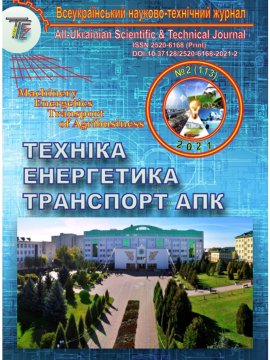
Issue №: 2(113)
The journal solves the problems of creation and improvement of machinery and technologies for agriculture: 131 - Applied Mechanics, 132 - Materials Science, 133 - Industrial Engineering, 141 - Power Engineering, Electrical Engineering and Electromechanics, 208 - Agricultural Engineering.
IMPROVING OF ROUND HOLE CUTTING PROCESS IN THE SHEET METAL
Anatoliy Ostrovsky– Assistant of the Department "Machinery and Equipment for Agricultural Production" of the Vinnytsia National Agrarian University (3, Solnechnaya St., Vinnitsa, 21008, Ukraine, email: anatol.u.ostrowski@gmail.com, https://orcid.org/0000-0001-5700-3593).
Improving existing technological processes is an important stage in the development of all industries. As a consequence, this article is devoted to the analysis of the process of flanging round holes in sheet steel. The existing typical technological process, with a detailed analysis, gives grounds for substantiating the idea of an innovative solution. Changing the sequence of the traditional flanging method will ensure high productivity and material savings.
Of the many promising methods of metal forming by pressure, which include flanging of round holes, two are given for comparison: the traditional one and the improved one. The methodology of the traditional direction, worked out over the years, provides for a clear sequence of the technological process using tools for marking, centering, making a hole and using tools for flanging.
The final, after the previous operations of marking the centers of the holes, punching, making holes, is the flanging stage. The tapered punch (usually a metal rod) prevents the small-diameter hole from deviating from the marking lines and ensures the centering of the punch-blank-matrix system. Following the above steps, the conventional workflow involves positioning the workpiece over the surface of the punch hole to guide the tool in the desired direction. For the manufacture of a flanged hole, a special sharpening of the working part of the punch is performed so that the diameter of the central part of the tool is equal to the difference between the diameters of the guide hole of the matrix and the inner diameter of the workpiece of the part. To avoid further displacement of the hole, the workpiece is centered by placing it on the die and the next operation is supposed to lower the punch to flang the hole.
As a result, the article touches on the topic, taking into account the widespread use of thin sheet metal, including in the agricultural sector, the feasibility of using an innovative idea to improve the technological process associated with the processing of sheet material, namely thin metal sheets. It is advisable to note that, for example, a material is considered that is characterized by its versatility, namely steel. Despite numerous sources devoted to the study of improving the flanging technological process, there are a number of issues, in particular, the extension of this direction to numerous varieties of metal materials that have surfaces with and without coating, various thicknesses within thin-walled rolled products. The most significant result is the improved technological process of flanging will find application in the system of efficient servicing of agricultural machinery.
[1] Pakholko S. A. (2002). Zabezpechennya yakosti vyrobiv v protsesakh vidbortuvannnya : dys. Pakholko S. A., kand. tekhn. nauk : 01.02.04. Zaporizhzhya, 150 [in Ukrainian].
[2] Tadeush Balavender, Romana Eva Shliva, Yoanna Kosidlo. Plastychne formuvannya krayiv flantsevykh otvoriv u tytanovykh lystakh z vykorystannyam efektu termichnoho tertya. URL: file:///C:/Users/anato/Downloads/7-Tekst%20artyku%C5%82u-6-1-10-20180131.pdf (data zvernennya: 30.05.2021). [in Poland].
[3] Kalyuzhnyy V. L., Kalyuzhnyy A. V., Pakholko S. A. Issledovaniye protsessa otbortovki kruglykh otverstiy profilirovannoy listovoy zagotovki. URL: file:///C:/ Users /anato /Downloads/ MGRP 201459.pdf (data zvernennya: 29.05.2021). [in Russian].
[4] Kalyuzhnyy O. V.,. Vplyv koefitsiyenta vidbortuvannya na sylovi rezhymy i yakistʹ vyrobiv pry vidbortuvanni kruhlykh otvoriv v tradytsiyniy ta v zprofilʹovaniy lystoviy zahotovtsi . URL: http://repository.kpi.kharkov.ua/bitstream/KhPI-Press/10153/1/vestnikHPI201246KaliuzhnyiVplyvkoef fitsienta.pdf (data zvernennya: 28.05.2021). [in Ukrainian].
[5] Kalyuzhnyy O. V., Pakholko A. S. Sylovi rezhymy ta formozmina metalu pry vidbortuvanni otvoriv u poperednʹo zprofilʹovaniy zahotovtsi v matrytsi z riznym radiusom zaokruhlennya. URL: http://dspace.kntu.kr.ua/jspui/bitstream/123456789/8937/1/THSHlabrab2019.pdf(data zvernennya: 31.05.2021). [in Ukrainian].
[6] Shalamov P. V. Geometriya i prochnost' otverstiy pod rez'bu, obrazovannykh vrashchayushchimsya puansonom, v tonkolistovykh zagotovkakh. URL: https://docplayer.ru/70081458-Udk-geometriya-i-prochnost-otverstiy-pod-rezbu-obrazovannyh-vrashchayushchimsya-puansonom-v-tonkolistovyh-zagoto vkah.html (data zvernennya: 31.05.2021). [in Russian].
[7] Sposib vidbortuvannya otvoriv: pat. UA 69344 U Ukrayina. № 69344 zayavl. 18.10.2011; opubl. 25.04.2012, Byul. № 8. [in Ukrainian].
[8] Ostrovsky A. Y. (2020). Udoskonalennia tekhnolohichnoho protsesu sverdlinnia tonkolystovoho prokatu. Tekhnika Enerhetyka Transport APK, 4(111). 48–54. [in Ukrainian].
[9] Ostrovsky A. Y. (2021). Modernizatsiia Shablonu Dlia Rozmichannia Lystovykh Zahotovok Vyrobiv Naiposhyrenishykh Prostorovykh Form. Tekhnika Enerhetyka Transport APK, 1(112). 53–59. [in Ukrainian].
About the journal
G8 – Materials Science
G9 – Applied Mechanics
G10 – Metallurgy
G11 – Mechanical Engineering (by specializations)
The journal "Engineering, Energy, Transport AIC" is indexed according to the following databases and catalogs:


The All-Ukrainian scientific journal “Technology, energy, agriculture transport AIC” is an open-access scientific publication that publishes the results of original research, theoretical and applied developments, as well as scientific papers in the fields of engineering sciences, energy systems, and transport technologies of the agro-industrial complex.
The main objective of the scientific journal “Technology, energy, agriculture transport AIC” is to disseminate the results of modern scientific research and to promote the development of technical, energy, and transport solutions for the agro-industrial complex through the publication of scientific materials characterized by scientific novelty and practical significance in the field of design and modernization of machinery, equipment, and technologies.
The journal’s activities are focused on supporting the development of engineering science, stimulating the implementation of innovative approaches into industrial practice, as well as ensuring effective exchange of scientific achievements among researchers, educators, engineers, and other specialists in relevant fields.
Objectives of the Journal
To achieve its defined objective, the journal ensures the implementation of the following key tasks:
· publication of the results of fundamental and applied research covering the fields of applied mechanics, mechanical engineering, materials science, energy systems, electrical engineering, electromechanics, and transport systems of the agro-industrial sector;
· promotion of the implementation of advanced technical and technological developments aimed at improving the efficiency of machinery, equipment, and production processes;
· creation of conditions for active scientific exchange among research institutions, higher education institutions, industrial enterprises, and other interested organizations;
· support for the development of interdisciplinary research and expansion of cooperation among specialists in various fields of science and technology;
· promotion of the improvement of the scientific and technical level of research related to the design, modernization, and operation of technical equipment used in agro-industrial production;
· dissemination of information on modern achievements in science and technology and the implementation of innovative technologies in the fields of technical support, energy, and transport;
· development of a scientific information environment that facilitates effective scientific communication and the integration of national research into the international scientific community.
Publication frequency: 4 issues per year
Languages of publication: Ukrainian, English
Editor-in-Chief: Vitalii YAROPUD
State Registration: Decision of the National Council of Ukraine on Television and Radio Broadcasting № 1337 and № 1180. Media Identifier: R30-05173
EDRPOU Code: 00497236
Publisher ROR: https://ror.org/05m3ysc06
Publisher DOI prefix: 10.37128 ISSN (print): 2520-6168
The scientific journal is included in Category “B” of the List of Scientific Professional Publications of Ukraine in which the results of dissertation research for obtaining the degrees of Doctor and Candidate of Sciences may be published in the following specialties: G8 – Materials Science; G9 – Applied Mechanics; G10 – Metallurgy; G11 – Mechanical Engineering (by specializations). (Order of the Ministry of Education and Science of Ukraine dated June 11, 2026 №928
Technology, energy, agriculture transport AIC is a scholarly professional journal with a long-standing history and stable academic tradition, reflecting the evolution of engineering and technical sciences within the agro-industrial sector of Ukraine.
The journal was founded in 1997 under the title Bulletin of Vinnytsia State Agricultural Institute. According to the Resolution of the Presidium of the Higher Attestation Commission of Ukraine dated September 11, 1997, the publication obtained the status of a professional scientific journal, which enabled the publication of the main results of doctoral and candidate dissertations in technical sciences. From its inception, the journal positioned itself as an academic platform for addressing current issues of mechanization, electrification, and technical support of agricultural production. During 2001–2014, the journal was published under the title Proceedings of Vinnytsia National Agrarian University. Series: Technical Sciences (State Registration Certificate of Print Media KV No. 16644-5116 PR dated April 30, 2010). Throughout this period, a systematic approach to the selection and peer review of scientific manuscripts was established, the thematic scope of publications was expanded, and continuity of scientific directions as well as the development of sectoral engineering schools was ensured. Since 2015, the journal has been published under its current title, Technology, energy, agriculture transport AIC (State Registration Certificate No. 21906-11806 R dated March 12, 2016). The change of title reflected the expansion of the journal’s thematic coverage and its orientation toward interdisciplinary research in mechanical engineering, energy systems, electrical engineering, transport technologies, automation, and digital solutions for the agro-industrial complex.
