

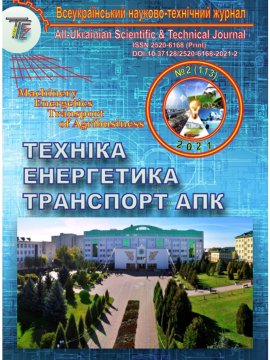
Issue №: 2(113)
The journal solves the problems of creation and improvement of machinery and technologies for agriculture: 131 - Applied Mechanics, 132 - Materials Science, 133 - Industrial Engineering, 141 - Power Engineering, Electrical Engineering and Electromechanics, 208 - Agricultural Engineering.
INFLUENCE OF PHYSICAL AND MECHANICAL PROPERTIES OF STEM FEED AND DESIGN OF THE WORKING BODY ON THE DRIVE POWER OF THE CUTTING MECHANISM
Serhiy Shargorodskiy – Ph.D., Associate Professor of the Department "Machinery and Equipment of Agricultural Production" of the Vinnytsia National Agrarian University (3, Solnychna str., Vinnytsia, Ukraine, 21008, e-mail: sergey20@vsau.vin.ua, https://orcid.org/0000-0003-2125-773X).
Volodymyr Rutkevych – Ph.D., Associate Professor of the Department of Machinery and Equipment for Agricultural Production of Vinnytsia National Agrarian University (Sonyachna Str., 3, Vinnytsia, Ukraine, 21008, e-mail: v_rut@ukr.net, https://orcid.org/0000-0002-6366-7772 ).
The paper considers the problem of reducing the drive power of the mechanism for separating stalk feed from trench storages by the batch method by developing and substantiating the parameters and operating modes of the hydraulic drive system. The structure and principle of construction of a system of hydraulic drives of the mechanism for separating a portion of stem feed are proposed. This will significantly reduce the power of the used hydraulic motors by simultaneously controlling the cutting speed of the monolith of stem feed and the feed of the cutting device.
The analysis of changes in the physical and mechanical properties of stalk forage (silage and haylage), depending on the height of occurrence in the trench storage, has been carried out.
The process of separation of the stalk feed from the feed monolith is considered. The complexity of the technological process of separating the portion of the stalk feed from the feed monolith due to the change in the physical and mechanical properties of the feed from the height in the trench storage and the lack of adaptation of the loader drive to such differences is indicated.
A basic hydraulic diagram of the loader drives is proposed, which is based on the dependence of the cutting force of the material on the parameters of cutting modes. The theoretical foundations of the calculation were formulated by I. Timme and later adapted to the peculiarities of the work of agricultural machinery by V.P. Garyachkin. This theory allows you to determine the cutting force on the working body of the cutter bar depending on the cutting speed, feed of the cutter bar and depth of cut.
An adaptive hydraulic drive of the mechanism for separating the stalk feed is proposed, which makes it possible to coordinate the operation of the cutter bar drive with its supply. The possibility of reducing the drive power of the mechanism for separating the stalk feed to 5-6 kW when using a system of hydraulic drives with a mechanism for adapting the working bodies to their working conditions has been confirmed.
The modes of operation and the possibilities of increasing energy efficiency, competitiveness of technological machines and aggregates of the agro-industrial complex, by developing and substantiating the parameters of the hydraulic drive system, are indicated.
[1] Shmat, S.I., & Luzan, S.V., & Kolisnyk, S.V. (2010). Tendentsii stalogo rozvytku suchasnogo silskogospodarckogo mashyno-buduvannia v Ukraini i za rubiezem [Product innovative policy]. [Trendsin Sustainable Development of Modern Agricultural Machinery in Ukraine and Abroad]. Retrieved from http://dspace.kntu.kr.ua/jspui/handle/123456789/4971. /КNTU.–2010 [in Ukrainian].
[2] Ratushna, N., & Mahmudov, I., & Kokhno, A. (2007). Metodychni pidkhody do stvorennia novoi silskokhospodarskoi tekhniky u vidpovidnosti z vymohamy rynku naukoiemnoi produktsii [Methodical approaches to the creation of new agricultural machinery in accordance with the demands of the market of science-intensive products]. MOTROL– MOTROL, 9. 119–123 [in Ukrainian].
[3] Reznik, N. (1975). Teoriya rezaniya lezviyem i osnovy rascheta rezhushchikh apparatov. [Theory of cutting with a blade and the basics of calculating the cutting apparatus]. Moscow: Mashinostroenie [in Russian].
[4] Rutkеvych, V.S. (2010). Suchаsnyi stаn mеkhаnіzаtsіi vyvаntаzhеnnia kоnsеrvоvаnykh kоrmіv [The current state of mechanization of unloading of canned food]. Zbіrnyk nаukоvykh prаts VNАU – Collection of scientific works of VNAU, 4. 87–95 [in Ukraine].
[5] Rutkеvych, V.S. (2017). Аdaptyvnyi hіdrаvlіchnyi pryvоd blоchnо-pоrtsіinоhо vіdоkrеmliuvаchа kоnsеrvоvаnоhо kоrmu [Adaptive hydraulic drive block-portable of canned forage block-batch separator]. Tekhnika, enerhetyka, transport APC. 4, 108¬113 [in Ukraine].
[6] Dubinin, V. F. (1994). Оbоsnоvаniе prоtsеssоv i srеdstv pоhruski оbеktоv sеlskоkhоziaistvеnnоgо prоizvоdstvа [Substantiation of processes and means of loading of objects of agricultural production]. Extended abstract of canddidates thesis. Mosskva. [in Russian].
[7] Pаvlоv, I.М. (1990). Sоvеrshеnstvоvаniе tеkhnоlоhichеskоhо prоtsеssа i оbоsnоvаniе pаrаmеtrоv rаbоchеhо оrhаnа pоhruzchиkа dlia blоchnоi vyеmki kоnsеrvirоvаnnykh kоrmоv iz trаnshеinykh khrаnilishch [Improvement of technological process and substantiation of parameters of a working body of the loader for block excavation of canned forages from trench storages]. Extended abstract of canddidates thesis. Saratov. [in Russian].
[8] Hоriachkin, V.P. (1968). Sоbrаniе sоchinеnii. V 3 t. T.3. Теоriia sоlоmоrеzki i silоsоrеzki [Collection of works. In 3 vols. Vol.3. Theory of straw chopper and silage cutter]. Моskva: Kоlоs [in Russian].
[9] Voitiuk, D.G. & Ytsun, S.S., & Dovzhyk, M.Y. (2008). Silskogospodarcki mashyny: Osnovy teorii i rozrakhunku. [Agricultural machines: the basics of theory and calculation:]. Sumy: VTD “Universytetska knyga” [in Ukraine].
[10] Zhеlihоvskii, V.А. (1940). Ekspеrimеntаlnаia tеоriia rеzаniia lеzviеm [Experimental theory of blade cutting]. Моskvа: Trudy МIМESKh [in Russian].
[11] Tsarenko, O., Yatsun, S., Dovzhik, M. & Oliynik, G. (2016). Mekhaniko-tekhnolohichni vlastyvosti sil´s´kohospodars´kykh materialiv [Mechanical and technological properties of agricultural materials]. Kyiv: Ahrarna osvita [in Ukrainian].
[12] Sylоs іz zеlеnиkh rоslyn. Теkhnіchnі umоvy. DSТU 4782:2007. (2009). Kyiv:Derzhspozhyvstandart. [in Ukrainian].
[13] Kuzmenko, V. F., Yampolskyy, S. M. & Maksimenko, V. V. (2014). Eksperymentalne vyznachennya fraktsiynoho skladu masy kukurudzy pry zahotivli sylosu u pizni stroky [Experimental determination of fractional composition of corn mass during silage preparation in late terms]. Mekhanizatsiya ta elektryfikatsiya silskoho hospodarstva: mizhvid. temat. nauk. zb. – Mechanization and electrification of agriculture: intersectionality. theme. of sciences. Sat, 99, 559–568[in Ukrainian].
[14] Chubyk, R.V. & Zelinskyi, I.D. (2015). Identyfikatsiia kryteriiv dlia enerhozberihaiuchoho keruvannia vibropry-vodamy adaptyvnykh vibromashyn [Identification of criteria for energy saving control of vibration drives of adaptive vibrating machines]. Avtomatyzatsiia vyrobnychykh protsesiv u mashynobuduvanni ta pryladobuduvanni – Automation of production processes in machine building and instrument making, 49. 107–111 [in Ukrainian].
[15] Pаt. KM 80958 Ukraina. (2013). Hidravlichnyi pryvod blochno-porziinogo vidokremliuvacha konserovanykh kormiv [The hydraulic drive of the block-portion separator of canned forages]. Publ. 10.06.2013 [in Ukrainian].
About the journal
G8 – Materials Science
G9 – Applied Mechanics
G10 – Metallurgy
G11 – Mechanical Engineering (by specializations)
The journal "Engineering, Energy, Transport AIC" is indexed according to the following databases and catalogs:


The All-Ukrainian scientific journal “Technology, energy, agriculture transport AIC” is an open-access scientific publication that publishes the results of original research, theoretical and applied developments, as well as scientific papers in the fields of engineering sciences, energy systems, and transport technologies of the agro-industrial complex.
The main objective of the scientific journal “Technology, energy, agriculture transport AIC” is to disseminate the results of modern scientific research and to promote the development of technical, energy, and transport solutions for the agro-industrial complex through the publication of scientific materials characterized by scientific novelty and practical significance in the field of design and modernization of machinery, equipment, and technologies.
The journal’s activities are focused on supporting the development of engineering science, stimulating the implementation of innovative approaches into industrial practice, as well as ensuring effective exchange of scientific achievements among researchers, educators, engineers, and other specialists in relevant fields.
Objectives of the Journal
To achieve its defined objective, the journal ensures the implementation of the following key tasks:
· publication of the results of fundamental and applied research covering the fields of applied mechanics, mechanical engineering, materials science, energy systems, electrical engineering, electromechanics, and transport systems of the agro-industrial sector;
· promotion of the implementation of advanced technical and technological developments aimed at improving the efficiency of machinery, equipment, and production processes;
· creation of conditions for active scientific exchange among research institutions, higher education institutions, industrial enterprises, and other interested organizations;
· support for the development of interdisciplinary research and expansion of cooperation among specialists in various fields of science and technology;
· promotion of the improvement of the scientific and technical level of research related to the design, modernization, and operation of technical equipment used in agro-industrial production;
· dissemination of information on modern achievements in science and technology and the implementation of innovative technologies in the fields of technical support, energy, and transport;
· development of a scientific information environment that facilitates effective scientific communication and the integration of national research into the international scientific community.
Publication frequency: 4 issues per year
Languages of publication: Ukrainian, English
Editor-in-Chief: Vitalii YAROPUD
State Registration: Decision of the National Council of Ukraine on Television and Radio Broadcasting № 1337 and № 1180. Media Identifier: R30-05173
EDRPOU Code: 00497236
Publisher ROR: https://ror.org/05m3ysc06
Publisher DOI prefix: 10.37128 ISSN (print): 2520-6168
The scientific journal is included in Category “B” of the List of Scientific Professional Publications of Ukraine in which the results of dissertation research for obtaining the degrees of Doctor and Candidate of Sciences may be published in the following specialties: G8 – Materials Science; G9 – Applied Mechanics; G10 – Metallurgy; G11 – Mechanical Engineering (by specializations). (Order of the Ministry of Education and Science of Ukraine dated June 11, 2026 №928
Technology, energy, agriculture transport AIC is a scholarly professional journal with a long-standing history and stable academic tradition, reflecting the evolution of engineering and technical sciences within the agro-industrial sector of Ukraine.
The journal was founded in 1997 under the title Bulletin of Vinnytsia State Agricultural Institute. According to the Resolution of the Presidium of the Higher Attestation Commission of Ukraine dated September 11, 1997, the publication obtained the status of a professional scientific journal, which enabled the publication of the main results of doctoral and candidate dissertations in technical sciences. From its inception, the journal positioned itself as an academic platform for addressing current issues of mechanization, electrification, and technical support of agricultural production. During 2001–2014, the journal was published under the title Proceedings of Vinnytsia National Agrarian University. Series: Technical Sciences (State Registration Certificate of Print Media KV No. 16644-5116 PR dated April 30, 2010). Throughout this period, a systematic approach to the selection and peer review of scientific manuscripts was established, the thematic scope of publications was expanded, and continuity of scientific directions as well as the development of sectoral engineering schools was ensured. Since 2015, the journal has been published under its current title, Technology, energy, agriculture transport AIC (State Registration Certificate No. 21906-11806 R dated March 12, 2016). The change of title reflected the expansion of the journal’s thematic coverage and its orientation toward interdisciplinary research in mechanical engineering, energy systems, electrical engineering, transport technologies, automation, and digital solutions for the agro-industrial complex.
