

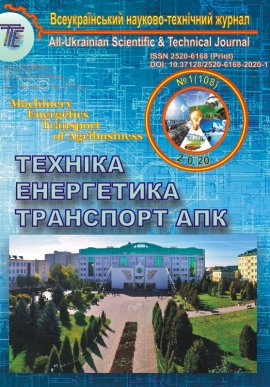
Issue №: 1(108)
В журналі вирішуються проблеми створення та удосконалення техніки та технологій для сільського господарства, харчових та переробних виробництв, машинобудування, енергетики та транспорту.
INFLUENCE OF THE QUANTITY OF TECHNOLOGICAL OPERATIONS FOR THE PROCESSING OF LYCERNY IN THE CUTTING ON ITS CHEMICAL COMPOSITION
Zhurenko Yuri – PhD, Associate Professor of the Department of Agricultural Machines of the Vinnytsia National Agrarian University (3, Solnychna str., Vinnytsia, Ukraine, 21008, е-mail: jurenko@vsau.vin.ua).
The chemical composition and nutritional value of alfalfa hay are influenced by: climatic conditions, soils, phase of development in the period of mowing mass, variety, technology of cultivation and harvesting, etc. Hay harvesting is associated with high nutrient losses due to leaf loss and inflorescence or significant energy consumption for artificial drying. Mechanical losses often exceed 40% or more, with more than half of them occurring in the field operations: mowing, flattening, stirring, raking and weight gain.
The question of the impact of the multiplicity of technological operations on the processing of the roll by elastic working bodies when harvesting hay from alfalfa on the chemical composition has not been sufficiently studied, which was the purpose of the research.Field technological experiments were carried out on pure crops of alfalfa of the blue Vinnychanka variety in different weather conditions. The results obtained by us in the field technological experiments show that the multiplicity of cultivation of the roll in the process of harvesting alfalfa for hay and weather conditions to some extent affect its quality and nutrient content in it.
Thus, the protein content in the initial mass (first experiment) was 15.61, in the hay prepared without the use of roll processing - 13.43, using a single treatment - 14.81, twice - 13.69 and three times 13.65% in dry matter.According to the results of the research, it was found that the hay harvested using single roll processing had the highest carotene content in natural mass - 32.4 mg / kg in the first and 30.4 mg / kg in the second experiments.No significant difference in the variants of experiments was observed in the content of ash and minerals, calcium and phosphorus. By all indicators of nutrient content, the technology of hay harvesting with the use of one-time processing of the roll per day was the best.
[1] Belenchuk, V. I. (1984). Improvement of hay quality. M .: Kolos. [in Russian].
[2] Bogdanov, G. А., Zverev, A. I., Prokopenko, L. S., Privalo, O. E. (1984). Handbook for feed and feed additives. K.: Harvest. [in Russian].
[3] Boyarsky, L. G., Dzardanov, V. D. (1988). Production and use of feed in industrial livestock production. Moscow: Rosselkhozizdat. [in Russian].
[4] Burnie L. (1979). Means of reducing energy consumption by drying equipment. Dokl. United Nations Economic Commission for Europe. New York. [in English].
[5] DSTU 4674: 2006. Hay. Specifications. Kiev. 2008[in Ukrainian].
[6] Zhelezkov T. (1979). Influence of the time of harvesting and preservation of alfalfa on its composition and digestibility during fattening of lambs. Feeding and feeding, 9, 48. [in Russian].
[7] Karpus, M. M., Karpovich, S. I., Prokopenko, L. S. (1978). Nutrition Feeder. K.: Harvest. [in Ukrainian].
[8] Karpus, M. M., Katsukova, A. A., Filatova, S. I. (1988). Feed nutrition guide. K.: Harvest. [in Ukrainian].
[9] Kinsburg, Z. S. (1985). Efficiency of fractionation of alfalfa grass and feed values of the products obtained: Author's abstract. diss Cand. s.c. Sciences.M., 21 p. [in Russian].
[10] Lesnitsky, V. A. (1980). Billets of pressed hay. Moscow: Moscow State University of the USSR. [in Russian].
[11] Ormechi, K. S., Barabash, G. I. (1981). Operating technology of feed harvesting. Moscow: Rosselkhozizdat. [in Russian].
[12] Smurogin, M. A., Lesnitsky, V. R., Serdechnyj, A. I. (1986). Progressive Technologies of Hay Preparation. Moscow: Agropromizdat. [in Russian].
[13] Hoffman, L., Kautfold, P., Piatkovskii, V. (1978). Use of nutrients with ruminant animals. M .: Kolos. [in Russian].
[14] Yakubovsky, S. V. (1992). The main source of protein increase. Livestock of Ukraine, 6, 8–9. [in Ukrainian].
[15] Jelinowska, A., Skryniar, H. (1988). Lucerna w Nowoczesnej gocpodarce paszowej. Pr. zegl Hodawl, 21, 21–23. [in English].
About the journal
G8 – Materials Science
G9 – Applied Mechanics
G10 – Metallurgy
G11 – Mechanical Engineering (by specializations)
The journal "Engineering, Energy, Transport AIC" is indexed according to the following databases and catalogs:


The All-Ukrainian scientific journal “Technology, energy, agriculture transport AIC” is an open-access scientific publication that publishes the results of original research, theoretical and applied developments, as well as scientific papers in the fields of engineering sciences, energy systems, and transport technologies of the agro-industrial complex.
The main objective of the scientific journal “Technology, energy, agriculture transport AIC” is to disseminate the results of modern scientific research and to promote the development of technical, energy, and transport solutions for the agro-industrial complex through the publication of scientific materials characterized by scientific novelty and practical significance in the field of design and modernization of machinery, equipment, and technologies.
The journal’s activities are focused on supporting the development of engineering science, stimulating the implementation of innovative approaches into industrial practice, as well as ensuring effective exchange of scientific achievements among researchers, educators, engineers, and other specialists in relevant fields.
Objectives of the Journal
To achieve its defined objective, the journal ensures the implementation of the following key tasks:
· publication of the results of fundamental and applied research covering the fields of applied mechanics, mechanical engineering, materials science, energy systems, electrical engineering, electromechanics, and transport systems of the agro-industrial sector;
· promotion of the implementation of advanced technical and technological developments aimed at improving the efficiency of machinery, equipment, and production processes;
· creation of conditions for active scientific exchange among research institutions, higher education institutions, industrial enterprises, and other interested organizations;
· support for the development of interdisciplinary research and expansion of cooperation among specialists in various fields of science and technology;
· promotion of the improvement of the scientific and technical level of research related to the design, modernization, and operation of technical equipment used in agro-industrial production;
· dissemination of information on modern achievements in science and technology and the implementation of innovative technologies in the fields of technical support, energy, and transport;
· development of a scientific information environment that facilitates effective scientific communication and the integration of national research into the international scientific community.
Publication frequency: 4 issues per year
Languages of publication: Ukrainian, English
Editor-in-Chief: Vitalii YAROPUD
State Registration: Decision of the National Council of Ukraine on Television and Radio Broadcasting № 1337 and № 1180. Media Identifier: R30-05173
EDRPOU Code: 00497236
Publisher ROR: https://ror.org/05m3ysc06
Publisher DOI prefix: 10.37128 ISSN (print): 2520-6168
The scientific journal is included in Category “B” of the List of Scientific Professional Publications of Ukraine in which the results of dissertation research for obtaining the degrees of Doctor and Candidate of Sciences may be published in the following specialties: G8 – Materials Science; G9 – Applied Mechanics; G10 – Metallurgy; G11 – Mechanical Engineering (by specializations). (Order of the Ministry of Education and Science of Ukraine dated June 11, 2026 №928
Technology, energy, agriculture transport AIC is a scholarly professional journal with a long-standing history and stable academic tradition, reflecting the evolution of engineering and technical sciences within the agro-industrial sector of Ukraine.
The journal was founded in 1997 under the title Bulletin of Vinnytsia State Agricultural Institute. According to the Resolution of the Presidium of the Higher Attestation Commission of Ukraine dated September 11, 1997, the publication obtained the status of a professional scientific journal, which enabled the publication of the main results of doctoral and candidate dissertations in technical sciences. From its inception, the journal positioned itself as an academic platform for addressing current issues of mechanization, electrification, and technical support of agricultural production. During 2001–2014, the journal was published under the title Proceedings of Vinnytsia National Agrarian University. Series: Technical Sciences (State Registration Certificate of Print Media KV No. 16644-5116 PR dated April 30, 2010). Throughout this period, a systematic approach to the selection and peer review of scientific manuscripts was established, the thematic scope of publications was expanded, and continuity of scientific directions as well as the development of sectoral engineering schools was ensured. Since 2015, the journal has been published under its current title, Technology, energy, agriculture transport AIC (State Registration Certificate No. 21906-11806 R dated March 12, 2016). The change of title reflected the expansion of the journal’s thematic coverage and its orientation toward interdisciplinary research in mechanical engineering, energy systems, electrical engineering, transport technologies, automation, and digital solutions for the agro-industrial complex.
