

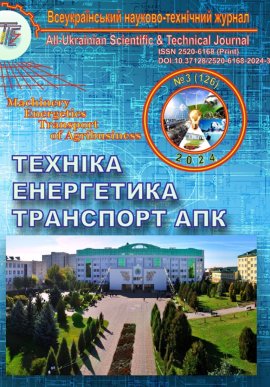
Issue №: 3 (126)
The journal solves the problems of creation and improvement of machinery and technologies for agriculture: 131 - Applied Mechanics, 132 - Materials Science, 133 - Industrial Engineering, 141 - Power Engineering, Electrical Engineering and Electromechanics, 208 - Agricultural Engineering.
INNOVATIVE METHODS OF INCREASING THE EFFICIENCY OF SELECTING PLANTS
Vitalii YAROPUD – Candidate of Technical Sciences, Associate Professor of the Department of machinery and equipment for agricultural production of Vinnytsia National Agrarian University (St. Soniachna, 3, Vinnytsia, Ukraine, 21008, e-mail: yaropud77@gmail.com, https://orcid.org/0000-0003-0502-1356).
Dmytro DATSIUK – Doctor of Philosophy in Industrial Engineering, Senior Lecturer of Vinnytsia National Agrarian University (St. Soniachna, 3, Vinnytsia, Ukraine, 21008, e-mail: datsiuk.vnay@gmail.com, https://orcid.org/0000-0002-4614-2245 ).
In modern crop production, energy-saving technologies play a key role, being one of the most promising directions. This requires the introduction of new-generation agricultural machines that guarantee high-quality operations, in particular, the sowing of small-seeded crops. New constructions of agricultural machinery are developed with an emphasis on multi-functionality, energy efficiency and resource conservation.
Existing sowing machines often do not meet the requirements of universal seeders, which prompts the search for new solutions. One of such promising directions is the development of seeding technological processes, which are based on the formation of a uniform flow of seeds, using sowing devices of the new generation.
The development of the construction and technological scheme of the seeding device for the selection seeder and the substantiation of its parameters is an urgent and strategically important task for the modern agricultural sector.
In addition to this, it is important to consider the requirements for adapting new technologies to changing field conditions and climatic factors. The development of technologies that reduce seed losses, reduce energy costs and increase sowing accuracy is an integral part of this process. In addition, modern selection planters must integrate the latest automation systems that allow monitoring of sowing parameters in real time, which helps to reduce the human factor and improve the accuracy of operations.
The use of advanced materials and innovative designs improves the durability and performance of sowing devices. Lightweight materials reduce energy consumption, while modular constructions simplify maintenance and adaptability. Incorporating renewable energy sources, like solar-powered systems, further supports energy-efficient and eco-friendly agricultural practices.
1. Polyakov, O.I., Vakhnenko, S.V., Nikitenko, O.V., Wendel, V.V. (2016). Osoblyvosti formuvannya produktyvnosti hirchytsi yaroyi pid vplyvom mineralʹnykh dobryv za riznykh norm vysivu [Features of formation of productivity of spring mustard under the influence of mineral fertilizers at different seeding rates]. Scientific and technical bulletin of the Institute of Oilseeds of NAAS, 23, 155–161. http://bulletin.imk.zp.ua/pdf/2016/23/Poliakov3_23.pdf . [in Ukrainian].
2. Polyakov, O.I., Vakhnenko, S.V. (2012). Vodospozhyvannya ripaka yaroho v zalezhnosti vid strokiv, sposobiv sivby ta norm vysivu nasinnya [Water consumption of spring rape depending on the timing, methods of sowing and seeding rates]. Scientific and technical bulletin of the Institute of Oilseeds of NAAS, 17, 130–133. http://bulletin.imk.zp.ua/pdf/2012/17/Poliakov_17.pdf . [in Ukrainian].
3. Polyakova, I.O. (2020). Korelyatsiyno-rehresiynyy analiz hospodarsʹkykh oznak v selektsiyniy roboti z lʹonom oliynym [Correlation-regression analysis of economic characteristics in selection work with oil flax]. Scientific and technical bulletin of the Institute of Oilseeds of NAAS, 29, 92–101. http://bulletin.imk.zp.ua/index.php?menu=4&id=376&lang=ua. [in Ukrainian].
4. Zhaksylykova, Z.S. (2013). Vysevayushchyy apparat dlya vnesenyya myneralʹnykh udobrenyy [Sowing device for applying mineral fertilizers]. Materials of the Republican scientific-theoretical conference "Seifullin Readings - 9: a new vector of development of higher education and science" dedicated to the Day of the First President of the Republic of Kazakhstan, 1 (1), 78–80 [in Ukrainian].
5. Pankov, A.A., Aulin, V.V., Chernovol, M.I. (2016). Tekhnycheskye sredstva protsessa vyseva na osnove élementov pnevmonyky [Seeding process technical means based on pneumonics elements] : Monograph. Kirovograd National Technical University. Kirovograd: publisher Lysenko V.F. [in Ukrainian].
6. Boyko, A.I., Sviren, M.O., Shmat, S.I., Nozhnov, M.M. (2003). Novi konstruktsiyi gruntoobrobnykh ta posivnykh mashyn [New designs of tillage and seeding machines] : Textbook. Kirovograd, Center. Ukr. Publishing house. [in Ukrainian].
7. Sysolin, P.V., Sviren, M.O. (2004). Vysivni aparaty sivalok (evolyutsiya konstruktsiy, rozrakhunky parametriv) [Sowing machines of seeders (evolution of designs, calculations of parameters] : Textbook. Kirovograd. Center. Ukr. Publishing house. [in Ukrainian].
8. Boyko, V.B., Aliyev, E.B. (2015). Teoretychni doslidzhennya rukhu ridyny v yemnosti hidropnevmatychnoho vysivnoho aparata [Theoretical studies of fluid motion in the tank of hydropneumatic seeding machine]. Environmental engineering, 2 (4), 78–84. [in Ukrainian].
9. Boyko, V.B., Aliyev, E.B. (2015). Doslidzhennya protsesu zaryadzhennya nasinyny v nasinnyeprovid hidropnevmatychnoho vysivnoho aparata [Investigation of the process of loading seeds into the seed line of a hydropneumatic sowing machine]. Proceedings of the International Scientific Internet Conference "Prospects and Strategy for Adaptive and Resource-Growing Oilseeds in Climate Change" (October 30, 2015). Zaporozhye: IOC NAAS. 148–149. [in Ukrainian].
10. Gorobey, V.P. (2017). Mekhaniko-tekhnolohichni i konstruktyvni osnovy pidvyshchennya efektyvnosti robochykh orhaniv dlya sivby v seletsiyi i nasinnytstvi [Mechanic-technological and constructive basis for the advancement of the efficiency of working organs for sivbi in the village and in the field]. Dis. ... doctors of technical sciences: 05.05.11. Melitopol. [in Ukrainian].
11. Leela, C., Saravanakumar, M. (2019). Development of Electronically Meterized Maize Planter. Int.J.Curr.Microbiol.App.Sci, 8 (4), 2432–2440. https://doi.org/10.20546/ijcmas.2019.804.283. [in English]
12. Elijah, A. Alhassan, Adejoke, D. Adewumi, Bernard, Okpodjah. (2018). Development of a self-propelled multi-crop two rows precision planter: a new design concept for the metering mechanism. International Journal of Mechanical Engineering and Technology (IJMET), 9 (10), 349–358. DOI: http://www.iaeme.com/ijmet/issues.asp?JType=IJMET&VType= 9&IType=10. [in English].
13. Olexander, Lavrov, Igor, Smirnov, Maksim, Litvinov. (2018). Justification of the construction of a self-propelled selection seeder with an intelligent seeding system. MATEC Web of Conferences, 224, 05011. DOI: https://doi.org/10.1051/matecconf/201822405011. [in English].
14. Zhai Jianbo, Xia Junfang, Zhou Yong, Zhang Shun. (2014). Design and experimental study of the control system for precision seed-metering device. Int J Agric & Biol Eng, 7 (3), 13–18. [in English].
About the journal
G8 – Materials Science
G9 – Applied Mechanics
G10 – Metallurgy
G11 – Mechanical Engineering (by specializations)
The journal "Engineering, Energy, Transport AIC" is indexed according to the following databases and catalogs:


The All-Ukrainian scientific journal “Technology, energy, agriculture transport AIC” is an open-access scientific publication that publishes the results of original research, theoretical and applied developments, as well as scientific papers in the fields of engineering sciences, energy systems, and transport technologies of the agro-industrial complex.
The main objective of the scientific journal “Technology, energy, agriculture transport AIC” is to disseminate the results of modern scientific research and to promote the development of technical, energy, and transport solutions for the agro-industrial complex through the publication of scientific materials characterized by scientific novelty and practical significance in the field of design and modernization of machinery, equipment, and technologies.
The journal’s activities are focused on supporting the development of engineering science, stimulating the implementation of innovative approaches into industrial practice, as well as ensuring effective exchange of scientific achievements among researchers, educators, engineers, and other specialists in relevant fields.
Objectives of the Journal
To achieve its defined objective, the journal ensures the implementation of the following key tasks:
· publication of the results of fundamental and applied research covering the fields of applied mechanics, mechanical engineering, materials science, energy systems, electrical engineering, electromechanics, and transport systems of the agro-industrial sector;
· promotion of the implementation of advanced technical and technological developments aimed at improving the efficiency of machinery, equipment, and production processes;
· creation of conditions for active scientific exchange among research institutions, higher education institutions, industrial enterprises, and other interested organizations;
· support for the development of interdisciplinary research and expansion of cooperation among specialists in various fields of science and technology;
· promotion of the improvement of the scientific and technical level of research related to the design, modernization, and operation of technical equipment used in agro-industrial production;
· dissemination of information on modern achievements in science and technology and the implementation of innovative technologies in the fields of technical support, energy, and transport;
· development of a scientific information environment that facilitates effective scientific communication and the integration of national research into the international scientific community.
Publication frequency: 4 issues per year
Languages of publication: Ukrainian, English
Editor-in-Chief: Vitalii YAROPUD
State Registration: Decision of the National Council of Ukraine on Television and Radio Broadcasting № 1337 and № 1180. Media Identifier: R30-05173
EDRPOU Code: 00497236
Publisher ROR: https://ror.org/05m3ysc06
Publisher DOI prefix: 10.37128 ISSN (print): 2520-6168
The scientific journal is included in Category “B” of the List of Scientific Professional Publications of Ukraine in which the results of dissertation research for obtaining the degrees of Doctor and Candidate of Sciences may be published in the following specialties: G8 – Materials Science; G9 – Applied Mechanics; G10 – Metallurgy; G11 – Mechanical Engineering (by specializations). (Order of the Ministry of Education and Science of Ukraine dated June 11, 2026 №928
Technology, energy, agriculture transport AIC is a scholarly professional journal with a long-standing history and stable academic tradition, reflecting the evolution of engineering and technical sciences within the agro-industrial sector of Ukraine.
The journal was founded in 1997 under the title Bulletin of Vinnytsia State Agricultural Institute. According to the Resolution of the Presidium of the Higher Attestation Commission of Ukraine dated September 11, 1997, the publication obtained the status of a professional scientific journal, which enabled the publication of the main results of doctoral and candidate dissertations in technical sciences. From its inception, the journal positioned itself as an academic platform for addressing current issues of mechanization, electrification, and technical support of agricultural production. During 2001–2014, the journal was published under the title Proceedings of Vinnytsia National Agrarian University. Series: Technical Sciences (State Registration Certificate of Print Media KV No. 16644-5116 PR dated April 30, 2010). Throughout this period, a systematic approach to the selection and peer review of scientific manuscripts was established, the thematic scope of publications was expanded, and continuity of scientific directions as well as the development of sectoral engineering schools was ensured. Since 2015, the journal has been published under its current title, Technology, energy, agriculture transport AIC (State Registration Certificate No. 21906-11806 R dated March 12, 2016). The change of title reflected the expansion of the journal’s thematic coverage and its orientation toward interdisciplinary research in mechanical engineering, energy systems, electrical engineering, transport technologies, automation, and digital solutions for the agro-industrial complex.
