

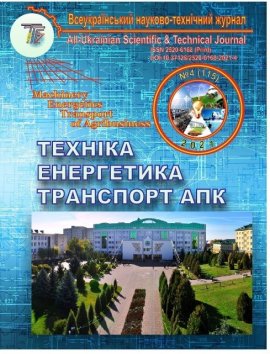
Issue №: 4(115)
The journal solves the problems of creation and improvement of machinery and technologies for agriculture: 131 - Applied Mechanics, 132 - Materials Science, 133 - Industrial Engineering, 141 - Power Engineering, Electrical Engineering and Electromechanics, 208 - Agricultural Engineering.
INNOVATIVE METHODS OF SEPARATION OF GLYCEROL-CONTAINING RAW MATERIALS FROM BIOFUELS
Yurii Polievoda – Candidate of Technical Sciences (Ph. D in Eng.), Associate Professor of the department of technological processes and equipment for processing and food production, Vinnytsia National Agrarian University (21008, Vinnytsia, st. Sonyachna, 3, e-mail: vinyura36@gmail.com, https://orcid.org/0000-0002-2485-0611).
Serhiy Burlaka – Doctor of Philosophy, Senior Lecturer, department of technological processes and equipment of processing and food production, Vinnytsia National Agrarian University (21008, Vinnytsia, st. Sonyachna, 3, e-mail: ipserhiy@gmail.com, https://orcid.org/0000-0002-4079-4867).
Transport consumes about 20% of the world's primary energy, mainly oil. This situation is unacceptable for countries that do not have their own oil reserves and want a stable economy and energy independence. Communities in many countries recognize that these problems continue to accompany the use of road transport and have long paid serious attention to the use of alternative fuels for vehicles, including biofuels, natural gas and hydrogen. However, in the current increase in the number of food industry facilities, it is necessary to deal with food products that have a negative impact on the environment (food fats). According to some data, the amount of garbage per day can range from a few kilograms to tens of tons.
Approximately 90% of diesel biofuels (DBs) are mainly derived from processed oils and raw materials, including fats and oils of animal or vegetable origin that are recyclable. Biofuel is a biologically harmless product. In contact with water, the wine does not harm aquatic flora and fauna. In water or soil, it undergoes almost complete biological decomposition. Combustion of diesel biofuels emits much less carbon dioxide (CO2) than combustion of conventional fuels. Of course, there are drawbacks. First, biofuels have low frost resistance. Undiluted biofuel damages rubber hoses and gaskets. Biofuels have a certain shelf life. Due to increased maintenance costs, deposits can contaminate fuel equipment and filters during operation. Particular attention should be paid to the free glycerin that remains during production.
The article considers biofuel production technologies and methods of glycerin removal. The focus is on devices that allow you to remove glycerin mobile. As a result, a faucet was proposed in which a filter was installed to remove residual glycerin and a study of its operation using the FlowVision program was performed. The simulation model of operation of the mixer with reception of indicators of its work is executed.
[1] Kaletnik, H. M., Pryshliak, V. M. (2010). Biopalyvo: efektyvnist yoho vyrobnytstva ta spozhyvannia v APK Ukrainy. [Biofuels: efficiency of its production and consumption in the agro-industrial complex of Ukraine]. Kyiv [in Ukrainian].
[2] Kaletnik, H. M. (2010). Biopalyvo. Prodovolcha, enerhetychna ta ekolohichna bezpeka Ukrainy. [Biofuels. Food, energy and environmental security of Ukraine]. Kyiv [in Ukrainian].
[3] Palamarchuk, I. P., Polievoda, Y. A., Yanovych, V. P. (2008). Obgruntuvannia konstruktyvnoi skhemy vibratsiinoi mashyny dlia ochyshchennia hlitserynu. [Substantiation of the constructive scheme of the vibrating machine for glycerin purification]. Vinnytsia [in Ukrainian].
[4] Palamarchuk, I. P., Polievoda, Y. A. (2012). Obgruntuvannia konstruktyvnoho osnashchennia dlia ochyshchennia hlitserynu tekhnolohii vyrobnytstva biopalyva. [Substantiation of structural equipment for glycerin purification of biofuel production technology]. [in Ukrainian].
[5] Palamarchuk, I. P., Polievoda, Y. A., Yanovych, V. P. (2009). Analiz matematychnoi modeli vibrovidtsentrovoi mashyny dlia ochyshchennia ridkoi syrovyny. [Analysis of a mathematical model of a vibrocentric machine for purification of liquid raw materials]. Vinnytsia [in Ukrainian].
[6] Palamarchuk, I. P., Polievoda, Y. A. (2012). Doslidzhennia osnovnykh faktoriv, shcho vyznachaiut protses vibrovidtsentrovoho rozdilennia syroho hlitserynu. [Investigation of the main factors determining the process of vibrocentric separation of crude glycerin]. Melitopol [in Ukrainian].
[7] Burlaka, S. A. (2020). Rozrobka zmishuvacha biodyzelʹnoho palyva ta modelyuvannyam protsesu zmishuvannya. [Development of a biodiesel mixer and modeling of the mixing process]. Vinnytsia [in Ukrainian].
[8] Hunʹko, I. V., Burlaka, S. A., Yelenych, A. P. (2018). Otsinka ekolohichnosti naftovoho palyva ta biopalyva z vykorystannyam metodolohiyi povnoho zhyttyevoho tsyklu. [Environmental assessment of petroleum fuels and biofuels using the full life cycle methodology]. Khmelnitsky [in Ukrainian].
[9] Burlaka, S. A., Yaropud, V. M., Zdyrko, N. H. (2021). Rekomendatsiyi shchodo otsinky ta diahnostuvannya dyzelʹnoho dvyhuna pry vykorystanni biopalyva. [Recommendations for the assessment and diagnosis of a diesel engine using biofuels]. Khmelnitsky [in Ukrainian].
[10] Burlaka, S., Kravets, S. (2021). Diagnosis of fuel equipment of diesel engine by removing vybro indicators of fuel supply. Vinnytsia [in English].
About the journal
G8 – Materials Science
G9 – Applied Mechanics
G10 – Metallurgy
G11 – Mechanical Engineering (by specializations)
The journal "Engineering, Energy, Transport AIC" is indexed according to the following databases and catalogs:


The All-Ukrainian scientific journal “Technology, energy, agriculture transport AIC” is an open-access scientific publication that publishes the results of original research, theoretical and applied developments, as well as scientific papers in the fields of engineering sciences, energy systems, and transport technologies of the agro-industrial complex.
The main objective of the scientific journal “Technology, energy, agriculture transport AIC” is to disseminate the results of modern scientific research and to promote the development of technical, energy, and transport solutions for the agro-industrial complex through the publication of scientific materials characterized by scientific novelty and practical significance in the field of design and modernization of machinery, equipment, and technologies.
The journal’s activities are focused on supporting the development of engineering science, stimulating the implementation of innovative approaches into industrial practice, as well as ensuring effective exchange of scientific achievements among researchers, educators, engineers, and other specialists in relevant fields.
Objectives of the Journal
To achieve its defined objective, the journal ensures the implementation of the following key tasks:
· publication of the results of fundamental and applied research covering the fields of applied mechanics, mechanical engineering, materials science, energy systems, electrical engineering, electromechanics, and transport systems of the agro-industrial sector;
· promotion of the implementation of advanced technical and technological developments aimed at improving the efficiency of machinery, equipment, and production processes;
· creation of conditions for active scientific exchange among research institutions, higher education institutions, industrial enterprises, and other interested organizations;
· support for the development of interdisciplinary research and expansion of cooperation among specialists in various fields of science and technology;
· promotion of the improvement of the scientific and technical level of research related to the design, modernization, and operation of technical equipment used in agro-industrial production;
· dissemination of information on modern achievements in science and technology and the implementation of innovative technologies in the fields of technical support, energy, and transport;
· development of a scientific information environment that facilitates effective scientific communication and the integration of national research into the international scientific community.
Publication frequency: 4 issues per year
Languages of publication: Ukrainian, English
Editor-in-Chief: Vitalii YAROPUD
State Registration: Decision of the National Council of Ukraine on Television and Radio Broadcasting № 1337 and № 1180. Media Identifier: R30-05173
EDRPOU Code: 00497236
Publisher ROR: https://ror.org/05m3ysc06
Publisher DOI prefix: 10.37128 ISSN (print): 2520-6168
The scientific journal is included in Category “B” of the List of Scientific Professional Publications of Ukraine in which the results of dissertation research for obtaining the degrees of Doctor and Candidate of Sciences may be published in the following specialties: G8 – Materials Science; G9 – Applied Mechanics; G10 – Metallurgy; G11 – Mechanical Engineering (by specializations). (Order of the Ministry of Education and Science of Ukraine dated June 11, 2026 №928
Technology, energy, agriculture transport AIC is a scholarly professional journal with a long-standing history and stable academic tradition, reflecting the evolution of engineering and technical sciences within the agro-industrial sector of Ukraine.
The journal was founded in 1997 under the title Bulletin of Vinnytsia State Agricultural Institute. According to the Resolution of the Presidium of the Higher Attestation Commission of Ukraine dated September 11, 1997, the publication obtained the status of a professional scientific journal, which enabled the publication of the main results of doctoral and candidate dissertations in technical sciences. From its inception, the journal positioned itself as an academic platform for addressing current issues of mechanization, electrification, and technical support of agricultural production. During 2001–2014, the journal was published under the title Proceedings of Vinnytsia National Agrarian University. Series: Technical Sciences (State Registration Certificate of Print Media KV No. 16644-5116 PR dated April 30, 2010). Throughout this period, a systematic approach to the selection and peer review of scientific manuscripts was established, the thematic scope of publications was expanded, and continuity of scientific directions as well as the development of sectoral engineering schools was ensured. Since 2015, the journal has been published under its current title, Technology, energy, agriculture transport AIC (State Registration Certificate No. 21906-11806 R dated March 12, 2016). The change of title reflected the expansion of the journal’s thematic coverage and its orientation toward interdisciplinary research in mechanical engineering, energy systems, electrical engineering, transport technologies, automation, and digital solutions for the agro-industrial complex.
