

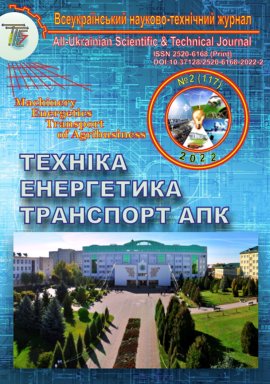
Issue №: 2(117)
The journal solves the problems of creation and improvement of machinery and technologies for agriculture: 131 - Applied Mechanics, 132 - Materials Science, 133 - Industrial Engineering, 141 - Power Engineering, Electrical Engineering and Electromechanics, 208 - Agricultural Engineering.
PECULIARITIES OF DETERMINATION OF RECONSTRUCTION POTENTIAL OF ENERGY SOURCE IN THE CONDITIONS OF AVIATION ENTERPRISES
Serhii Boiko – Candidate of Technical Sciences. Zaporizhzhya Polytechnic National University (street Zhukovsky, 64, Zaporozhye, Ukraine, 69063 e-mail: boiko_s_n@ukr.net ).
Oleksii Zhukov – Candidate of Technical Sciences. Vinnytsia National Technical University (Khmelnitsky hwy, 95, Vinnytsia, Ukraine, 21008 e-mail: alex4444_2004@ukr.net ).
Olga Melnyk – Candidate of Technical Sciences, Associate Professor. Kryvyi Rih National University (street Vitaliy Matusevych, 11, Kryvyi Rih, 50027, Ukraine e-mail: bsn1987@i.ua).
Gennady Rykov – Senior Lecturer. Kremenchug National University named after Mykhailo Ostrogradsky (Pershotravneva Street, 20, Kremenchuk, Poltava Region, Ukraine, 39600 e-mail: abonentqwerty141@gmail.com).
Sergiy Babiy– Candidate of Technical Sciences. Vinnytsia National Technical University (Khmelnitsky hwy, 95, Vinnytsia, Ukraine, 21008 e-mail: babiy82sm@gmail.com)
In the context of the world economy, air transport today, among other characteristics, is characterized by high technological complexity of vehicles, increasing the safety of air transport, strengthening measures to protect aviation from acts of unlawful interference and development of modern multimodal transport technologies and infrastructure for various modes of transport. Due to the global trend, unmanned aerial vehicles have become widespread in various areas and sectors of the world economy. Meanwhile, the issue of energy security as a component of aviation security at airfields and specialized enterprises in their operation, storage and maintenance remains unresolved.
The problem of this work is the synthesis of the method of determining the potential of dispersed energy sources in aviation enterprises. Combining the parallel operation of dispersed generation and network will give a synergistic effect - the emergence of new properties that were not in the components, which is manifested, in particular, in increasing factors influencing energy performance, irregularity of the total load schedule of integrated systems, reducing its unevenness in daily, weekly and seasonal sections, reducing the dependence of the frequency of electric current on power balance fluctuations. In previous studies, the authors justify the positive effect of the introduction of sources of dispersed generation in industrial enterprises, namely modularity, reliability, local governance, reducing the negative impact on the environment and short start-up period.
Given the complexity of the technological process and the specifics of the operation of electrical equipment of aviation enterprises, an urgent scientific and practical task is to develop a method for determining the potential of dispersed energy sources in these enterprises.
To determine the potential of sources of dispersed generation in aviation enterprises, it is necessary to have as complete and clear data on electricity supply and power consumption of electrical equipment of these enterprises during the day, as well as data on electricity consumption in the power grid, operation and load consumption.
At aviation enterprises, the introduction of dispersed generation based on renewable energy sources into the general structure of power supply systems is relevant and possible. The proposed method of determining the potential of dispersed energy sources in the conditions of aviation enterprises will allow to effectively implement dispersed generation in the power supply structure of aviation enterprises.
[1] Babak, V.P., Kharchenko, V.P., Maximov, V.O. (2004). Aviation Safety. K. [in Ukrainian].
[2] Angular, O.P. (2014). Trends in the development of unmanned aerial vehicles. Science and armaments, 4, 39–47. [in Ukrainian].
[3] Lutsky, M.G., Kharchenko, V.P., Bugayko, D.O. (2015). Development of international regulation and regulatory framework for the use of unmanned aerial vehicles. Bulletin of NAU, 4, 5–14. [in Ukrainian].
[4] Code of Civil Protection of Ukraine. URL: https://zakon.rada.gov.ua/laws/show/5403-17#Text (access date: 27.11.2021). [in Ukrainian].
[5] Air Code of Ukraine. URL: https://zakon.rada.gov.ua/laws/show/3393-17#Text (access date: 27.11.2021). [in Ukrainian].
[6] Sinchuk, O.M., Sinchuk, I.O., Boyko, S.M., Karamanits, F.I., Yalova, O.M., Parkhomenko, R.O. (2017). Renewable energy sources in the structures of power supply systems of iron ore enterprises. (Analysis, prospects, projects): monograph. Kryvyi Rih: Publishing House PE Shcherbatykh O.V. [in Ukrainian].
[7] Boyko, S.M., Sinchuk, O.M., Sinchuk, I.O., Minakov, I.A. (2016). Algorithm for selection of non-traditional and renewable sources of electricity to the local power supply system of mining enterprises. Electronics and Communications, 21, 5 (94). 6–13. [in Ukrainian].
[8] Karmazin, O.O. (2014). Problems of entering wind farms into the general balance of UES of Ukraine. Renewable energy, 3, 70–76. [in Ukrainian].
[9] Fedorov, A.A., Sadchikov, S.O. (1982). Characteristics and algorithms of formation and selection of variants of industrial power supply systems. Electricity, 2, 1–5. [in Ukrainian].
[10] Kudrya, S.O., Morozov, Y.P., Kuznetsov, M.P. (2013). Research of efficiency of combined use of energy of wind, the sun and heat of the earth for reception of hydrogen at electrolysis of water. Hydrogen in alternative energy and new technologies: thesis add. scientific reporting session of the National Academy of Sciences of Ukraine. Kyiv. [in Ukrainian].
[11] Bilolid, V.D., Taranets, K.V. (2008). Small energy and its importance in the regional systems of the future. Problems of general energy, 18, 40–47. [in Ukrainian].
[12] Bryl, A.O., Vasko, V.P., Vasko, P.F. (2002). Energy compatibility of wind farms as part of a centralized power system. Unconventional energy in the XXI century: III international. conf . AR Crimea, 2002. K.: ITTF NASU. 113–115. [in Ukrainian].
[13] Golovko, V.M., Denisyuk, P.L., Kirilenko, V.M. (2008). Analysis of the principles of construction of local energy supply systems based on renewable energy sources. Renewable energy of the XXI century: IX International. Conf., September 15–19. AR Crimea. 124–125. [in Ukrainian].
About the journal
G8 – Materials Science
G9 – Applied Mechanics
G10 – Metallurgy
G11 – Mechanical Engineering (by specializations)
The journal "Engineering, Energy, Transport AIC" is indexed according to the following databases and catalogs:


The All-Ukrainian scientific journal “Technology, energy, agriculture transport AIC” is an open-access scientific publication that publishes the results of original research, theoretical and applied developments, as well as scientific papers in the fields of engineering sciences, energy systems, and transport technologies of the agro-industrial complex.
The main objective of the scientific journal “Technology, energy, agriculture transport AIC” is to disseminate the results of modern scientific research and to promote the development of technical, energy, and transport solutions for the agro-industrial complex through the publication of scientific materials characterized by scientific novelty and practical significance in the field of design and modernization of machinery, equipment, and technologies.
The journal’s activities are focused on supporting the development of engineering science, stimulating the implementation of innovative approaches into industrial practice, as well as ensuring effective exchange of scientific achievements among researchers, educators, engineers, and other specialists in relevant fields.
Objectives of the Journal
To achieve its defined objective, the journal ensures the implementation of the following key tasks:
· publication of the results of fundamental and applied research covering the fields of applied mechanics, mechanical engineering, materials science, energy systems, electrical engineering, electromechanics, and transport systems of the agro-industrial sector;
· promotion of the implementation of advanced technical and technological developments aimed at improving the efficiency of machinery, equipment, and production processes;
· creation of conditions for active scientific exchange among research institutions, higher education institutions, industrial enterprises, and other interested organizations;
· support for the development of interdisciplinary research and expansion of cooperation among specialists in various fields of science and technology;
· promotion of the improvement of the scientific and technical level of research related to the design, modernization, and operation of technical equipment used in agro-industrial production;
· dissemination of information on modern achievements in science and technology and the implementation of innovative technologies in the fields of technical support, energy, and transport;
· development of a scientific information environment that facilitates effective scientific communication and the integration of national research into the international scientific community.
Publication frequency: 4 issues per year
Languages of publication: Ukrainian, English
Editor-in-Chief: Vitalii YAROPUD
State Registration: Decision of the National Council of Ukraine on Television and Radio Broadcasting № 1337 and № 1180. Media Identifier: R30-05173
EDRPOU Code: 00497236
Publisher ROR: https://ror.org/05m3ysc06
Publisher DOI prefix: 10.37128 ISSN (print): 2520-6168
The scientific journal is included in Category “B” of the List of Scientific Professional Publications of Ukraine in which the results of dissertation research for obtaining the degrees of Doctor and Candidate of Sciences may be published in the following specialties: G8 – Materials Science; G9 – Applied Mechanics; G10 – Metallurgy; G11 – Mechanical Engineering (by specializations). (Order of the Ministry of Education and Science of Ukraine dated June 11, 2026 №928
Technology, energy, agriculture transport AIC is a scholarly professional journal with a long-standing history and stable academic tradition, reflecting the evolution of engineering and technical sciences within the agro-industrial sector of Ukraine.
The journal was founded in 1997 under the title Bulletin of Vinnytsia State Agricultural Institute. According to the Resolution of the Presidium of the Higher Attestation Commission of Ukraine dated September 11, 1997, the publication obtained the status of a professional scientific journal, which enabled the publication of the main results of doctoral and candidate dissertations in technical sciences. From its inception, the journal positioned itself as an academic platform for addressing current issues of mechanization, electrification, and technical support of agricultural production. During 2001–2014, the journal was published under the title Proceedings of Vinnytsia National Agrarian University. Series: Technical Sciences (State Registration Certificate of Print Media KV No. 16644-5116 PR dated April 30, 2010). Throughout this period, a systematic approach to the selection and peer review of scientific manuscripts was established, the thematic scope of publications was expanded, and continuity of scientific directions as well as the development of sectoral engineering schools was ensured. Since 2015, the journal has been published under its current title, Technology, energy, agriculture transport AIC (State Registration Certificate No. 21906-11806 R dated March 12, 2016). The change of title reflected the expansion of the journal’s thematic coverage and its orientation toward interdisciplinary research in mechanical engineering, energy systems, electrical engineering, transport technologies, automation, and digital solutions for the agro-industrial complex.
