

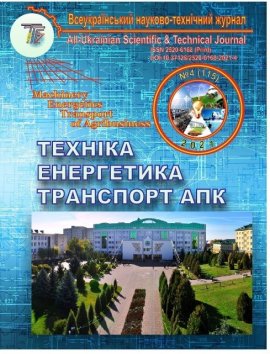
Issue №: 4(115)
The journal solves the problems of creation and improvement of machinery and technologies for agriculture: 131 - Applied Mechanics, 132 - Materials Science, 133 - Industrial Engineering, 141 - Power Engineering, Electrical Engineering and Electromechanics, 208 - Agricultural Engineering.
RECOVERY OF WASTE OINTMENTS BY ULTRAFILTRATION METHOD
Yuliya Melnyk – Lecturer of Technical Disciplines of Chernyatyn Vocational College of Vinnytsia National Agrarian University (Chernyatyn village, 28 Grafa Lvova str., Zhmerynskyi district, Vinnytsia region, 23124, Ukraine, e-mail: julia.me.vn@gmail.com).
Andriy Melnyk – lecturer of technical disciplines of Chernyatyn Vocational College of Vinnytsia National Agrarian University (Chernyatyn village, 28 Grafa Lvova str., Zhmerynskyi district, Vinnytsia region, 23124, Ukraine, e-mail: andrijm901@gmail.com).
Ultrafiltration devices are currently being developed and manufactured around the world, and productivity varies greatly from 1 to 300,000 m/day. In practice, ultrafiltration parameters are used and performed in batch, semi-periodic and continuous modes. Continuous and semi-periodic modes are mainly used for large volumes of liquids. In the case of a small volume, the batch mode prefers the continuous mode - the area of the membrane is smaller and it is easier to clean. The deposition of spent grease is based on the fact that mechanical impurities and water are in a suspended state and settle over time.
When selecting the process of restoring the quality of the lubricant to the required level, first use a mechanical cleaning method to remove free water and hard dirt.
In practice, rough cleaning of the lubricant is carried out using filter elements made of metal mesh with a filtration fineness of 60 ... 80 μm. A complex filter element made of non-woven materials is used for fine cleaning. Type of oil filter "FMN" (cleaning accuracy 15 ... 20 microns). However, these filters cannot provide a degree of purification of the spent lubricant, as the latter contains a large amount of carbon contaminants, preferably with a particle size of less than 5 μm.
In the process of ultrafiltration of oil, the initial stream is separated and concentrated. Varnish, resin and other small contaminants are retained by the superporous layer on the surface and are continuously washed away by a tangential flow of purified oil. Only cleaned grease can pass through the membrane. This allows for a long filtration process without replacing the membrane filter element. The ultrafiltration process is performed at a pressure of 0.3-1 MPa and a flow rate of 2-5 m/s, using membranes with a size of 0.1-0.005 μm.
[1] Kaletnik, H.M., Klymchuk, O.V. (2013). Ekolohichna enerhetyka – osnova rozvytku ekonomiky derzhavy. Zbalansovane pryrodokorystuvannya. Naukovo-praktychnyy zhurnal. 23. 14–17. [in Ukranian]
[2] Hunʹko, I.V., Pʺyasetsʹkyy, A.A., Burlaka, S.A. (2017). Systema palyvopodachi dyzelʹnoho dvyhuna z elektronnym rehulyuvannyam skladu dozovanoyi palyvnoyi sumishi. Tekhnika, enerhetyka, transport APK. 2 (97). 47–51. [in Ukranian]
[3] Smailys, V., Senčila, V., Marchenko, A., Prochorenko, A., Osetrov, A., Bereišienė, K. (2004). Assessment of chemmotological properties and problems of practical implementation of vegetable oils derived fuels. Jura Ir Aplinka. 2(11). 65–75. [in English]
[4] Korchemnyy, M.O., Fedoreyko, V.S., Shcherbanʹ, V.V. (2001). Enerhozberezhennya v ahropromyslovomu kompleksi. Ternopilʹ: Pidruchnyk ta posibnyk. [in Ukranian]
[5] Hunʹko, I.V., Burlaka, S.A., Yelenych, A.P. (2018). Otsinka ekolohichnosti naftovoho palyva ta biopalyva z vykorystannyam metodolohiyi povnoho zhyttyevoho tsyklu. Visnyk Khmelʹnytsʹkoho natsionalʹnoho universytetu. 2. (6 (267)). 246–249. [in Ukranian]
[6] Barabash, V. M., Abiev, R. Sh., Kulov, N. N. (2018). Theory and Practice of Mixing: A Review. Theoretical Foundations of Chemical Engineering. 52(4), 473–487. [in English]
[7] Chernenko, S.M., Atamasʹ, A.I. (2007). Ekonomichni ta enerhetychni pokaznyky roboty dyzelʹnoho dvyhuna pry vykorystanni biopalyva z ripaku. Visnyk KDPU imeni Mykhayla Ostrohradsʹkoho. 43(2). 85–89. [in Ukranian]
[8] Hunʹko, I.V., Halushchak, O.O. Burlaka, S.A. (2018). Vyznachennya faktoriv vplyvu biopalyva na hlobalʹni zminy klimatu. Tekhnika, enerhetyka, transport APK. 3(102). 90–97. [in Ukranian]
About the journal
G8 – Materials Science
G9 – Applied Mechanics
G10 – Metallurgy
G11 – Mechanical Engineering (by specializations)
The journal "Engineering, Energy, Transport AIC" is indexed according to the following databases and catalogs:


The All-Ukrainian scientific journal “Technology, energy, agriculture transport AIC” is an open-access scientific publication that publishes the results of original research, theoretical and applied developments, as well as scientific papers in the fields of engineering sciences, energy systems, and transport technologies of the agro-industrial complex.
The main objective of the scientific journal “Technology, energy, agriculture transport AIC” is to disseminate the results of modern scientific research and to promote the development of technical, energy, and transport solutions for the agro-industrial complex through the publication of scientific materials characterized by scientific novelty and practical significance in the field of design and modernization of machinery, equipment, and technologies.
The journal’s activities are focused on supporting the development of engineering science, stimulating the implementation of innovative approaches into industrial practice, as well as ensuring effective exchange of scientific achievements among researchers, educators, engineers, and other specialists in relevant fields.
Objectives of the Journal
To achieve its defined objective, the journal ensures the implementation of the following key tasks:
· publication of the results of fundamental and applied research covering the fields of applied mechanics, mechanical engineering, materials science, energy systems, electrical engineering, electromechanics, and transport systems of the agro-industrial sector;
· promotion of the implementation of advanced technical and technological developments aimed at improving the efficiency of machinery, equipment, and production processes;
· creation of conditions for active scientific exchange among research institutions, higher education institutions, industrial enterprises, and other interested organizations;
· support for the development of interdisciplinary research and expansion of cooperation among specialists in various fields of science and technology;
· promotion of the improvement of the scientific and technical level of research related to the design, modernization, and operation of technical equipment used in agro-industrial production;
· dissemination of information on modern achievements in science and technology and the implementation of innovative technologies in the fields of technical support, energy, and transport;
· development of a scientific information environment that facilitates effective scientific communication and the integration of national research into the international scientific community.
Publication frequency: 4 issues per year
Languages of publication: Ukrainian, English
Editor-in-Chief: Vitalii YAROPUD
State Registration: Decision of the National Council of Ukraine on Television and Radio Broadcasting № 1337 and № 1180. Media Identifier: R30-05173
EDRPOU Code: 00497236
Publisher ROR: https://ror.org/05m3ysc06
Publisher DOI prefix: 10.37128 ISSN (print): 2520-6168
The scientific journal is included in Category “B” of the List of Scientific Professional Publications of Ukraine in which the results of dissertation research for obtaining the degrees of Doctor and Candidate of Sciences may be published in the following specialties: G8 – Materials Science; G9 – Applied Mechanics; G10 – Metallurgy; G11 – Mechanical Engineering (by specializations). (Order of the Ministry of Education and Science of Ukraine dated June 11, 2026 №928
Technology, energy, agriculture transport AIC is a scholarly professional journal with a long-standing history and stable academic tradition, reflecting the evolution of engineering and technical sciences within the agro-industrial sector of Ukraine.
The journal was founded in 1997 under the title Bulletin of Vinnytsia State Agricultural Institute. According to the Resolution of the Presidium of the Higher Attestation Commission of Ukraine dated September 11, 1997, the publication obtained the status of a professional scientific journal, which enabled the publication of the main results of doctoral and candidate dissertations in technical sciences. From its inception, the journal positioned itself as an academic platform for addressing current issues of mechanization, electrification, and technical support of agricultural production. During 2001–2014, the journal was published under the title Proceedings of Vinnytsia National Agrarian University. Series: Technical Sciences (State Registration Certificate of Print Media KV No. 16644-5116 PR dated April 30, 2010). Throughout this period, a systematic approach to the selection and peer review of scientific manuscripts was established, the thematic scope of publications was expanded, and continuity of scientific directions as well as the development of sectoral engineering schools was ensured. Since 2015, the journal has been published under its current title, Technology, energy, agriculture transport AIC (State Registration Certificate No. 21906-11806 R dated March 12, 2016). The change of title reflected the expansion of the journal’s thematic coverage and its orientation toward interdisciplinary research in mechanical engineering, energy systems, electrical engineering, transport technologies, automation, and digital solutions for the agro-industrial complex.
