

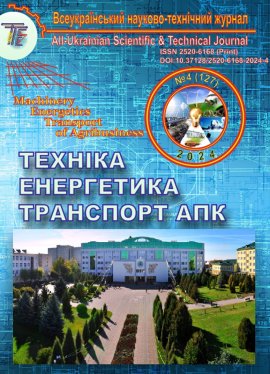
Issue №: 4 (127)
The journal solves the problems of creation and improvement of machinery and technologies for agriculture: 131 - Applied Mechanics, 132 - Materials Science, 133 - Industrial Engineering, 141 - Power Engineering, Electrical Engineering and Electromechanics, 208 - Agricultural Engineering.
RESEARCH AND DEVELOPMENT OF UNIT FOR CUTTING BRANCHES WITH CROPPING AND MIXING THEM WITH SOIL
Ludmila SHVETS – Candidate of Technical Sciences, Associate Professor, Department of Agricultural Engineering and Technical Service Vinnytsia National Agrarian University (Sunny str., 3, Vinnytsia, Ukraine, 21008, e-mail: shlv0505@i.ua, https://orcid.org/0000-0002-4364-0126).
Daryna PAVLYUK – Recipient of the First Educational and Qualification Level bachelor's degree in mechanical engineering Vinnytsia National Agrarian University (Sunny str., 3, Vinnytsia, Ukraine, 21008).
Modern technologies in agriculture are actively aimed at increasing the efficiency of processing garden plantings, which provides optimal conditions for the growth and development of plants. One of the key operations in tree care is regular pruning of branches, which helps to rejuvenate the garden and increase productivity. However, traditional pruning methods are time-consuming and require significant investment of time and resources. In addition, after cutting a branch, there is a need for further processing of the cut material, which adds additional operations.
In order to increase productivity and reduce labor costs, there is a need to develop universal mechanisms capable of performing several operations simultaneously. This work presents the development of an innovative unit that provides simultaneous cutting of garden branches, grinding of material and its incorporation into the soil. This approach not only simplifies the process of disposal of organic waste, but also increases soil fertility by enriching it with organic substances. Thus, the use of this unit can significantly increase the effectiveness of agrotechnical measures in horticulture.
The article presents the development and research of a unit for cutting garden branches with simultaneous grinding of material and its incorporation into the soil. The structural features of the mechanism and the principle of its operation are described. The main advantages of using the unit are analyzed, including increasing the efficiency of pruning, reducing the cost of manual labor and improving the condition of the soil thanks to the use of crushed organic material as fertilizer. The unit's performance was evaluated based on experimental studies and recommendations for its use in horticulture were given.
By integrating branch pruning, grinding, and soil incorporation into a single process, it minimizes the environmental impact of traditional methods. Furthermore, the unit's design prioritizes energy efficiency and ease of use, making it a practical solution for both small-scale and large-scale horticultural enterprises.
1. Shvets, L.V. (2017) Mashyna dlia rizannia i podribnennia chaharnykiv [A machine for cutting and shredding shrubs]. Engineering, Energy, Transport AIC, 2 (97), 153–161. [in Ukrainian].
2. Li, CJ; Zhang, HS (2022). Factors affecting the cutting force when cutting apple branches. Journal Impact Factor. AGRICULTURE-BASEL arrow drop up, 12 (2), 229–336. [in English].
3. Krilek, J., Kováč, J., & Kučera, M. (2014). Wood Crosscutting Process Analysis for Circular Saws. BioResources, 9(1), 1417–1429. DOI: https://doi.org/10.15376/biores.9.1.1417-1429 [in English].
4. Ghahraei, O., Ahmad, D., Khalina, A., Suryanto, H., Othman, J. (2011). Cutting Tests of Kenaf Stems. Transactions of the ASABE, 54 (1), 51–56. DOI: https://doi.org/10.13031/2013.36252 [in English].
5. Johnson, P.C., Clementson, C.L., Mathanker, S.K., Grift, T.E., & Hansen, A.C. (2012). Cutting energy characteristics of Miscanthus x giganteus stems with varying oblique angle and cutting speed. Biosystems Engineering, 112 (1), 42–48. DOI: https://doi.org/10.1016/j.biosystemseng.2012.02.003 [in English].
6. Esgici, R.; Pekitkan, F.; Ozdemir, G.; Güzel, E.; Sessiz, A. (2019). Cutting parameters of some grape varieties subject to the diameter and age of canes. Fresenius Environ. Bull, 28, 167–170. [in English].
7. Kang, F., Tong, S., Zhang, H., Li, W., Chen, Z., Zheng, Y. (2020). Analysis and experiments of reciprocating cutting parameters for apple tree branches. Trans. Chin. Soc. Agric. Eng, 36, 9–16. [in English].
8. Kaletnik, H.M., Zdyrko, N.H., Fabiianska, V.Yu. (2018). Biohaz - v domohospodarstvakh - zaporuka enerhonezalezhnosti silskykh terytorii [Biogas - in households - a guarantee of energy independence of rural areas]. Economy. Finances. Management: topical issues of science and practice, 8 (36). 7–22. [in Ukrainian].
9. Shvets, L.V., Trukhanska, O.O. (2017). Utility model patent Universal tree pruning machine. Patent Ukrainian, No. 121770. Publication of information 11.12.2017, Bull. No. 23. [in Ukrainian].
10. Shvets, L.V. (2020). Proektuvannia tekhnolohichnoi linii dlia vyhotovlennia palyvnykh hranul [Designing a technological line for the production of fuel pellets]. Vibrations in engineering and technology, 2 (97), 149–156. [in Ukrainian].
11. Hunko, I.V., Burlaka, S.A. (2022). Otsinka enerhetychnykh pokaznykiv gruntoobrobnoho ahrehatu [Evaluation of the energy indicators of the tillage unit]. Engineering, Energy, Transport AIC, 2 (117), 47–52. [in Ukrainian].
12. Veselovska, N.R., Rutkevych, V.S., Sharhorodskyi, S.A. (2019). Tekhnolohichni osnovy silskohospodarskoho mashynobuduvannia [Technological foundations of agricultural machine building]: Study guide. Vinnytsia: VNAU. [in Ukrainian].
13. Budiak, R.V., Posviatenko, E.K., Shvets, L.V., Zhuchenko, H.A. (2020). Konstruktsiini materialy i tekhnolohii [Construction materials and technologies]: Study guide. Vinnytsia National Agrarian University. [in Ukrainian].
14. Shvets, L.V. (2019). Tekhnolohichni peredumovy vykorystannia bioenerhetychnoho potentsialu sadiv ta zemel lisohospodarskoho pryznachennia [Technological prerequisites for using the bioenergy potential of gardens and forestry lands]. Vibrations in engineering and technology, 4 (95), 86–93. [in Ukrainian].
15. Shvets, L.V. (2017). Mashyna dlia zrizuvannia ta podribnennia chaharnykiv [A machine for cutting and shredding shrubs]. Engineering, Energy, Transport AIC, 2 (97), 153–161. [in Ukrainian].
About the journal
G8 – Materials Science
G9 – Applied Mechanics
G10 – Metallurgy
G11 – Mechanical Engineering (by specializations)
The journal "Engineering, Energy, Transport AIC" is indexed according to the following databases and catalogs:


The All-Ukrainian scientific journal “Technology, energy, agriculture transport AIC” is an open-access scientific publication that publishes the results of original research, theoretical and applied developments, as well as scientific papers in the fields of engineering sciences, energy systems, and transport technologies of the agro-industrial complex.
The main objective of the scientific journal “Technology, energy, agriculture transport AIC” is to disseminate the results of modern scientific research and to promote the development of technical, energy, and transport solutions for the agro-industrial complex through the publication of scientific materials characterized by scientific novelty and practical significance in the field of design and modernization of machinery, equipment, and technologies.
The journal’s activities are focused on supporting the development of engineering science, stimulating the implementation of innovative approaches into industrial practice, as well as ensuring effective exchange of scientific achievements among researchers, educators, engineers, and other specialists in relevant fields.
Objectives of the Journal
To achieve its defined objective, the journal ensures the implementation of the following key tasks:
· publication of the results of fundamental and applied research covering the fields of applied mechanics, mechanical engineering, materials science, energy systems, electrical engineering, electromechanics, and transport systems of the agro-industrial sector;
· promotion of the implementation of advanced technical and technological developments aimed at improving the efficiency of machinery, equipment, and production processes;
· creation of conditions for active scientific exchange among research institutions, higher education institutions, industrial enterprises, and other interested organizations;
· support for the development of interdisciplinary research and expansion of cooperation among specialists in various fields of science and technology;
· promotion of the improvement of the scientific and technical level of research related to the design, modernization, and operation of technical equipment used in agro-industrial production;
· dissemination of information on modern achievements in science and technology and the implementation of innovative technologies in the fields of technical support, energy, and transport;
· development of a scientific information environment that facilitates effective scientific communication and the integration of national research into the international scientific community.
Publication frequency: 4 issues per year
Languages of publication: Ukrainian, English
Editor-in-Chief: Vitalii YAROPUD
State Registration: Decision of the National Council of Ukraine on Television and Radio Broadcasting № 1337 and № 1180. Media Identifier: R30-05173
EDRPOU Code: 00497236
Publisher ROR: https://ror.org/05m3ysc06
Publisher DOI prefix: 10.37128 ISSN (print): 2520-6168
The scientific journal is included in Category “B” of the List of Scientific Professional Publications of Ukraine in which the results of dissertation research for obtaining the degrees of Doctor and Candidate of Sciences may be published in the following specialties: G8 – Materials Science; G9 – Applied Mechanics; G10 – Metallurgy; G11 – Mechanical Engineering (by specializations). (Order of the Ministry of Education and Science of Ukraine dated June 11, 2026 №928
Technology, energy, agriculture transport AIC is a scholarly professional journal with a long-standing history and stable academic tradition, reflecting the evolution of engineering and technical sciences within the agro-industrial sector of Ukraine.
The journal was founded in 1997 under the title Bulletin of Vinnytsia State Agricultural Institute. According to the Resolution of the Presidium of the Higher Attestation Commission of Ukraine dated September 11, 1997, the publication obtained the status of a professional scientific journal, which enabled the publication of the main results of doctoral and candidate dissertations in technical sciences. From its inception, the journal positioned itself as an academic platform for addressing current issues of mechanization, electrification, and technical support of agricultural production. During 2001–2014, the journal was published under the title Proceedings of Vinnytsia National Agrarian University. Series: Technical Sciences (State Registration Certificate of Print Media KV No. 16644-5116 PR dated April 30, 2010). Throughout this period, a systematic approach to the selection and peer review of scientific manuscripts was established, the thematic scope of publications was expanded, and continuity of scientific directions as well as the development of sectoral engineering schools was ensured. Since 2015, the journal has been published under its current title, Technology, energy, agriculture transport AIC (State Registration Certificate No. 21906-11806 R dated March 12, 2016). The change of title reflected the expansion of the journal’s thematic coverage and its orientation toward interdisciplinary research in mechanical engineering, energy systems, electrical engineering, transport technologies, automation, and digital solutions for the agro-industrial complex.
