

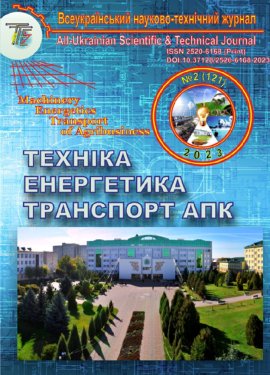
Issue №: 2 (121)
The journal solves the problems of creation and improvement of machinery and technologies for agriculture: 131 - Applied Mechanics, 132 - Materials Science, 133 - Industrial Engineering, 141 - Power Engineering, Electrical Engineering and Electromechanics, 208 - Agricultural Engineering.
RESULTS OF LABORATORY STUDIES ON THE PROCESS OF MAKING FUEL BRIQUETTES FROM RAPESEED STRAW
Volodymyr Govorukha – Doctor of Physical and Mathematical Sciences, Professor, Head of the Department of higher mathematics, physics and general engineering disciplines of Dnipro State Agrarian and Economic University (25 Serhiy Yefremova St., Dnipro, Ukraine, 49600, e-mail: govorukhavb@yahoo .com).
Pavlo Luts – Candidate of Technical Sciences, Senior Lecturer of Department of machines and equipment of agricultural production of Vinnytsia National Agrarian University (St. Soniachna, 3, Vinnytsia, Ukraine, 21008, e-mail: luts@vsau.vin.ua).
Oleksii Kyselov – Candidate of Technical Sciences, Senior Researcher (Zaporizhia, St. Pivdennoukrainska, bldg. 15, sq. 31, Ukraine, 69035, e-mail: awbakis@gmail.com).
When producing fuel briquettes, the main material used for pressing is agricultural waste, specifically plant residues, which most often consist of straw from cereal and small-seeded crops. Therefore, the success of the briquetting process largely depends on the properties of their physico-mechanical component.
Within the variation of the studied factors, as the average length of rapeseed straw particles decreases, the density and energy density of the briquettes increase. Also positively affecting these indicators are the increase in the content of binding material (clay or manure), the cone angle of the matrix, and the ratio of the cross-sectional area of the matrix channel to its perimeter. Increasing the moisture content of the pressed material leads to an increase in the density of briquettes and a decrease in their energy density.
To ensure the production of briquettes with a density of over 600 kg/m², both with and without binding material, a round matrix should be used.
The optimal temperature for heating the matrix during pressing is 160-180°C. This results in the release of lignin from rapeseed straw, which also acts as a binding agent. Furthermore, it enhances plasticization, accelerating relaxation processes, reducing friction coefficients, lowering the energy intensity of the process, and enabling the achievement of the required briquette quality.
Pressing at a heating temperature of 160-180°C leads to stable production of rapeseed straw briquettes with a moisture content of the initial material of up to 16%. In the case of particle size reduction to 20 mm, briquetting can be performed without adding a binding agent.
The most acceptable initial moisture content of the briquetting mass is 8-12%. Higher moisture results in fluffy briquettes, while lower moisture leads to less density. With moisture exceeding 16%, intensive steam formation occurs in the pressing chamber, which is dangerous during operation.
[1]. Chen, S., Zhao, Y., Tang, Z., Ding, H., Su, Z., Ding, Z. (2022). Structural Model of Straw Briquetting Machine with Vertical Ring Die and Optimization of Briquetting Performance. Agriculture, 12 (5), 736. DOI: 10.3390/agriculture12050736 [in English]
[2]. Aliev, E.B., Patsula, O.M., Hrytsenko, V.T. (2017). Tekhnolohiia kompleksnoi bezvidkhidnoi pererobky makukhy z nasinnia oliinykh kultur z otrymanniam vysokoiakisnykh povnotsinnykh proteïnovykh dobavok u vyhliadi pellet ta tverdoho biopalyva. Naukovo-metodychni rekomendatsii. Instytut oliinykh kultur Natsionalnoi akademii ahrarnykh nauk Ukrainy. Elektronnyi analoh drukovanoho vydannia (elektronna knyha). Zaporizhzhia. ISBN 978-617-7353-59-0 [in Ukrainian]
[3]. Sengar, S.H., Mohod, A.G., Khandetod, Y.P., Patil, S.S., Chendake, A.D. (2012). Performance of Briquetting Machine for Briquette Fuel. International Journal of Energy Engineering, 2 (1), 28–34. DOI: 10.5923/j.ijee.20120201.05 [in English]
[4]. Grover, P.D., Mishra, S.K. (1996). Biomass Briquetting: Technology and Practices. Regional Wood Energy Development Programme In Asia Gcp/Ras/154/Net. Field Document, 46. URL: https://www.fao.org/3/ad579e/ad579e00.pdf [in English]
[5]. Wang, F.H., Tian, Z.Y. (2011). The Virtual Design of Cluster Straw Fuel Briquetting Machine. Advanced Materials Research, 299–300, 925–928. DOI: 10.4028/www.scientific.net/amr.299-300.925 [in English]
[6]. Aliiev, E.B., Patsula, O.M., Havryilchenko, O.S. (2016). Rezultaty eksperymentalnykh doslidzhen ustanovky dlia vyhotovlennia palivnykh bryketiv z lushpynnoi fraktsii makukh nasinnia oliinykh kultur. Tekhnichni systemy i tekhnolohii tvarynnytstva: Visnyk Kharkivskoho natsionalnoho tekhnichnoho universytetu silskoho hospodarstva imeni Petra Vasylenka, 170, 3–7. [in Ukrainian]
[7]. Aliev, E.B., Yaropud, V.M., Havryilchenko, O.S., Ivanchenko, O.V., Patsula, O.M. (2018). Ustanovka dlia vyhotovlennia palivnykh bryketiv. Tekhnika, enerhetyka, transport APK, 4 (103). 69–74. [in Ukrainian]
[8]. Berdychowski, M., Wilczyński, D., Wałęsa, K., Górecki, J. (2020). Research on the compaction process of loose materials with use of helix technology. IOP Conference Series: Materials Science and Engineering, 776, 012063. DOI: 10.1088/1757-899X/776/1/012063 [in English]
[9]. Marreiro, H.M.P., Peruchi, R.S., Lopes, R.M.B.P., Andersen, S.L.F., Eliziário, S.A., Rotella Junior P. (2021). Empirical Studies on Biomass Briquette Production: A Literature Review. Energies, 14 (24), 8320. DOI: 10.3390/en14248320 [in English]
[10]. Kpalo, S.Y., Zainuddin, M.F., Manaf, L.A., Roslan, A.M. (2020). A Review of Technical and Economic Aspects of Biomass Briquetting. Sustainability, 12 (11), 4609. DOI: 10.3390/su12114609 [in English]
[11]. Dolgov, I.A. (1972). Zakonomirnosti stysnennia sino-solomistykh materialiv. Mekhanizatsiia i elektrifikatsiia silskoho hospodarstva. Kyiv. [in Ukrainian]
[12]. Kyselov, O.V., Bakardzhiiev, R.O. (1996). Vybir typu pres-bryketuvalnyka ta yoho kinematychnyi analiz. Zbirnyk prats III Mizhnarodnoi naukovo-praktychnoi konferentsii "Suchasni problemy heometrychnoho modeliuvannia". Melitopol. [in Ukrainian]
[13]. Kyselov, O.V., Komarova, I.B., Milko, D.O., Bakardzhiiev R.O. (2017). Statystychna obrobka i oformlennia rezultativ eksperymentalnykh doslidzhen (iz dosvidu napisannia dysertatsiinykh robit). Navchalnyi posibnyk. Za zah. red. D.O. Milka. Instytut mekhanizatsii tvarynnytstva NAAN. Zaporizhzhia. [in Ukrainian]
[14]. Bakardzhiiev, R.O. (1997). Obgruntuvannia konstruktyvnykh parametrov i rezhymiv roboty pres-brekeruvalnyka dlia utylizatsii roslynnykh materialiv: dys. kand. tekhn. nauk: 05.20.01 / Tavriiska derzhavna ahrotekhnichna akademiia. Melitopol. [in Ukrainian]
About the journal
G8 – Materials Science
G9 – Applied Mechanics
G10 – Metallurgy
G11 – Mechanical Engineering (by specializations)
The journal "Engineering, Energy, Transport AIC" is indexed according to the following databases and catalogs:


The All-Ukrainian scientific journal “Technology, energy, agriculture transport AIC” is an open-access scientific publication that publishes the results of original research, theoretical and applied developments, as well as scientific papers in the fields of engineering sciences, energy systems, and transport technologies of the agro-industrial complex.
The main objective of the scientific journal “Technology, energy, agriculture transport AIC” is to disseminate the results of modern scientific research and to promote the development of technical, energy, and transport solutions for the agro-industrial complex through the publication of scientific materials characterized by scientific novelty and practical significance in the field of design and modernization of machinery, equipment, and technologies.
The journal’s activities are focused on supporting the development of engineering science, stimulating the implementation of innovative approaches into industrial practice, as well as ensuring effective exchange of scientific achievements among researchers, educators, engineers, and other specialists in relevant fields.
Objectives of the Journal
To achieve its defined objective, the journal ensures the implementation of the following key tasks:
· publication of the results of fundamental and applied research covering the fields of applied mechanics, mechanical engineering, materials science, energy systems, electrical engineering, electromechanics, and transport systems of the agro-industrial sector;
· promotion of the implementation of advanced technical and technological developments aimed at improving the efficiency of machinery, equipment, and production processes;
· creation of conditions for active scientific exchange among research institutions, higher education institutions, industrial enterprises, and other interested organizations;
· support for the development of interdisciplinary research and expansion of cooperation among specialists in various fields of science and technology;
· promotion of the improvement of the scientific and technical level of research related to the design, modernization, and operation of technical equipment used in agro-industrial production;
· dissemination of information on modern achievements in science and technology and the implementation of innovative technologies in the fields of technical support, energy, and transport;
· development of a scientific information environment that facilitates effective scientific communication and the integration of national research into the international scientific community.
Publication frequency: 4 issues per year
Languages of publication: Ukrainian, English
Editor-in-Chief: Vitalii YAROPUD
State Registration: Decision of the National Council of Ukraine on Television and Radio Broadcasting № 1337 and № 1180. Media Identifier: R30-05173
EDRPOU Code: 00497236
Publisher ROR: https://ror.org/05m3ysc06
Publisher DOI prefix: 10.37128 ISSN (print): 2520-6168
The scientific journal is included in Category “B” of the List of Scientific Professional Publications of Ukraine in which the results of dissertation research for obtaining the degrees of Doctor and Candidate of Sciences may be published in the following specialties: G8 – Materials Science; G9 – Applied Mechanics; G10 – Metallurgy; G11 – Mechanical Engineering (by specializations). (Order of the Ministry of Education and Science of Ukraine dated June 11, 2026 №928
Technology, energy, agriculture transport AIC is a scholarly professional journal with a long-standing history and stable academic tradition, reflecting the evolution of engineering and technical sciences within the agro-industrial sector of Ukraine.
The journal was founded in 1997 under the title Bulletin of Vinnytsia State Agricultural Institute. According to the Resolution of the Presidium of the Higher Attestation Commission of Ukraine dated September 11, 1997, the publication obtained the status of a professional scientific journal, which enabled the publication of the main results of doctoral and candidate dissertations in technical sciences. From its inception, the journal positioned itself as an academic platform for addressing current issues of mechanization, electrification, and technical support of agricultural production. During 2001–2014, the journal was published under the title Proceedings of Vinnytsia National Agrarian University. Series: Technical Sciences (State Registration Certificate of Print Media KV No. 16644-5116 PR dated April 30, 2010). Throughout this period, a systematic approach to the selection and peer review of scientific manuscripts was established, the thematic scope of publications was expanded, and continuity of scientific directions as well as the development of sectoral engineering schools was ensured. Since 2015, the journal has been published under its current title, Technology, energy, agriculture transport AIC (State Registration Certificate No. 21906-11806 R dated March 12, 2016). The change of title reflected the expansion of the journal’s thematic coverage and its orientation toward interdisciplinary research in mechanical engineering, energy systems, electrical engineering, transport technologies, automation, and digital solutions for the agro-industrial complex.
