

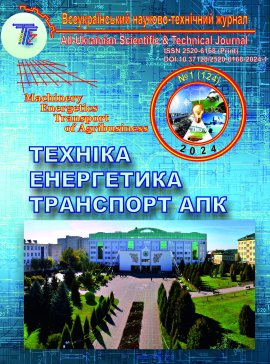
Issue №: 1 (124)
The journal solves the problems of creation and improvement of machinery and technologies for agriculture: 131 - Applied Mechanics, 132 - Materials Science, 133 - Industrial Engineering, 141 - Power Engineering, Electrical Engineering and Electromechanics, 208 - Agricultural Engineering.
REVIEW OF MODERN TECHNOLOGIES FOR INACTIVATION OF ANTI-NUTRIENTS IN SOYBEANS
Ihor KUPCHUK – Candidate of Technical Sciences, Associate Professor of the Department of Technological Processes and Equipment of Processing and Food Production, Faculty of Engineering and Technology of Vinnytsia National Agrarian University (3, Sonychna St., Vinnytsia, 21008, Ukraine, e-mail: kupchuk.igor@i.ua, http://orcid.org/0000-0002-2973-6914).
Yevhenii VOLYNETS – Assistant of the Department of Labor Protection and Biotechnical Systems in Animal Husbandry, Faculty of Production Technology, Processing and Robotics in Animal Husbandry of Vinnytsia National Agrarian University (3 Sunny Street, Vinnytsia, 21008, Ukraine, e-mail: evgen110596@gmail.com, https://orcid.org/0000-0002-3298-6316).
Oleh SIMAKOV – engineer of the "LITAGOR" farm (22160, Peace St., 36a, Mykolaivka Village, Khmilnytskyi District, Vinnytsia Region, Ukraine, e-mail: simakov35@gmail.com, https://orcid.org/0000-0003-2335-8980).
The study examines technologies for inactivating anti-nutrients in soybeans, such as proteolytic enzyme inhibitors. In addition, soybeans have two trypsin inhibitors that bind cystine and methionine. Protease inhibitors include trypsin and chymotrypsin inhibitors, which are substances that are naturally present in soybeans to protect them from being eaten by birds and rodents and from the development of microflora. According to their heat resistance, antinutrients can be classified into heat-sensitive and heat-resistant. The purpose of the research was to study modern methods and technological solutions aimed at optimizing the preservation of useful characteristics of soybeans and reducing the content of anti-nutrients. To inactivate these anti-nutrients, physical, chemical and biological methods of legume processing are used. As a result of heat treatment, the nutritional value of beans increases, namely, the digestibility of proteins increases by up to 90%, and the contamination of beans with microflora is significantly reduced. The amount of trypsin inhibitor in soybeans after roasting with a roaster significantly decreased by 2.45 times, and lipoxygenase activity - by 2.71 times. One of the most attractive and highly effective, but not sufficiently researched methods is the method of heat treatment of legume seeds called micronization. In this case, the process of inactivation of anti-nutrients in soybeans is very fast - within 50...70 seconds, the nutritional value of protein is significantly increased, and the energy value increases (approximately from 7800 to 16000 kJ/kg). The technology of neutralization of anti-nutrients in soybeans based on their heat treatment in a 2.5 % solution of calcium hydroxide is considered. Processing of soybeans according to the developed technology allows to obtain feed without urease activity, and the content of trypsin inhibitor is at the level of 2-3 mg/g.
[1] Zabolotnyi, H.M., Mazur, V.A., Tsyhanska, O.I., Didur, I.M., Tsyhanskyi, V.I., Pantsyreva, H.V. (2020). Ahrobiolohichni osnovy vyroshchuvannia soi ta shliakhy maksymalnoi realizatsii yii produktyvnosti [Agribiological basis of soybean cultivation and ways to maximize its productivity]. Vinnytsia: VNAU. [in Ukrainian].
[2] Mazur, V.A., Tkachuk, O.P., Pantsyreva, H.V., Kupchuk, I.M. (2022). Soia v intensyvnomu zemlerobstvi [Soybean in intensive farming]. Vinnytsia: TVORY. [in Ukrainian].
[3] Mandygra, M.S. et al. (2018). Vyvchennia vplyvu hennomodyfikovanoi soi linii mon 89788 na orhanizm laboratornykh tvaryn [Study of the effect of genetically modified soybean line mon 89788 on the organism of laboratory animals]. Visnyk ahrarnoi nauky – Bulletin of Agrarian Science, 9, 32–38. [in Ukrainian].
[4] Berbenets, O.V. (2019). Svitove vyrobnytstvo soi yak nevycherpnoho dzherela bilkiv roslynnoho pokhodzhennia ta mistse Ukrainy na svitovomu rynku torhivli neiu [World production of soybeans as an inexhaustible source of proteins of plant origin and Ukraine's place in the world market of soybean trade]. Ahrosvit – Agrosvit, 10, 41–45. [in Ukrainian].
[5] Peisker, M. (2001). Manufacturing of soy protein concentrate for animal nutrition. Feed manufacturing in the Mediterranean region. Improving safety: From feed to food. Zaragoza: CIHEAM, 103–107. [in English].
[6] Obertiukh, Yu.V. (2012). Antypozhyvni rechovyny soi, yikh inaktyvatsiia ta tekhnolohii pererobky soievykh bobiv na promyslovii osnovi y v umovakh hospodarstva [Antinutrients of soybeans, their inactivation and technologies of soybean processing on an industrial basis and in farm conditions]. Kormy i kormovyrobnytstvo – Feeds and feed production, 71, 62–71. [in Ukrainian].
[7] Czerwiński, J., Leontowicz, H., Leontowicz, M., Gralak, M. A. (2005). Response of rats to a moderate intake of soybean lectin. Anim Feed Sci., 14, (1), 537–540. [in English].
[8] Ireland, P.A., Dziedzic, S.Z., Kearsley, M.W. (2008). Saponin content of soya and some commercial soya products by means of high-performance liquid chromatography of the sapogenins. Sci. Food Agrie, 37, 694–698. [in English].
[9] Ivanenko, F.V., & Sinchenko, V.M. (2005). Tekhnolohiia zberihannia ta pererobky silskohospodarskoi produktsii [Technology of storage and processing of agricultural products]. Kyiv: KNEU. [in Ukrainian].
[10] Gilani, G., Cockell, K., Sepehr, E. (2005). Effects of antinutritional factors on protein digestibility and amino acid availability in foods. Journal of AOAC international, 88 (3), 967–987. [in English].
[11] Bandura, V.M., & Popiak, O.H. (2019). Tekhnolohichni protsesy sushinnia soi [Technological processes of soybean drying]. Tekhnika, enerhetyka, transport APK, 2 (105), 52–58. [in Ukrainian].
[12] Plavynska, S.V. (2011). Mikronizatsiia bobiv soi - perspektyvnyi metod otrymannia yakisnoho produktu dlia kormovyrobnytstva (kormopryhotuvannia) [Micronization of soybeans - a promising method of obtaining a quality product for feed production (feed preparation)]. Suchasne ptakhivnytstvo – Modern poultry, 11/12, 26–28. [in Ukrainian].
[13] Radchuk, O.V., & Plavynska, S. V. (2010). Obgruntuvannia optymalnoho vyboru metodu teplovoi obrobky zerna bobovykh kultur [Substantiation of the optimal choice of the method of heat treatment of legume grain]. Visnyk SNAU – Bulletin of the SNAU, 1 (21), 37–41. [in Ukrainian].
[14] García, R., & Martínez, C. (2017). Optimization of Soybean Processing Parameters for Maximizing Nutritional Value. Food Research International, 96, 85–92. [in English].
[15] Shevchenko, A.M., Feshchenko, D.V., Romanyshyna, T.O. (2023). Rosterna obrobka soi, yak sposib deaktyvatsii antypozhyvnykh rechovyn [Roaster treatment of soybeans as a way to deactivate anti-nutrients]. Proceeding from: Bezpechnist ta yakist kharchovykh produktiv u kontseptsii «Iedyne zdorovia» – Food safety and quality in the concept of «One Health». (pp. 39-40). Lviv. [in Ukrainian].
[16] Plavynskyi, V.I., Plavynska, S.V., Plavynska, O.V. (2016). Problemy mikronizatsii bobiv soi [Problems of micronization of soybeans]. Mekhanizatsiia ta avtomatyzatsiia vyrobnychykh protsesiv – Mechanization and automation of production processes, 10/2, 127–132. [in Ukrainian].
[17] Sait Ankorex [Site Ankorex] www.ankores.com.ua. Retrieved from: https://www.ankores.com.ua/ua/publications/antipozhivni-rechovini-soyi-ta-sposobi-yih-nejtralizaciyi-suchasnij-tehnologichnij-poglyad/. [in Ukrainian].
[18] Ratych, I., Hunchak, A., Kyryliv, B. (2013). Navmysna ruinatsiia [Deliberate destruction]. Nashe ptakhivnytstvo – Our Poultry Farming, 2. Retrieved from: https://agrotimes.ua/article/navmisna_rujnaciya/. [in Ukrainian].
About the journal
G8 – Materials Science
G9 – Applied Mechanics
G10 – Metallurgy
G11 – Mechanical Engineering (by specializations)
The journal "Engineering, Energy, Transport AIC" is indexed according to the following databases and catalogs:


The All-Ukrainian scientific journal “Technology, energy, agriculture transport AIC” is an open-access scientific publication that publishes the results of original research, theoretical and applied developments, as well as scientific papers in the fields of engineering sciences, energy systems, and transport technologies of the agro-industrial complex.
The main objective of the scientific journal “Technology, energy, agriculture transport AIC” is to disseminate the results of modern scientific research and to promote the development of technical, energy, and transport solutions for the agro-industrial complex through the publication of scientific materials characterized by scientific novelty and practical significance in the field of design and modernization of machinery, equipment, and technologies.
The journal’s activities are focused on supporting the development of engineering science, stimulating the implementation of innovative approaches into industrial practice, as well as ensuring effective exchange of scientific achievements among researchers, educators, engineers, and other specialists in relevant fields.
Objectives of the Journal
To achieve its defined objective, the journal ensures the implementation of the following key tasks:
· publication of the results of fundamental and applied research covering the fields of applied mechanics, mechanical engineering, materials science, energy systems, electrical engineering, electromechanics, and transport systems of the agro-industrial sector;
· promotion of the implementation of advanced technical and technological developments aimed at improving the efficiency of machinery, equipment, and production processes;
· creation of conditions for active scientific exchange among research institutions, higher education institutions, industrial enterprises, and other interested organizations;
· support for the development of interdisciplinary research and expansion of cooperation among specialists in various fields of science and technology;
· promotion of the improvement of the scientific and technical level of research related to the design, modernization, and operation of technical equipment used in agro-industrial production;
· dissemination of information on modern achievements in science and technology and the implementation of innovative technologies in the fields of technical support, energy, and transport;
· development of a scientific information environment that facilitates effective scientific communication and the integration of national research into the international scientific community.
Publication frequency: 4 issues per year
Languages of publication: Ukrainian, English
Editor-in-Chief: Vitalii YAROPUD
State Registration: Decision of the National Council of Ukraine on Television and Radio Broadcasting № 1337 and № 1180. Media Identifier: R30-05173
EDRPOU Code: 00497236
Publisher ROR: https://ror.org/05m3ysc06
Publisher DOI prefix: 10.37128 ISSN (print): 2520-6168
The scientific journal is included in Category “B” of the List of Scientific Professional Publications of Ukraine in which the results of dissertation research for obtaining the degrees of Doctor and Candidate of Sciences may be published in the following specialties: G8 – Materials Science; G9 – Applied Mechanics; G10 – Metallurgy; G11 – Mechanical Engineering (by specializations). (Order of the Ministry of Education and Science of Ukraine dated June 11, 2026 №928
Technology, energy, agriculture transport AIC is a scholarly professional journal with a long-standing history and stable academic tradition, reflecting the evolution of engineering and technical sciences within the agro-industrial sector of Ukraine.
The journal was founded in 1997 under the title Bulletin of Vinnytsia State Agricultural Institute. According to the Resolution of the Presidium of the Higher Attestation Commission of Ukraine dated September 11, 1997, the publication obtained the status of a professional scientific journal, which enabled the publication of the main results of doctoral and candidate dissertations in technical sciences. From its inception, the journal positioned itself as an academic platform for addressing current issues of mechanization, electrification, and technical support of agricultural production. During 2001–2014, the journal was published under the title Proceedings of Vinnytsia National Agrarian University. Series: Technical Sciences (State Registration Certificate of Print Media KV No. 16644-5116 PR dated April 30, 2010). Throughout this period, a systematic approach to the selection and peer review of scientific manuscripts was established, the thematic scope of publications was expanded, and continuity of scientific directions as well as the development of sectoral engineering schools was ensured. Since 2015, the journal has been published under its current title, Technology, energy, agriculture transport AIC (State Registration Certificate No. 21906-11806 R dated March 12, 2016). The change of title reflected the expansion of the journal’s thematic coverage and its orientation toward interdisciplinary research in mechanical engineering, energy systems, electrical engineering, transport technologies, automation, and digital solutions for the agro-industrial complex.
