

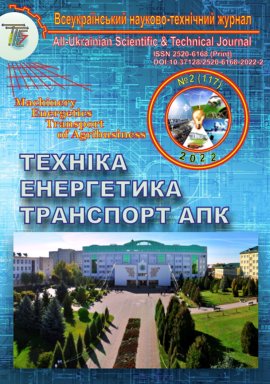
Issue №: 2(117)
The journal solves the problems of creation and improvement of machinery and technologies for agriculture: 131 - Applied Mechanics, 132 - Materials Science, 133 - Industrial Engineering, 141 - Power Engineering, Electrical Engineering and Electromechanics, 208 - Agricultural Engineering.
STUDY OF ICE FORMATION PROCESSES ON OVERHEAD POWER LINES AND DEVELOPMENT OF SYSTEMS TO COMBAT THIS PHENOMENON
Oleg Gaidamak – Candidate of Science (Engineering), Associate Professor, Associate Professor of the Department of Power engineering, electrical engineering and electromechanics of Vinnitsa National Agrarian University (3 Soniachna St., Vinnitsa, Ukraine, 21008, e-mail: haidamak@vsau.vin.ua, https://orcid.org/0000-0001-5116-6017).
Icing on the wires of overhead power lines is a big problem to maintain their integrity. The process of icing wires leads to a significant increase in their mass and, accordingly, to large overloads on the wire and electric supports. Exceeding the loads above the permissible ones can cause great damage to power lines. Wires, cables can break, fittings can be damaged and even lead to collapse of electrical poles. At the same time, damage is caused from the undersupply of electricity. This damage may exceed the damage from damage to the elements of power lines.
Ice on the wires usually appear in winter, especially when the warming is going to be replaced by a cold snap and the temperature fluctuates around zero. The problem can be exacerbated by strong wind loads. An increase in air humidity also accelerates the formation of an ice "coat" on wires and electrical poles. Under the most unfavorable conditions, the wall thickness of the “fur coat” of ice on the wire can reach more than 70 mm. Such an ice coat can lead to exceeding the maximum permissible loads and damage to the power line, as well as damage from a power outage.
The mechanism of ice formation on overhead power lines, as well as negative damage to power lines and high-voltage pylons under the action of ice load, has been studied. An analysis of the known methods of dealing with ice on power lines has been carried out. An innovative device for combating icing formations is proposed. The advantage of the proposed device is the ability to operate in two modes: vibrating and shock-shaking, which expands its functionality.
In preventive mode, the device operates continuously due to the interaction with alternating current flowing through the wires of power lines in the normal mode of their operation, without the need for shutdown for maintenance, which gives the electromechanical interactions of devices with the wire of the power line a vibrational character and ensures the continuity of the process of removing water drops from the wires at an early stage before ice formation.
Thus, in the preventive mode of operation of the power line, the causes of icing of the wires are eliminated, and not its consequences, which eliminates the need to shut down for maintenance, and reduces the required costs of resources and energy.
[1] Yelizar'yev, A.YU. (2017). Obespecheniye nadezhnosti raboty vozdushnykh liniy elektroperedachi v usloviyakh gololednykh nagruzok. [Ensuring the reliability of the operation of overhead power lines under ice loads]: Candidate’s thesis. Tomsk: NITPU.
[2] Method for measuring ice and wind loads on overhead power lines: Pat. 2461941 RF, IPC H02G 7/16 № 2011109048/07; claimed 10/03/2011; publ. 20/09/12, 26, 12.
[3] A method for detecting the appearance of ice on the wires of a power line: Pat. 2399133 RF, IPC H02G 7/16 № 20091223947/09; claimed 23/06/2009; publ. 10/09/10, 25, 10.
[4] Method for determining ice on the wires of an overhead power line: Pat. 2461942 RF, IPC H02G 7/16 № 2011130725/07; claimed 21/07/2011; publ. 20/09/12, 26, 14.
[5] Signalizator of ice deposits: Pat. 2409881 RF, IPC H02G 7/16 № 2008153016/07; claimed. 31/12/2008; publ. 20/01/11, 2, 11.
[6] Levchenko, I.I., Zasypkin, A.S., Alliluev, A.A., Satsuk, E.I. (2007). Diagnostika, rekonstruktsiya i ekspluatatsiya vozdushnykh liniy elektroperedachi v gololednykh rayonakh [Diagnostics, reconstruction and operation of overhead power lines in icy areas]. M: Izdatel'skiy dom MEI.
[7] Levchenko, I.I. (2015). Diagnostika, rekonstruktsiya i ekspluatatsiya vozdushnykh liniy elektroperedachi v gololednykh rayonakh. [Diagnostics, reconstruction and operation of overhead power lines in icy areas]. M: MEI Publishing House.
[8] D'yakov, A.F. (2000). Predotvrashcheniye i likvidatsiya gololednykh avariy v elektricheskikh setyakh. [Prevention and elimination of icy accidents in electrical networks]. Pyatigors'k: Izd-vo RP «Yuzhenergotekhnadzor».
[9] Kaganov, V.I. (2010). Bor'ba s gololodom v liniyakh elektroperedachi s pomoshch'yu vysokochastotnoy elektromagnitnoy volny. [Fighting ice in power lines using a high-frequency electromagnetic wave]. Elektro, 5, 41–45.
[10] Glukhov, V.G. (1972). Meteorologicheskiye usloviya obrazovaniya gololoda na vysotnykh sooruzheniyakh. [Meteorological conditions for the formation of ice on high-rise structures]. L: Gidrometeoizdat.
About the journal
G8 – Materials Science
G9 – Applied Mechanics
G10 – Metallurgy
G11 – Mechanical Engineering (by specializations)
The journal "Engineering, Energy, Transport AIC" is indexed according to the following databases and catalogs:


The All-Ukrainian scientific journal “Technology, energy, agriculture transport AIC” is an open-access scientific publication that publishes the results of original research, theoretical and applied developments, as well as scientific papers in the fields of engineering sciences, energy systems, and transport technologies of the agro-industrial complex.
The main objective of the scientific journal “Technology, energy, agriculture transport AIC” is to disseminate the results of modern scientific research and to promote the development of technical, energy, and transport solutions for the agro-industrial complex through the publication of scientific materials characterized by scientific novelty and practical significance in the field of design and modernization of machinery, equipment, and technologies.
The journal’s activities are focused on supporting the development of engineering science, stimulating the implementation of innovative approaches into industrial practice, as well as ensuring effective exchange of scientific achievements among researchers, educators, engineers, and other specialists in relevant fields.
Objectives of the Journal
To achieve its defined objective, the journal ensures the implementation of the following key tasks:
· publication of the results of fundamental and applied research covering the fields of applied mechanics, mechanical engineering, materials science, energy systems, electrical engineering, electromechanics, and transport systems of the agro-industrial sector;
· promotion of the implementation of advanced technical and technological developments aimed at improving the efficiency of machinery, equipment, and production processes;
· creation of conditions for active scientific exchange among research institutions, higher education institutions, industrial enterprises, and other interested organizations;
· support for the development of interdisciplinary research and expansion of cooperation among specialists in various fields of science and technology;
· promotion of the improvement of the scientific and technical level of research related to the design, modernization, and operation of technical equipment used in agro-industrial production;
· dissemination of information on modern achievements in science and technology and the implementation of innovative technologies in the fields of technical support, energy, and transport;
· development of a scientific information environment that facilitates effective scientific communication and the integration of national research into the international scientific community.
Publication frequency: 4 issues per year
Languages of publication: Ukrainian, English
Editor-in-Chief: Vitalii YAROPUD
State Registration: Decision of the National Council of Ukraine on Television and Radio Broadcasting № 1337 and № 1180. Media Identifier: R30-05173
EDRPOU Code: 00497236
Publisher ROR: https://ror.org/05m3ysc06
Publisher DOI prefix: 10.37128 ISSN (print): 2520-6168
The scientific journal is included in Category “B” of the List of Scientific Professional Publications of Ukraine in which the results of dissertation research for obtaining the degrees of Doctor and Candidate of Sciences may be published in the following specialties: G8 – Materials Science; G9 – Applied Mechanics; G10 – Metallurgy; G11 – Mechanical Engineering (by specializations). (Order of the Ministry of Education and Science of Ukraine dated June 11, 2026 №928
Technology, energy, agriculture transport AIC is a scholarly professional journal with a long-standing history and stable academic tradition, reflecting the evolution of engineering and technical sciences within the agro-industrial sector of Ukraine.
The journal was founded in 1997 under the title Bulletin of Vinnytsia State Agricultural Institute. According to the Resolution of the Presidium of the Higher Attestation Commission of Ukraine dated September 11, 1997, the publication obtained the status of a professional scientific journal, which enabled the publication of the main results of doctoral and candidate dissertations in technical sciences. From its inception, the journal positioned itself as an academic platform for addressing current issues of mechanization, electrification, and technical support of agricultural production. During 2001–2014, the journal was published under the title Proceedings of Vinnytsia National Agrarian University. Series: Technical Sciences (State Registration Certificate of Print Media KV No. 16644-5116 PR dated April 30, 2010). Throughout this period, a systematic approach to the selection and peer review of scientific manuscripts was established, the thematic scope of publications was expanded, and continuity of scientific directions as well as the development of sectoral engineering schools was ensured. Since 2015, the journal has been published under its current title, Technology, energy, agriculture transport AIC (State Registration Certificate No. 21906-11806 R dated March 12, 2016). The change of title reflected the expansion of the journal’s thematic coverage and its orientation toward interdisciplinary research in mechanical engineering, energy systems, electrical engineering, transport technologies, automation, and digital solutions for the agro-industrial complex.
