

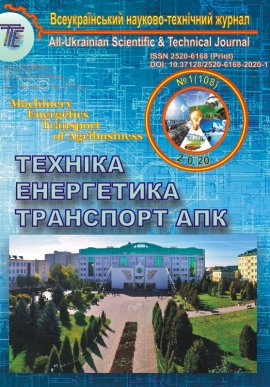
Issue №: 1(108)
В журналі вирішуються проблеми створення та удосконалення техніки та технологій для сільського господарства, харчових та переробних виробництв, машинобудування, енергетики та транспорту.
SUBSTANTIATION OF PARAMETERS FOR REDUCING THE TOXICITY OF EXHAUST GASES OF THE DIESEL ENGINE
Yuriy Paladiychuk – Candidate of Science (Engineering), Associate Professor of the Department of Agroengineering and Technical Service of Vinnitsa National Agrarian University (3 Soniachna St., Vinnitsa, 21008, Ukraine, e-mail: rewet@vsau.vin.ua).
Inna Telyatnuk – 4th year student of specialty 208 of Agroengineering, Faculty of Engineering and Technology of Vinnytsia National Agrarian University (3, Solnychna st., Vinnytsia, 21008, Ukraine, e-mail: inna201098@gmail.com) .
Annual emissions of more than 6 million tons of pollutants and carbon dioxide into Ukraine. Mostly polluting industrial enterprises. However, with the increase in the number of cars on the roads, the number of harmful emissions into the atmosphere has increased. Over the past few years, the amount of exhaust gas entering the air in major cities has increased by 50-70%. More than half of the pollutants are emitted by private cars: in 2019, 1.7 million tonnes of harmful substances fell on them, while the total amount of all car emissions was 2.3 million tonnes.
This article highlights the problem of environmental pollution by the exhaust gases of diesel internal combustion engines. Ways to improve environmental performance are presented. The composition of the exhaust gases and their effects on the environment are analyzed. The standards of Euro - 1 Euro - 6, on the reduction of harmful substances in diesel fuel are considered. The modern environmental standards of Stage and Tier and the regulation of smoke by standards are given. A formula for the determination of harmful substances in the exhaust gases of cars and a formula for the determination of the smoke of gases are proposed. The ways of neutralizing the toxicity of the exhaust gases with the help of neutralizers and the reduction of soot by means of the diesel particulate filter are considered. Common Rail DRNR systems, EGR and Selective Neutralization (SCR) systems using Adblu reagent, its advantages and disadvantages are described. The comparative characteristics of EGR and SCR systems are presented.
Gasoline engines are not considered in this article.
[1] Anisimov, V. F., Pryshlyak, V. M., Pyasetsky, A. A., Burlak, S. A. (2013). Experimental study of the exhaust gases of diesel engines. Collection of scientific works of Vinnytsia National Agrarian University. Avg. Engineering sciences. 12. Retrieved from: http://www.irbis-nbuv.gov.ua/pdf [in Ukrainian].
[2] Bilichenko, V. V., Melnyk, M. E., Vakarenko, S. V. (2012). Prospects for the development of gas-diesel engines. Bulletin of the Donetsk Academy of Road Transport. of sciences. 4. 42-48. [in Ukrainian]
[3] Exhaust Gas: Website. Retrieved from: https://en.wikipedia.org/ [in Ukrainian].
[4] EU standards for flue gas toxicity. Retrieved from: https://ppt-online.org/153845 [in Ukrainian].
[5] Beshun, O. A. Modern and promising environmental standards for forestry and agricultural mobile vehicle diesel engines and the technologies that enable them to be met. Scientific Bulletin: TDATU. 5(2). Retrieved from: http://nauka.tsatu.edu.ua/e-journals-tdatu/pdf2t5/12boatte.pdf [in Ukrainian].
[6] Standards and methods for measuring the exhaust fumes of cars with diesel or gas diesel engines. (2005). DSTU 4276: 2004 from 01th July 2005. Kyiv: Derzhstandart Ukraine [in Ukrainian].
[7] Redzuk, A. M. 2008, Checking the technical condition of wheeled vehicles. Norms of the international treaties of Ukraine and the law of the European Union. Kyiv [in Ukrainian].
[8] Study materials online. Ways to reduce flue gas toxicity. Retrieved from: https://pidruchniki.com/ [in Ukrainian].
[9] Study materials online. Ways to reduce road transport emissions. Retrieved from: https://pidruchniki.com/ [in Ukrainian].
[10] Soot filter (DPF). SCR System. Retrieved from: https://topik.ru/ [in Ukrainian].
[11] Euro environmental standards. Retrieved from: https://propozitsiya.com/ ekologichni-normi-ievro [in Ukrainian].
[12] What is a SCR system and what is it for. Retrieved from: https://m-standard.by/novosti/chto-takoe-scr-sistema-i-dlia-chego-ona-neobhodima [in Ukrainian].
About the journal
G8 – Materials Science
G9 – Applied Mechanics
G10 – Metallurgy
G11 – Mechanical Engineering (by specializations)
The journal "Engineering, Energy, Transport AIC" is indexed according to the following databases and catalogs:


The All-Ukrainian scientific journal “Technology, energy, agriculture transport AIC” is an open-access scientific publication that publishes the results of original research, theoretical and applied developments, as well as scientific papers in the fields of engineering sciences, energy systems, and transport technologies of the agro-industrial complex.
The main objective of the scientific journal “Technology, energy, agriculture transport AIC” is to disseminate the results of modern scientific research and to promote the development of technical, energy, and transport solutions for the agro-industrial complex through the publication of scientific materials characterized by scientific novelty and practical significance in the field of design and modernization of machinery, equipment, and technologies.
The journal’s activities are focused on supporting the development of engineering science, stimulating the implementation of innovative approaches into industrial practice, as well as ensuring effective exchange of scientific achievements among researchers, educators, engineers, and other specialists in relevant fields.
Objectives of the Journal
To achieve its defined objective, the journal ensures the implementation of the following key tasks:
· publication of the results of fundamental and applied research covering the fields of applied mechanics, mechanical engineering, materials science, energy systems, electrical engineering, electromechanics, and transport systems of the agro-industrial sector;
· promotion of the implementation of advanced technical and technological developments aimed at improving the efficiency of machinery, equipment, and production processes;
· creation of conditions for active scientific exchange among research institutions, higher education institutions, industrial enterprises, and other interested organizations;
· support for the development of interdisciplinary research and expansion of cooperation among specialists in various fields of science and technology;
· promotion of the improvement of the scientific and technical level of research related to the design, modernization, and operation of technical equipment used in agro-industrial production;
· dissemination of information on modern achievements in science and technology and the implementation of innovative technologies in the fields of technical support, energy, and transport;
· development of a scientific information environment that facilitates effective scientific communication and the integration of national research into the international scientific community.
Publication frequency: 4 issues per year
Languages of publication: Ukrainian, English
Editor-in-Chief: Vitalii YAROPUD
State Registration: Decision of the National Council of Ukraine on Television and Radio Broadcasting № 1337 and № 1180. Media Identifier: R30-05173
EDRPOU Code: 00497236
Publisher ROR: https://ror.org/05m3ysc06
Publisher DOI Prefix: 10.37128
Technology, energy, agriculture transport AIC is a scholarly professional journal with a long-standing history and stable academic tradition, reflecting the evolution of engineering and technical sciences within the agro-industrial sector of Ukraine.
The journal was founded in 1997 under the title Bulletin of Vinnytsia State Agricultural Institute. According to the Resolution of the Presidium of the Higher Attestation Commission of Ukraine dated September 11, 1997, the publication obtained the status of a professional scientific journal, which enabled the publication of the main results of doctoral and candidate dissertations in technical sciences. From its inception, the journal positioned itself as an academic platform for addressing current issues of mechanization, electrification, and technical support of agricultural production. During 2001–2014, the journal was published under the title Proceedings of Vinnytsia National Agrarian University. Series: Technical Sciences (State Registration Certificate of Print Media KV No. 16644-5116 PR dated April 30, 2010). Throughout this period, a systematic approach to the selection and peer review of scientific manuscripts was established, the thematic scope of publications was expanded, and continuity of scientific directions as well as the development of sectoral engineering schools was ensured. Since 2015, the journal has been published under its current title, Technology, energy, agriculture transport AIC (State Registration Certificate No. 21906-11806 R dated March 12, 2016). The change of title reflected the expansion of the journal’s thematic coverage and its orientation toward interdisciplinary research in mechanical engineering, energy systems, electrical engineering, transport technologies, automation, and digital solutions for the agro-industrial complex.
