

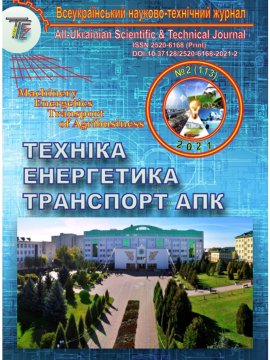
Issue №: 2(113)
The journal solves the problems of creation and improvement of machinery and technologies for agriculture: 131 - Applied Mechanics, 132 - Materials Science, 133 - Industrial Engineering, 141 - Power Engineering, Electrical Engineering and Electromechanics, 208 - Agricultural Engineering.
THE CHOICE OF FACTORS OF INFLUENCE ON VIBRO-CENTRIC SEPARATION OF LIQUID INHOMOGENEOUS RAW MATERSALS
Polievoda Yurii – PhD, Associate Professor of the Department of Technological processes and Equipment for Processing and Food Productions of the Vinnytsia National Agrarian University (3, Sonyachna st., Vinnytsia, Ukraine, 21008, e-mail: vinyura36@gmail.com, https://orcid.org/0000-0002-2485-0611 ).
Solomon Alla – PhD, Associate Professor of the Department of food technology and microbiology of the Vinnytsia National Agrarian University (3, Sonyachna st., Vinnytsia, Ukraine, 21008, e-mail: Soloalla78@ukr.net, https://orcid.org/0000-0003-2982-302X).
The development of modern equipment and technology leads to healthy competition, which in turn allows you to freely choose a machine or installation for the separation of liquid inhomogeneous systems. Each production when choosing equipment takes into account the relevant factors and its specifics.
Mathematical and statistical planning of a multifactorial experiment was used to refine the glycerin quality indicators and determine their weight.
The article constructs the response surfaces of the optimization criteria, which allow us to clearly illustrate the dependences of the values of the mass fraction of pure glycerin and energy consumption on individual optimization parameters. The research method includes the selection of optimal modes of operation of the vibrocentric machine for purification of liquid glycerol-containing raw materials according to technical and economic criteria for evaluation and determination of quality indicators of purified glycerol with variation of processing time, process temperature, etc. During the study, special attention was paid to the main operating parameters of this vibrating machine, namely: amplitude-frequency, power and energy.
The efficiency of the process of vibration-based purification of crude glycerol was evaluated on such parameters as vibration control, angular rate of flow, rate of temperature. The recommendations of the second basic parameters of the lateral period were determined in accordance with the second set of the second order.
Analyzing the results of studies of vibration-centrifugal separation of liquid inhomogeneous raw materials, it can be argued that the most influential factors in the separation of these products are the rotor speed, vibration shaft speed, oscillation amplitude, power, temperature and processing time.
[1] Kaletnik, G. M. (2010). Biofuel. Food, energy and ecological security of Ukraine: Monograph. K.: Hi-Tech Press. [in Ukrainian].
[2] Boyko, N. G., Ustimenko, T. A. (2009). Theory and methods of engineering experiment. Donetsk, DonNTU. [in Russian].
[3] Polievoda, Y. A. (2015). Prospects for the application of vibration effects in liquid technological systems of food and processing industries. Collection of scientific works of Vinnytsia National Agrarian University, series of technical sciences. [in Ukrainian].
[4] Yanovych, V., Polievoda, Y., Duda, D. (2019). Development of a vibrocentric machine for raw glycerin purification. University Politehnica of Bucharest. Scientific bulletin, Series D: Mechanical Engineering. [in English].
[5] Polievoda, Y. A. (2012). Substantiation of regime parameters of crude glycerin purification. Ukrainian interdepartmental scientific and technical collection. Automation of production processes in mechanical engineering and instrument making. Lviv Polytechnic National University. [in Ukrainian].
[6] Palamarchuk, I. P., Polievoda, Y. A., Yanovich, V. P. (2012). Experimental evaluation of crude glycerol purification process by qualitative characteristics. Scientific works of the National University of Food Technologies. [in Ukrainian].
[7] Rantala, S and Suoranta, R. (1991). Enhanced vibration monitoring using parametric modelling technique. In: Eighth IEEE instrumentation and measurement technology conference. [in English].
[8] She-Dong Ren, Yan-Wei Zhao,Jiong-Jiong Lou, Huan-Huan Hong, Hong-Wei Wang. (2016). Multifactor correlation analysis and modeling for product low-carbon design. Journal of Industrial and Production Engineering. [in English].
[9] Litvinova, M., Andrieieva, N., Zavodyannyi, V., Loi, S., Shtanko, O. (2019). Application of multiple correlation analysis method to modeling the physical properties of crystals (on the example of gallium arsenide). Eastern-European Journal of Enterprise Technologies. [in English].
[10] Lawley, D. N., Maxwell, A. E. (1973). Regression and Factor Analysis. Biometrika. Oxford University Press. [in English].
[11] Vadasz Peter, Havstad Mark. (1999). Research of centrifugal filtration of suspension. Trans. ASME. J. Fluids Eng. [in English].
[12] Polievoda, Y. A. (2013). Assessment of the adequacy of the mathematical model. Proceedings of the VII scientific and technical conference «Prospects for the development of agricultural machinery». Vinnytsia, VNAU. [in Ukrainian].
About the journal
G8 – Materials Science
G9 – Applied Mechanics
G10 – Metallurgy
G11 – Mechanical Engineering (by specializations)
The journal "Engineering, Energy, Transport AIC" is indexed according to the following databases and catalogs:


The All-Ukrainian scientific journal “Technology, energy, agriculture transport AIC” is an open-access scientific publication that publishes the results of original research, theoretical and applied developments, as well as scientific papers in the fields of engineering sciences, energy systems, and transport technologies of the agro-industrial complex.
The main objective of the scientific journal “Technology, energy, agriculture transport AIC” is to disseminate the results of modern scientific research and to promote the development of technical, energy, and transport solutions for the agro-industrial complex through the publication of scientific materials characterized by scientific novelty and practical significance in the field of design and modernization of machinery, equipment, and technologies.
The journal’s activities are focused on supporting the development of engineering science, stimulating the implementation of innovative approaches into industrial practice, as well as ensuring effective exchange of scientific achievements among researchers, educators, engineers, and other specialists in relevant fields.
Objectives of the Journal
To achieve its defined objective, the journal ensures the implementation of the following key tasks:
· publication of the results of fundamental and applied research covering the fields of applied mechanics, mechanical engineering, materials science, energy systems, electrical engineering, electromechanics, and transport systems of the agro-industrial sector;
· promotion of the implementation of advanced technical and technological developments aimed at improving the efficiency of machinery, equipment, and production processes;
· creation of conditions for active scientific exchange among research institutions, higher education institutions, industrial enterprises, and other interested organizations;
· support for the development of interdisciplinary research and expansion of cooperation among specialists in various fields of science and technology;
· promotion of the improvement of the scientific and technical level of research related to the design, modernization, and operation of technical equipment used in agro-industrial production;
· dissemination of information on modern achievements in science and technology and the implementation of innovative technologies in the fields of technical support, energy, and transport;
· development of a scientific information environment that facilitates effective scientific communication and the integration of national research into the international scientific community.
Publication frequency: 4 issues per year
Languages of publication: Ukrainian, English
Editor-in-Chief: Vitalii YAROPUD
State Registration: Decision of the National Council of Ukraine on Television and Radio Broadcasting № 1337 and № 1180. Media Identifier: R30-05173
EDRPOU Code: 00497236
Publisher ROR: https://ror.org/05m3ysc06
Publisher DOI prefix: 10.37128 ISSN (print): 2520-6168
The scientific journal is included in Category “B” of the List of Scientific Professional Publications of Ukraine in which the results of dissertation research for obtaining the degrees of Doctor and Candidate of Sciences may be published in the following specialties: G8 – Materials Science; G9 – Applied Mechanics; G10 – Metallurgy; G11 – Mechanical Engineering (by specializations). (Order of the Ministry of Education and Science of Ukraine dated June 11, 2026 №928
Technology, energy, agriculture transport AIC is a scholarly professional journal with a long-standing history and stable academic tradition, reflecting the evolution of engineering and technical sciences within the agro-industrial sector of Ukraine.
The journal was founded in 1997 under the title Bulletin of Vinnytsia State Agricultural Institute. According to the Resolution of the Presidium of the Higher Attestation Commission of Ukraine dated September 11, 1997, the publication obtained the status of a professional scientific journal, which enabled the publication of the main results of doctoral and candidate dissertations in technical sciences. From its inception, the journal positioned itself as an academic platform for addressing current issues of mechanization, electrification, and technical support of agricultural production. During 2001–2014, the journal was published under the title Proceedings of Vinnytsia National Agrarian University. Series: Technical Sciences (State Registration Certificate of Print Media KV No. 16644-5116 PR dated April 30, 2010). Throughout this period, a systematic approach to the selection and peer review of scientific manuscripts was established, the thematic scope of publications was expanded, and continuity of scientific directions as well as the development of sectoral engineering schools was ensured. Since 2015, the journal has been published under its current title, Technology, energy, agriculture transport AIC (State Registration Certificate No. 21906-11806 R dated March 12, 2016). The change of title reflected the expansion of the journal’s thematic coverage and its orientation toward interdisciplinary research in mechanical engineering, energy systems, electrical engineering, transport technologies, automation, and digital solutions for the agro-industrial complex.
