

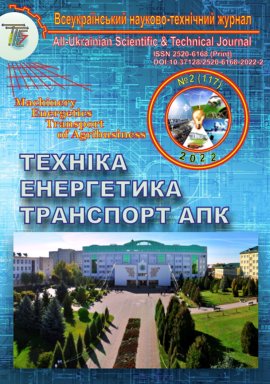
Issue №: 2(117)
The journal solves the problems of creation and improvement of machinery and technologies for agriculture: 131 - Applied Mechanics, 132 - Materials Science, 133 - Industrial Engineering, 141 - Power Engineering, Electrical Engineering and Electromechanics, 208 - Agricultural Engineering.
THE EFFICIENCY OF USING AGRAS DRONES FOR SPRAYING, THEIR DESIGN, TECHNICAL AND TECHNOLOGICAL FEATURES
Oleksandr Kholodyuk – Ph.D, Senior Lecturer of the Department of "Operation of a machine-tractor park and technical service" of Vinnytsia National Agrarian University (3, Sonychna St., Vinnytsia, 21008, Ukraine, e-mail: holodyk@vsau.vin. ua, ORCID iD 0000-0002-4161-6712).
Oleksii Tokarchuk – Ph.D., Associate Professor of the Department of “Technological Processes and Equipment of Processing and Food Productions” of the Vinnytsia National Agrarian University (3, Solnyshchaya St., Vinnytsia, 21008, Ukraine, e-mail: tokarchuk@vsau.vin.ua https://orcid.org/0000-0001-8036-1743).
Agrotechnical operations on spraying crops from diseases and pests are an important part of almost any agricultural technology. They make up a significant part of the cost of all agricultural technology and, as a result, the cost of the final product. The use of unmanned aerial vehicles (UAVs) has a huge potential in agriculture and every year the interest in their use grows primarily in the implementation of the tasks of precision farming.
The object of research in this article is the process of spraying work areas with Agras unmanned aerial vehicles.
The aim of the study is to study the effectiveness of DJI's Agras drones in spraying cultivated plants with pesticides, diseases, weeds and to establish their design and operating features.
The objectives of the work are to establish the design and mode features of unmanned aerial vehicles Agras T16, T20 and T30; to find out their productivity on spraying of cultural sites and to substantiate possible reserves in increase of productivity of drones-sprayers.
The research methodology is based on the method of cognitive activity, mathematical modeling, methods of analysis and synthesis of both information from official sources and information from the works of other researchers.
The scientific work considers the excellent technical and operational features of hexacopters Agras T16, T20 and T30. The performed analysis allows us to assert the dynamics in improving the efficiency of their use. The practical aspects of their use in spraying with plant protection products, the choice of the required mode of exploitation are substantiated.
It is noted that the performance of sprayers depends on the diameter of the swing of the rotors, which create a downward flow of air, the number of rotors and the height above the crop surface. Their maximum permissible speed is limited by the performance of the installed pumps, the capacity of the nozzles to ensure a given rate of discharge of the working drug, by properties of substances of the tank mixture, etc.
The calculation of operational productivity Sparaying Drones Agras T16, T20 and T30 at the length of the runs of sections 750 and 1000 m is given. Productivity of Sparaying Drones Agras T16, T20 and T30 at a run length of 1000 m is obtained, respectively, 7.65; 8.29 and 10.5 ha/h. With the reduction of the run length to 750 m, the productivity of all Sparaying Drones Agras T16, T20 and T30 increases, respectively 8.40; 9.10 and 11.06 ha/h. Analyzing the balance of time of change of Agras drones in percentage it was found, that about 25 % is due to downtime of unregulated time, which is caused by technical malfunctions, organizational problems and weather conditions.
The most important reserves in increasing the productivity of DJI's Agras drones for spraying cultivated plants with pesticides, diseases and weeds have been noted.
[1] Starynets, O.H. (2019). Vykorystannya droniv u diyalʹnosti pidpryyemstv ahrarnoyi sfery. Ekonomika ta upravlinnya pidpryyemstvamy, 43, 116–119 [in Ukrainian].
[2] Sukha, I.A. (2021). Zastosuvannya bezpilotnykh litalʹnykh aparativ yak napryamok innovatsiynoho zabezpechennya pidpryyemnytsʹkoyi diyalʹnosti, Problemy ta perspektyvy rozvytku biznesu v Ukrayini : materialy Mizhnarodnoyi nauk.-prakt. konf. molodykh vchenykh i studentiv (m. Lʹviv, 19 lyutoho 2021 r.) : tezy dopovidey. Lʹviv : Lʹvivsʹkyy torhovelʹno-ekonomichnyy universytet, 231–234 [in Ukrainian].
[3] Yun, H.M., Medynsʹkyy, D.V. (2017). Zastosuvannya bezpilotnykh litalʹnykh aparativ u silʹsʹkomu hospodarstvi. Naukoyemni tekhnolohiyi, 4(36), 335–341 [in Ukrainian].
[4] SmartField 2.0: Dron XAG P30: preymushchestvo v detalyakh. Rezhym dostupu: https://latifundist.com/photo/1262-smart-field-20-dron-xag-p30-kogda-nuzhen-ne-prosto-horoshij-opryskivatel (data zvernennya 25.03.2022) [in Ukrainian].
[5] Bezpilotnyky na ukrayinsʹkykh polyakh. Ohlyad ahrodroniv ukrayinsʹkoho vyrobnytstva [Elektronnyy resurs]. Rezhym dostupu: https://traktorist.ua/articles/bezpilotniki-na-ukrayinskih-polyah.-oglyad-agrodroniv-ukrayinskogo-virobnictva (data zvernennya 25.03.2022).
[6] QUADRO.ua (2021). Innovatsiynyy shlyakh DJI dlya tsyfrovoyi transformatsiyi ahrarnoho biznesu. Ahroelita, 8(103), 54–55 [in Ukrainian].
[7] Kholodyuk, O.V. (2021). Praktychni aspekty vykorystannya bezpilotnoho litalʹnoho aparata Agras T16. Tekhnika, enerhetyka, transport APK, 2(113), 152–167 [in Ukrainian].
[8] Prydbaly dron i mulʹtyspektralʹnu kameru – shcho z tsym robyty? [Elektronnyy resurs]. Rezhym dostupu: https://agroportal.ua/publishing/lichnyi-vzglyad/priobreli-dron-i-multispektralnuyu-kameru-chto-s-etim-delat (data zvernennya 07.04.2022) [in Ukrainian].
[9] Pasichnyk, N.A. (2020). Metodyka prohnozuvannya obsyahiv vrozhayu na osnovi danykh dystantsiynoho zonduvannya vysokoyi prostorovoyi rozpodilʹchoyi zdatnosti na prykladi pshenytsi. Zbalansovane pryrodokorystuvannya, 2, 129–134 [in Ukrainian].
[10] Pasichnyk, N.A., Opryshko, O.O., Tatariko, O.H. (2021). Dystantsiyne zonduvannya ahrofitotsenoziv iz platformy BPLA dlya otsinky rivnya zhyvlennya Roslyn. Ahroekolohichnyy zhurnal, 4. 75–81.
[11] Ohiychuk, V. (2019). Obpryskuvannya z drone. The Ukrainian Farmer, 5. 26–28 [in Ukrainian].
[12] Dovbush, T.A., Hevko, R.B., Khomyk, N.I. (2019). Sposib aviatsiynoyi khimichnoyi obrobky roslyn z vykorystannyam droniv-obpryskuvachiv. Materialy V-oyi Mizhnarodnoyi naukovo-praktychnoyi konferentsiyi «Suchasni tekhnolohiyi promyslovoho kompleksu – 2019», Kherson : KHNTU, 5. 40-41[in Ukrainian].
[13] Sukhyna, A. (2020).Vnesennya pestytsydiv dronamy. Propozytsiya. 10(301). 100–105.
[14] Lyubchenko, S.YE. (2021). Bezpilotni litalʹni aparaty v aviatsiynykh tekhnolohiyakh zakhystu roslyn. Ahroelita, 4(99), 38–39 [in Ukrainian].
[15] Byelyayeva, O.V., Zadorozhna, O.V. (2016). Vykorystannya bezpilotnykh litalʹnykh aparativ yak shlyakh pidvyshchennya vrozhaynosti silʹsʹkohospodarsʹkykh kulʹtur. Systemy upravlinnya, navihatsiyi ta zvʺyazku, 1(37), 20–22 [in Ukrainian].
[16] Horobetsʹ, N.M., Drevalʹ, YU.M. (2021). Osoblyvosti vykorystannya droniv v systemi stratehichnoho upravlinnya ahrarnymy pidpryyemstvamy. International scientific conference “Development of modern economic science in the context of digitalization” : conference proceedings, December 3–4, 2021. Riga, the Republic of Latvia : “Baltija Publishing”. 86–89 [in Ukrainian].
[17] Mogili, UM Rao, Deepak, BB VL (2018). Review on Application of Drone Systems in Precision Agriculture. International Conference on Robotics and Smart Manufacturing. 502–509 [in English].
[18] Klochko A. Matematyka obpryskuvannya ahrodronamy. URL: https://kurkul.com/spetsproekty/1173-matematika-obpriskuvannya-agrodronami--vse-pro-vartist-ta-rentabelnist-vikoristannya (data zvernennya 11.04.2022) [in Ukrainian].
[19] Ponomarenko, I.O., Tarasov, V.A., Ihnatchenko, A.S., Khymchenko, YU.V., Kovalʹov, B.L. (2021). Ekonomichna efektyvnistʹ vykorystannya droniv u silʹsʹkomu hospodarstvi. Visnyk SumDU. Seriya «Ekonomika», 4. 235–240 [in Ukrainian].
[20] User Manual Agras T16. URL:: http://dl.djicdn.com/downloads/t16/20191009/Agras_T16_User_Manual_v1.0_EN.pdf (data zvernennya 05.05.2022) [in English].
[21] User Manual Agras T20. URL: https://dl.djicdn.com/downloads/t20/20201201/Agras_T20_User_Manual_v1.4_EN.pdf (data zvernennya 05.05.2022) [in English].
[22] User Manual Agras T30. URL: https://dl.djicdn.com/downloads/t30/20210727/T30_User_Manual_v1.4_EN.pdf (data zvernennya 05.05.2022) [in English].
[23] Lastivka, M.M. (2019). Ekspluatatsiya mashyn i obladnannya: Navchalʹnyy posibnyk. Ladyzhyn. Ladyzhyn. [in Ukrainian].
About the journal
G8 – Materials Science
G9 – Applied Mechanics
G10 – Metallurgy
G11 – Mechanical Engineering (by specializations)
The journal "Engineering, Energy, Transport AIC" is indexed according to the following databases and catalogs:


The All-Ukrainian scientific journal “Technology, energy, agriculture transport AIC” is an open-access scientific publication that publishes the results of original research, theoretical and applied developments, as well as scientific papers in the fields of engineering sciences, energy systems, and transport technologies of the agro-industrial complex.
The main objective of the scientific journal “Technology, energy, agriculture transport AIC” is to disseminate the results of modern scientific research and to promote the development of technical, energy, and transport solutions for the agro-industrial complex through the publication of scientific materials characterized by scientific novelty and practical significance in the field of design and modernization of machinery, equipment, and technologies.
The journal’s activities are focused on supporting the development of engineering science, stimulating the implementation of innovative approaches into industrial practice, as well as ensuring effective exchange of scientific achievements among researchers, educators, engineers, and other specialists in relevant fields.
Objectives of the Journal
To achieve its defined objective, the journal ensures the implementation of the following key tasks:
· publication of the results of fundamental and applied research covering the fields of applied mechanics, mechanical engineering, materials science, energy systems, electrical engineering, electromechanics, and transport systems of the agro-industrial sector;
· promotion of the implementation of advanced technical and technological developments aimed at improving the efficiency of machinery, equipment, and production processes;
· creation of conditions for active scientific exchange among research institutions, higher education institutions, industrial enterprises, and other interested organizations;
· support for the development of interdisciplinary research and expansion of cooperation among specialists in various fields of science and technology;
· promotion of the improvement of the scientific and technical level of research related to the design, modernization, and operation of technical equipment used in agro-industrial production;
· dissemination of information on modern achievements in science and technology and the implementation of innovative technologies in the fields of technical support, energy, and transport;
· development of a scientific information environment that facilitates effective scientific communication and the integration of national research into the international scientific community.
Publication frequency: 4 issues per year
Languages of publication: Ukrainian, English
Editor-in-Chief: Vitalii YAROPUD
State Registration: Decision of the National Council of Ukraine on Television and Radio Broadcasting № 1337 and № 1180. Media Identifier: R30-05173
EDRPOU Code: 00497236
Publisher ROR: https://ror.org/05m3ysc06
Publisher DOI prefix: 10.37128 ISSN (print): 2520-6168
The scientific journal is included in Category “B” of the List of Scientific Professional Publications of Ukraine in which the results of dissertation research for obtaining the degrees of Doctor and Candidate of Sciences may be published in the following specialties: G8 – Materials Science; G9 – Applied Mechanics; G10 – Metallurgy; G11 – Mechanical Engineering (by specializations). (Order of the Ministry of Education and Science of Ukraine dated June 11, 2026 №928
Technology, energy, agriculture transport AIC is a scholarly professional journal with a long-standing history and stable academic tradition, reflecting the evolution of engineering and technical sciences within the agro-industrial sector of Ukraine.
The journal was founded in 1997 under the title Bulletin of Vinnytsia State Agricultural Institute. According to the Resolution of the Presidium of the Higher Attestation Commission of Ukraine dated September 11, 1997, the publication obtained the status of a professional scientific journal, which enabled the publication of the main results of doctoral and candidate dissertations in technical sciences. From its inception, the journal positioned itself as an academic platform for addressing current issues of mechanization, electrification, and technical support of agricultural production. During 2001–2014, the journal was published under the title Proceedings of Vinnytsia National Agrarian University. Series: Technical Sciences (State Registration Certificate of Print Media KV No. 16644-5116 PR dated April 30, 2010). Throughout this period, a systematic approach to the selection and peer review of scientific manuscripts was established, the thematic scope of publications was expanded, and continuity of scientific directions as well as the development of sectoral engineering schools was ensured. Since 2015, the journal has been published under its current title, Technology, energy, agriculture transport AIC (State Registration Certificate No. 21906-11806 R dated March 12, 2016). The change of title reflected the expansion of the journal’s thematic coverage and its orientation toward interdisciplinary research in mechanical engineering, energy systems, electrical engineering, transport technologies, automation, and digital solutions for the agro-industrial complex.
