

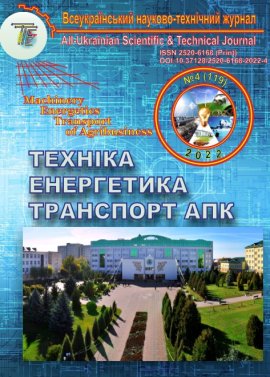
Issue №: 4(119)
The journal solves the problems of creation and improvement of machinery and technologies for agriculture: 131 - Applied Mechanics, 132 - Materials Science, 133 - Industrial Engineering, 141 - Power Engineering, Electrical Engineering and Electromechanics, 208 - Agricultural Engineering.
THE INFLUENCE OF TECHNOLOGICAL FACTORS ON THE ENERGY CONSUMPTION OF WORK OF THE CUT MASS ACCELERATOR
Volodymyr Kuzmenko – candidate of technical sciences, senior researcher, head of the laboratory "Mechanical-technological problems of fodder harvesting" of the Institute of Mechanics and Automation of Agricultural Production of the National Academy of Sciences of Ukraine (Vokzalna St., 11/1, Glevakh village, Vasylkiv district, Kyiv region , 08631, Ukraine, e-mail: vfkuzmenko@ukr.net, https://orcid.org/0000-0002-3474-939X)
Viktor Maksimenko – candidate of technical sciences, senior researcher at the Institute of Mechanics and Automation of Agro-industrial Production of the National Academy of Sciences of Ukraine (11/1 Vokzalna St., Glevakh village, Vasylkivsky District, Kyiv Oblast, 08631, Ukraine, e-mail:
v.v.max@ukr.net, https://orcid.org/0000-0002-0058-542X)
Oleksandr Kholodiuk – Ph.D., Associate Professor of the Department of "Operation of a machine-tractor park and technical service" of Vinnytsia National Agrarian University (3, Sonychna St., Vinnytsia, 21008, Ukraine, e-mail: holodyk@vsau.vin.ua, https://orcid.org/0000-0002-4161-6712).
Forage harvesters in modern design are powerful machines that ensure the harvesting of fodder according to agrotechnical requirements. The unloading channel in forage harvesters is made in such a way that the cut mass enters the vehicle for further transportation in the shortest time possible.
The accelerator in the unloading channel of the combine provides convenience in operation, allowing to load of cut mass into the vehicle at a distance of more than 10 m not only to the vehicles moving next to the combine but also behind it when mowing the swaths. The main function of the cut mass accelerator is to provide acceleration and formation of compactness of the flow of the cut mass after it passes through the grinding rollers.
Currently, the influence of the structural and technological parameters of the cut mass accelerator on the process of its unloading through the channel of the forage harvester has not been sufficiently investigated, therefore, for example, the substantiation of the technological parameters of the operation mode of the cut mass accelerator of the discharge channel of the forage harvester is relevant.
The object of the research is the process of transporting the cut stem mass by the combine accelerator through the unloading channel.
The purpose of the research is to experimentally establish the influence of technological factors in the process of transporting the cut mass of the harvester with an accelerator on the consumption of specific energy and the creation of effort on the shield catcher.
The objectives of the work are to study the state of the issue of the accelerators use of cut stem mass in the unloading channel of forage harvesters and their structural implementation; to carry out an analysis of research and publications on the acceleration of cut stem mass; to develop a method of experimental research and establish the influence of technological factors of the process of transportation of the cut stalk mass of the harvester with an accelerator on the consumption of specific energy and the creation of effort on the shield catcher.
The research methodology is experimental by determining the consumption of the specific energy of the accelerator, the effort created on the catcher shield, and the supply of the cut stem mass. Processing of experimental data is performed using methods of regression analysis and mathematical statistics.
As a result of the conducted experimental studies, it is established that the most significant of the studied technological factors (W, Lср, q) is the supply of cut stem mass. An increase in the supply of crushed stalk mass of corn from 6 to 13 kg/s leads to both an increase in effort from 15 to 140 N (almost ten times) and an increase in specific energy consumption from 0.12 to 0.18 kJ/kg. An increase in the moisture content of the stem mass of corn from 54 to 76% leads to a decrease in the effort on the catcher shield and the specific energy consumption. The minimum values of the specific energy consumption of the accelerator in the range of 0.103-0.105 kJ/kg are reached with a weighted average stem mass of 14-18 mm. The influence of technological factors on the process of transporting the cut stem mass by the accelerator of the harvester through the discharge channel is parabolic in nature.
The use of the cut stem mass accelerator leads to an increase in the effort on the catcher shield, which is an order of magnitude higher than without it, and a significant increase is observed at a supply over 6.5 kg/s.
[1] Yasenetsʹkyy, V.A., Honcharenko, P.V. (1990). Mashyny dlya zmyvannya kormiv. K.: Tekhnika. [in Ukrainian].
[2] Kuzʹmenko, V.F., Maksimenko, V.V., Yampolʹsʹkyy, S.M. (2012). Osnovni parametry pryskoryuvachiv kormozbyralʹnykh kombayniv. Mekhanizatsiya ta elektryfikatsiya silʹsʹkoho hospodarstva: mizhvidomch. temat. nauk. Zb, 96. 328–334. [in Ukrainian].
[3] Zayika, P.M. (2003). Teoriya silʹsʹkohospodarsʹkykh mashyn. Tom. 2 (ch. 1). Mashyny dlya zahotivli kormiv. KH.: Oko. [in Ukrainian].
[4] Vasylenko, P.M. (1996). Vvedenye v zemledelʹcheskuyu mekhanyku. K.: Silʹhosposvita. [in Ukrainian].
[5] Bulhakov, V.M. (2011). Buryakozbyralʹni mashyny. monohrafiya. K.: Ahrarna nauka. [in Ukrainian].
[6] Kuzʹmenko, V.F., Maksimenko, V.V., Yampolʹsʹkyy, S.M. (2010). Analiz skhem suchasnykh kormozbyralʹnykh kombayniv ta osoblyvosti yikh konstruktsiy. Mekhanizatsiya ta elektryfikatsiya silʹsʹkoho hospodarstva, 94. 279–287. [in Ukrainian].
[7] Pariychuk, D., Shcherbitsʹkyy, A. (2021). Poshuk optymalʹnykh konstruktsiy dopodribnyuyuchykh prystroyiv kormozbyralʹnykh kombayniv. Pryrodnychi ta humanitarni nauky. Aktualʹni pytannya. (pp. 48–49). Ternopilʹ. [in Ukrainian].
[8] Dulket, E. (1989). Wptyw rodzaju krawedzi tnacej noza aktywnego urzadzenia tnacego przyczrpy zbierajacej na zuzycie energii w procesie ciecia. Rocz. nauk. rolʹ, (2). 151–160. [in Polish].
[9] Osʹmak, V.YA., Kachan, I.V. (2003). Klasyfikatsiya ta prohnoz rozvytku konstruktsiy kormozbyralʹnykh kombayniv. Zb. nauk. pratsʹ Ukr NDIPVT. Doslidnytsʹke, 6 (20), 2. 250–254. [in Ukrainian].
[10] Kuzʹmenko, V.F., Maksimenko, V.V., Yampolʹsʹkyy, S.M. (2015). Metodyka provedennya eksperymentalʹnykh doslidzhenʹ pryskoryuvacha potoku rizanoyi masy. Tekhniko-tekhnolohichni aspekty rozvytku ta vyprobuvannya novoyi tekhniky i tekhnolohiy dlya silʹsʹkoho hospodarstva Ukrayiny : zb. nauk. pr. UkrNDIPVT im. L. Pohoriloho. Doslidnytsʹke, 19(33), 2. 426–436. [in Ukrainian].
[11] DSTU 4877:2007. (2007). Kormy podribneni steblovi. Pokaznyky fraktsiynoho skladu ta metody vyznachennya. [Chynnyy vid 2007-11-21]. Vyd. ofits. Kyyiv. (Informatsiya ta dokumentatsiya). [in Ukrainian].
[12] DSTU ISO 6498:2006. (2006). Kormy dlya tvaryn. Hotuvannya prob dlya doslidzhennya. [Chynnyy vid 2007-04-06]. Vyd. ofits. Kyyiv. (Informatsiya ta dokumentatsiya). [in Ukrainian].
[13] DSTU ISO 8909-3:2006. (2006). Kombayny kormozbyralʹni. Chastyna 3. Metody vyprobuvannya. (ISO 8909-3:1994, IDT). [Chynnyy vid 2007-08-003]. Vyd. ofits. Kyyiv. (Informatsiya ta dokumentatsiya). [in Ukrainian].
[14] DSTU ISO 6496:2005. (2005). Kormy dlya tvaryn. Vyznachennya vmistu volohy ta inshykh letkykh rechovyn. [Chynnyy vid 2007-03-21]. Vyd. ofits. Kyyiv. (Informatsiya ta dokumentatsiya). [in Ukrainian].
[15] Haluzevyy standart Ukrayiny. HSTU 46.032-2003. (2003). Mashyny dlya zbyrannya trav ta sylosnykh kulʹtur z podribnennyam dlya pryhotuvannya volohykh ta sukhykh kormiv. Metody funktsionalʹnykh vyprobuvanʹ: K. [in Ukrainian].
[16] Mokin, B.I., Mokin, O.B. (2015). Metodyka ta orhanizatsiya naukovykh doslidzhenʹ: Navchalʹnyy posibnyk. Vinnytsya: VNTU. [in Ukrainian].
[17] Bondar', A. G., Statyukha, G.A., Potyazhenko, I.A. (1980). Planirovaniye eksperimenta pri optimizatsii protsessov khimicheskoy tekhnologii (algoritmy i primery): Ucheb. posobiye. K: Vishcha shkola. [in Ukrainian].
About the journal
G8 – Materials Science
G9 – Applied Mechanics
G10 – Metallurgy
G11 – Mechanical Engineering (by specializations)
The journal "Engineering, Energy, Transport AIC" is indexed according to the following databases and catalogs:


The All-Ukrainian scientific journal “Technology, energy, agriculture transport AIC” is an open-access scientific publication that publishes the results of original research, theoretical and applied developments, as well as scientific papers in the fields of engineering sciences, energy systems, and transport technologies of the agro-industrial complex.
The main objective of the scientific journal “Technology, energy, agriculture transport AIC” is to disseminate the results of modern scientific research and to promote the development of technical, energy, and transport solutions for the agro-industrial complex through the publication of scientific materials characterized by scientific novelty and practical significance in the field of design and modernization of machinery, equipment, and technologies.
The journal’s activities are focused on supporting the development of engineering science, stimulating the implementation of innovative approaches into industrial practice, as well as ensuring effective exchange of scientific achievements among researchers, educators, engineers, and other specialists in relevant fields.
Objectives of the Journal
To achieve its defined objective, the journal ensures the implementation of the following key tasks:
· publication of the results of fundamental and applied research covering the fields of applied mechanics, mechanical engineering, materials science, energy systems, electrical engineering, electromechanics, and transport systems of the agro-industrial sector;
· promotion of the implementation of advanced technical and technological developments aimed at improving the efficiency of machinery, equipment, and production processes;
· creation of conditions for active scientific exchange among research institutions, higher education institutions, industrial enterprises, and other interested organizations;
· support for the development of interdisciplinary research and expansion of cooperation among specialists in various fields of science and technology;
· promotion of the improvement of the scientific and technical level of research related to the design, modernization, and operation of technical equipment used in agro-industrial production;
· dissemination of information on modern achievements in science and technology and the implementation of innovative technologies in the fields of technical support, energy, and transport;
· development of a scientific information environment that facilitates effective scientific communication and the integration of national research into the international scientific community.
Publication frequency: 4 issues per year
Languages of publication: Ukrainian, English
Editor-in-Chief: Vitalii YAROPUD
State Registration: Decision of the National Council of Ukraine on Television and Radio Broadcasting № 1337 and № 1180. Media Identifier: R30-05173
EDRPOU Code: 00497236
Publisher ROR: https://ror.org/05m3ysc06
Publisher DOI Prefix: 10.37128
Technology, energy, agriculture transport AIC is a scholarly professional journal with a long-standing history and stable academic tradition, reflecting the evolution of engineering and technical sciences within the agro-industrial sector of Ukraine.
The journal was founded in 1997 under the title Bulletin of Vinnytsia State Agricultural Institute. According to the Resolution of the Presidium of the Higher Attestation Commission of Ukraine dated September 11, 1997, the publication obtained the status of a professional scientific journal, which enabled the publication of the main results of doctoral and candidate dissertations in technical sciences. From its inception, the journal positioned itself as an academic platform for addressing current issues of mechanization, electrification, and technical support of agricultural production. During 2001–2014, the journal was published under the title Proceedings of Vinnytsia National Agrarian University. Series: Technical Sciences (State Registration Certificate of Print Media KV No. 16644-5116 PR dated April 30, 2010). Throughout this period, a systematic approach to the selection and peer review of scientific manuscripts was established, the thematic scope of publications was expanded, and continuity of scientific directions as well as the development of sectoral engineering schools was ensured. Since 2015, the journal has been published under its current title, Technology, energy, agriculture transport AIC (State Registration Certificate No. 21906-11806 R dated March 12, 2016). The change of title reflected the expansion of the journal’s thematic coverage and its orientation toward interdisciplinary research in mechanical engineering, energy systems, electrical engineering, transport technologies, automation, and digital solutions for the agro-industrial complex.
