

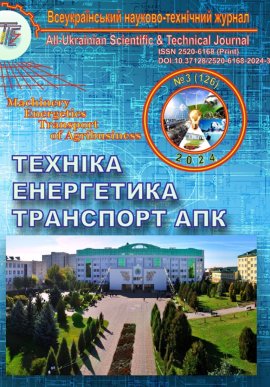
Issue №: 3 (126)
The journal solves the problems of creation and improvement of machinery and technologies for agriculture: 131 - Applied Mechanics, 132 - Materials Science, 133 - Industrial Engineering, 141 - Power Engineering, Electrical Engineering and Electromechanics, 208 - Agricultural Engineering.
THE INFLUENCE OF THE TYPE OF TRACTIONAL COUPLING DEVICE ON THE REDISTRIBUTION OF BRAKING TORQUES WHEN THE OPERATIONAL AND DESIGN FACTORS OF THE TRAILER CHANGE
Ivan KOLESNIK - Candidate of Technical Sciences, Associate Professor of the Department of Tractors and Automobiles of the National University of Life and Environmental Sciences of Ukraine (15 Heroiv Oborony St., Kyiv, 03041, Ukraine, e-mail: ivankolesnik@nubip.edu.ua, https: //orcid.org/0000-0003-4192-1773).
Yevhen KALININ - Doctor of Technical Sciences, Professor, Head of the Department of Tractors and Automobiles of the National University of Life and Environmental Sciences of Ukraine (15 Heroiv Oborony St., Kyiv, 03041, Ukraine, e-mail: kalinin@nubip.edu.ua, https: //orcid.org/0000-0001-6191-8446).
Yuliana KOLESNIK - Recipient of the Third Educational and Scientific Level of the Department of Tractors and Automobiles of the State Biotechnology University (44 Alchevskikh St., Kharkiv, 61002, Ukraine, e-mail: julianakolesnik26@gmail.com, https://orcid.org/0000-0002-9915- 2455).
A modern tractor is a complex mechanical system consisting of a large number of elements united into one whole by various types of connections. The relevance of this work lies in the fact that the tire-vehicle-driver system acts as an oscillating system when the tractor train moves on different road surfaces and off-road. At the same time, it must be taken into account that the entire variety of disturbing influences is taken into account by the "double" (dynamic and kinematic) and "two-frequency" nature of excitation. Both are mainly related to the unevenness of the road surface and the imbalance of the rotating and gradually moving masses.
It must be said that almost all research on vibration protection of a person and a transport unit was reduced to the study of high-frequency vibrations. However, along with high-frequency oscillations, low-frequency oscillations have a significant impact on the human operator and the transport unit.
The study of any oscillating system includes two stages:
1. Study of disturbing influences.
2. Study of vibration dampers.
The study of disturbing influences is mainly reduced to the study of the interaction of the micro-profile of the road and the drivers of the transport unit, to the mathematical description of the road profile and, at the same time, the mathematical description of the laws of change in the relative movement of the driver. It should be noted that the impact on the studied indicators of the road body and the laws of motion is given by the speed of movement, since the frequency and amplitude properties of the influences change. The state of the road, in turn, affects the traction forces, the nature of the interaction between the road surface and the driver in terms of power.
Thus, taking into account the peculiarities of the study of the road-tyre-vehicle-driver oscillatory system, in order to determine the influence of the traffic parameters of the transport-technological train and the characteristics of the road background on the performance indicators of the transport-technological train in general and the operator in particular, it is necessary to draw up a system of differential equations that describes the movement of the transport-technological train taking into account the type of traction-towing device used.
1. Altomonte, A., Frasci, E., Di Ilio, G., Arsie, I., & Jannelli, E. (2023). Experimental testing of a heavy-duty Diesel engine at the dynamic test bench to assess the potential of regenerative braking. У 2023 IEEE International Workshop on Metrology for Automotive (MetroAutomotive). IEEE. DOI: https://doi.org/10.1109/metroautomotive57488.2023.10219129 [in English].
2. Rakha, H., Yue, H., & Dion, F. (2011). VT-Meso model framework for estimating hot-stabilized light-duty vehicle fuel consumption and emission rates. Canadian Journal of Civil Engineering, 38(11), 1274–1286. DOI: https://doi.org/10.1139/l11-086 [in English].
3. Tucki, K. (2021). A Computer Tool for Modelling CO2 Emissions in Driving Tests for Vehicles with Diesel Engines. Energies, 14(2), 266. DOI: https://doi.org/10.3390/en14020266 [in English].
4. Felez J., Lopez-Mendez A. (2021). Advanced steering stability controls for articulated vehicles by using bond graphs and model predictive control. Simulation Series 53, №3. International Conference on Bond Graph Modeling and Simulation, ICBGM 2021. San Diego, 10 November 2021. Р. 98 – 110 [in English].
5. Borawski, A. (2020). EFFECTS OF INITIAL SPEED AND LOAD OF UNIVERSAL SEMITRAILER ON BRAKING SYSTEMS FRICTION PAIR HEATING. Heat Transfer Research, 51(15), 1417–1428. DOI: https://doi.org/10.1615/heattransres.2020035553 [in English].
6. Samorodov, V., Kozhushko, A., & Pelipenko, E. (2016). Formation of a rational change in controlling continuously variable transmission at the stages of a tractor’s acceleration and braking. Eastern-European Journal of Enterprise Technologies, 4(7(82)), 37. https://doi.org/10.15587/1729-4061.2016.75402 [in English].
7. Xu, S., Zhang, X., Jiao, Y., Wei, L., He, J., & Zeng, X. (2024). Research on the Multi-Mode Composite Braking Control Strategy of Electric Wheel-Drive Multi-Axle Heavy-Duty Vehicles. World Electric Vehicle Journal, 15(3), 83. DOI: https://doi.org/10.3390/wevj15030083\ [in English].
8. Ovsyannikov, S., Kalinin, E., & Koliesnik, I. (2019). Oscillation Process of Multi-support Machines When Driving Over Irregularities. У Advances in Intelligent Systems and Computing (с. 307–317). Springer International Publishing. DOI: https://doi.org/10.1007/978-3-030-19756-8_28 [in English].
9. Yan, Y., Chen, X., Wang, W., Hang, P., Chen, H., & Liu, J. (2022). Research on braking dynamics of multi-axle vehicle. Journal of Physics: Conference Series, 2246(1), 012019. DOI: https://doi.org/10.1088/1742-6596/2246/1/012019 [in English].
10. Wu, X., He, R., Ge, H., & Chen, M. (2024). Electronic mechanical braking system executive mechanism design, calculation, and modeling based on dynamic control. Frontiers in Mechanical Engineering, 10. DOI: https://doi.org/10.3389/fmech.2024.1368683 [in English].
About the journal
G8 – Materials Science
G9 – Applied Mechanics
G10 – Metallurgy
G11 – Mechanical Engineering (by specializations)
The journal "Engineering, Energy, Transport AIC" is indexed according to the following databases and catalogs:


The All-Ukrainian scientific journal “Technology, energy, agriculture transport AIC” is an open-access scientific publication that publishes the results of original research, theoretical and applied developments, as well as scientific papers in the fields of engineering sciences, energy systems, and transport technologies of the agro-industrial complex.
The main objective of the scientific journal “Technology, energy, agriculture transport AIC” is to disseminate the results of modern scientific research and to promote the development of technical, energy, and transport solutions for the agro-industrial complex through the publication of scientific materials characterized by scientific novelty and practical significance in the field of design and modernization of machinery, equipment, and technologies.
The journal’s activities are focused on supporting the development of engineering science, stimulating the implementation of innovative approaches into industrial practice, as well as ensuring effective exchange of scientific achievements among researchers, educators, engineers, and other specialists in relevant fields.
Objectives of the Journal
To achieve its defined objective, the journal ensures the implementation of the following key tasks:
· publication of the results of fundamental and applied research covering the fields of applied mechanics, mechanical engineering, materials science, energy systems, electrical engineering, electromechanics, and transport systems of the agro-industrial sector;
· promotion of the implementation of advanced technical and technological developments aimed at improving the efficiency of machinery, equipment, and production processes;
· creation of conditions for active scientific exchange among research institutions, higher education institutions, industrial enterprises, and other interested organizations;
· support for the development of interdisciplinary research and expansion of cooperation among specialists in various fields of science and technology;
· promotion of the improvement of the scientific and technical level of research related to the design, modernization, and operation of technical equipment used in agro-industrial production;
· dissemination of information on modern achievements in science and technology and the implementation of innovative technologies in the fields of technical support, energy, and transport;
· development of a scientific information environment that facilitates effective scientific communication and the integration of national research into the international scientific community.
Publication frequency: 4 issues per year
Languages of publication: Ukrainian, English
Editor-in-Chief: Vitalii YAROPUD
State Registration: Decision of the National Council of Ukraine on Television and Radio Broadcasting № 1337 and № 1180. Media Identifier: R30-05173
EDRPOU Code: 00497236
Publisher ROR: https://ror.org/05m3ysc06
Publisher DOI prefix: 10.37128 ISSN (print): 2520-6168
The scientific journal is included in Category “B” of the List of Scientific Professional Publications of Ukraine in which the results of dissertation research for obtaining the degrees of Doctor and Candidate of Sciences may be published in the following specialties: G8 – Materials Science; G9 – Applied Mechanics; G10 – Metallurgy; G11 – Mechanical Engineering (by specializations). (Order of the Ministry of Education and Science of Ukraine dated June 11, 2026 №928
Technology, energy, agriculture transport AIC is a scholarly professional journal with a long-standing history and stable academic tradition, reflecting the evolution of engineering and technical sciences within the agro-industrial sector of Ukraine.
The journal was founded in 1997 under the title Bulletin of Vinnytsia State Agricultural Institute. According to the Resolution of the Presidium of the Higher Attestation Commission of Ukraine dated September 11, 1997, the publication obtained the status of a professional scientific journal, which enabled the publication of the main results of doctoral and candidate dissertations in technical sciences. From its inception, the journal positioned itself as an academic platform for addressing current issues of mechanization, electrification, and technical support of agricultural production. During 2001–2014, the journal was published under the title Proceedings of Vinnytsia National Agrarian University. Series: Technical Sciences (State Registration Certificate of Print Media KV No. 16644-5116 PR dated April 30, 2010). Throughout this period, a systematic approach to the selection and peer review of scientific manuscripts was established, the thematic scope of publications was expanded, and continuity of scientific directions as well as the development of sectoral engineering schools was ensured. Since 2015, the journal has been published under its current title, Technology, energy, agriculture transport AIC (State Registration Certificate No. 21906-11806 R dated March 12, 2016). The change of title reflected the expansion of the journal’s thematic coverage and its orientation toward interdisciplinary research in mechanical engineering, energy systems, electrical engineering, transport technologies, automation, and digital solutions for the agro-industrial complex.
