

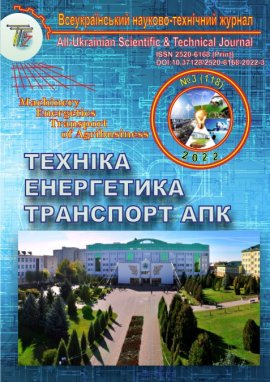
Issue №: 3(118)
The journal solves the problems of creation and improvement of machinery and technologies for agriculture: 131 - Applied Mechanics, 132 - Materials Science, 133 - Industrial Engineering, 141 - Power Engineering, Electrical Engineering and Electromechanics, 208 - Agricultural Engineering.
MATHEMATICAL MODEL OF THE PRIMARY MEASURING CONVERTER OF HUMIDITY TRANSFORMER OIL
Valerii Hraniak – Candidate of Science (Engineering), Associate Professor, Associate Professor of the Department of Power engineering, electrical engineering and electromechanics of Vinnitsa National Agrarian University. (3 Soniachna St., Vinnitsa, Ukraine, 21008, e-mail: titanxp2000@ukr.net https://orcid.org/0000-0001-6604-6157).
Viktor Yemchyk – director of the SRF «Agronomichne» USEC «All Ukrainian Scientific-educational Consortium» (Agronomichne village, Vinnytsia region, 23227, Ukraine, e-mail: agronomichne@ukr.net).
Oleksandr Kozhushko – 4rd year student of EI-19-1 group (Electric Power Engineering, Electrical Engineering and Electromechanics) of Vinnytsia National Agrarian University (3 Sonyachna St., Vinnytsia, Ukraine, 21008, e-mail: kozuskoaleksandr7@gmail.com).
Today, the vast majority of technological processes, both production and agriculture, are based on the use of electric machines. Among which, a significant part of production equipment requires the use of electric motors, the power of which exceeds hundreds of kilowatts. Such electric machines have also become widespread as generating equipment, where they are an integral part of power plants, both using traditional energy sources (thermal power plants, nuclear power plants, etc.), and renewable (hydroelectric power plants, wind farms, etc.), where the unit power of a single electrical machine is usually higher than in other sectors of economy.
When operating such equipment, systems for monitoring a significant number of technological parameters are often used, and in real time it characterizes the modes of their operation. This approach makes it possible to increase the reliability of operation and, with a fairly high probability, to avoid large-scale man-made threats that can be caused by an emergency failure of power electric machines (including powerful electric generators), which are quite often accompanied by the destruction of supporting structures, structural elements of industrial premises and can pose a threat to the life and health of production personnel. But the use of even the most modern systems for monitoring the technical condition does not provide one hundred percent reliability, and when operating electrical machines with a nominal power of the order of units of MW Today, the vast majority of technological processes, both production and agriculture, are based on the use of electrical equipment. A similar situation occurs in the household sector, where we can also note a significant increase in energy consumption in recent decades. Given this, it is obvious the need to ensure the transfer of significant amounts of electricity, which is not possible without the use of transformers and power electric devices, the construction of the lion's share of which provides insulation of live parts and excess heat using transformer oil. Such equipment, in particular, includes: oil transformers, oil and low oil switches, which are characterized by a relatively low cost at sufficiently high rated currents and voltages.
One of the most significant disadvantages of this equipment is the need for constant monitoring of the condition of transformer oil, the physical properties of which largely determine the dielectric strength and overload capacity of the equipment as a whole. The mass fraction of moisture in the latter is one of the key indicators that determine its dielectric and thermally conductive properties. Therefore, the existing technical regulations for the operation of the latter provide for regular laboratory examination of the physical properties of the latter during the technical inspection of equipment, which usually requires quite a lot of time. In turn, this leads to an increase in economic losses associated with increasing the duration of planned maintenance work. Therefore, given the above, it is obvious that the development of new high-precision means of rapid measurement of transformer oil humidity is an urgent task of considerable practical interest.
The article presents a mathematical model of a transformer oil sample, which establishes an unambiguous relationship between its humidity and integral dielectric conductivity in the range of humidity changes from 0% to 0.6%, which corresponds to the allowable moisture content in the latter. It is shown that the obtained functional dependence of the integral dielectric constant on moisture within the investigated range has a monotonically increasing character. Also, the design of a high-frequency humidity sensor based on a band asymmetric wave-water wave was developed, in which the primary measuring conversion of humidity into the amplitude of the output electromagnetic wave is carried out. A mathematical model of such a sensor is developed and the transformation equation is obtained.
To confirm the adequacy of the theoretical conclusions, an experimental study was conducted, based on which it was found that the total relative error does not exceed 2%.
[1] Rodrigues, A., Sardinha, R. A., Pita, G. (2021). Fundamental Principles of Environmental Physics. New York : Springer [in English].
[2] Plieshkov, P. H., Manuilov, V. F., Savelenko, I. V. (2010). Orhanizatsiia systemy monitorynhu sylovykh transformatoriv [Organization of the monitoring system of power transformers]. Naukovi zapysky: zbirnyk naukovykh prats – Scientific notes: a collection of scientific papers, 10 (2), 250–255 [in Ukrainian].
[3] Iserman, R. (2011). Fault–diagnosis applications. Model-based condition monitoring: actuators, drives, machinery, plants, sensors and fault–tolerant systems. New York : Springer [in English].
[4] Hraniak, V.F., Kukharchuk, V.V., Bogachuk, V.V., Vedmitskyi, Y.G. at all. (2018). Phase noncontact method and procedure for measurement of axial displacement of electric machine's rotor. Proceedings from MIIM '12: Photonics Applications in Astronomy, Communications, Industry, and High-Energy Physics Experiments. SPIE 10808 [in English].
[5] Demyda, B., Gapeeva, O. (2010). Avtomatyzovana systema monitorynhu promyslovykh transformatoriv [Automated monitoring system of industrial transformers]. Visnyk natsionalnoho universytetu «Lvivska politekhnika» – Bulletin of the Lviv Polytechnic National University, 686. 23–33 [in Ukrainian].
[6] Korotcenkov, G. (2019). Handbook of Humidity Measurement, Volume 2. Electronic and Electrical Humidity Sensors. Boca Raton : CRC Press [in English].
[7] Gubskyi, Y., Nizhenkovska I. (2020). Biological and Bioorganic Chemistry. In 2 books. Book 2. Biological Chemistry. Kyiv: Medicine [in English].
[8] Bilinskyi, Y.Y., Yukysh, M.V., Onushko V.V. (2010). Model perenesennia vyprominiuvannia v seredovyshchi volohoho hazu ta vyznachennia yoho vidnosnoi volohosti [Model of radiation transfer in a moist gas environment and determination of its relative humidity]. Visnyk Vinnytskoho politekhnichnoho instytutu – Bulletin of the Vinnytsia Polytechnic Institute, 5. 18–22 [in Ukrainian].
[9] Korotcenkov, G. (2020). Handbook of Humidity Measurement. CRC Press [in English].
[10] Hraniak, V.F., Kukharchuk V.V. (2012). Metod ta zasib vymiriuvannia volohosti heterohennykh dyspersnykh dielektrykiv z vykorystanniam VCh sensora na bazi smuhovoho nesymetrychnoho khvylevodu [Method and means of measuring the humidity of heterogeneous dispersed dielectrics using a HF sensor based on a band asymmetric waveguide]. Proceedings from MIIM '12: XLI naukovo-tekhnichna konferentsiia profesorsko-vykladatskoho skladu ta studentiv VNTU – XLI scientific and technical conference of professors and teaching staff and students of VNTU. Vinnytsia: VNTU. Retrieved from http://conf.vntu.edu.ua/allvntu/2012/ineeem/txt/granyak2.pdf [in Ukrainian].
[11] Gunko, I., Hraniak, V., Yaropud, V., Kupchuk, I. & Rutkevych, V. (2021). Optical sensor of harmful air impurity concentration. Przeglad Elektrotechnicznythis, 7. 76–79 [in English].
[12] Kryvoruchko, Y.S., Lerman, L.B., Shkoda, N.G. (2012). Bahatokomponentni heterohenni systemy: efektyvna dielektrychna pronyknist ta pohlynannia [Multicomponent heterogeneous systems: effective permittivity and absorption]. Visnyk NTU «Kharkivskyi politekhnichnyi instytut» – Bulletin of NTU «Kharkiv Polytechnic Institute», 66. 167–173 [in Ukrainian].
[13] Kukharchuk, V.V., Bohachuk, V.V., & Hraniak, V.F. (2012). Vysokochastotnyi metod i tsyfrovyi zasib vymiriuvannia volohosti heterohennykh dyspersnykh dielektrykiv [High-frequency method and digital means of measuring the humidity of heterogeneous dispersed dielectrics]. Naukovi pratsi VNTU – Scientific works of VNTU, 1 Retrieved from https://praci.vntu.edu.ua/index.php/praci/article/view/308 [in Ukrainian].
[14] Shulga, A.V., Singer, Y.L., & Adamenko V.O. (2017). Tryvymirne modeliuvannia radioelektronnoi aparatury [Three-dimensional modeling of radio-electronic equipment]. Kyiv: KPI named after Igor Sikorsky [in Ukrainian].
[15] Horbaty, I.V., & Bondarev, A.P. (2016). Telekomunikatsiini systemy ta merezhi. Pryntsypy funktsionuvannia, tekhnolohii ta protokoly [Telecommunication systems and networks. Principles of operation, technologies and protocols]. Lviv: Lviv Polytechnic [in Ukrainian].
[16] Kuharchuk, V.V., Hraniak, V.F. (2013). Phase-amplitude method for measuring humidity content of heterogenetic disperse dielectric. Metrolohiia ta prylady – Metrology and devices, 4, 3–8 [in English].
[17] Slobodyaniuk, P.V., Blagradnyi, V.G., Stupak, V.S. (2008). Dovidnyk z radiomonitorynhu [Handbook of radio monitoring]. Nizhin: Aspect-Polygraph [in Ukrainian].
[18] Forkun, Y.B. (2009). Teoretychni osnovy elektrotekhniky [Theoretical foundations of electrical engineering]. Kharkiv: KNAMG [in Ukrainian].
[19] Kukharchuk, V.V., Bogachuk, V.V., Dmitriev, Y.O., Hraniak, V.F. (2011). Doslidzhennia zalezhnosti parametriv zatukhannia ta zmishchennia fazy elektromahnitnykh khvyl vid volohosti seredovyshcha yikh poshyrennia [Study of the dependence of parameters of attenuation and phase shift of electromagnetic waves on the humidity of the environment of their propagation]. Visnyk Vinnytskoho politekhnichnoho instytutu – Bulletin of the Vinnytsia Polytechnic Institute, 4. 103–106 [in Ukrainian].
About the journal
G8 – Materials Science
G9 – Applied Mechanics
G10 – Metallurgy
G11 – Mechanical Engineering (by specializations)
The journal "Engineering, Energy, Transport AIC" is indexed according to the following databases and catalogs:


The All-Ukrainian scientific journal “Technology, energy, agriculture transport AIC” is an open-access scientific publication that publishes the results of original research, theoretical and applied developments, as well as scientific papers in the fields of engineering sciences, energy systems, and transport technologies of the agro-industrial complex.
The main objective of the scientific journal “Technology, energy, agriculture transport AIC” is to disseminate the results of modern scientific research and to promote the development of technical, energy, and transport solutions for the agro-industrial complex through the publication of scientific materials characterized by scientific novelty and practical significance in the field of design and modernization of machinery, equipment, and technologies.
The journal’s activities are focused on supporting the development of engineering science, stimulating the implementation of innovative approaches into industrial practice, as well as ensuring effective exchange of scientific achievements among researchers, educators, engineers, and other specialists in relevant fields.
Objectives of the Journal
To achieve its defined objective, the journal ensures the implementation of the following key tasks:
· publication of the results of fundamental and applied research covering the fields of applied mechanics, mechanical engineering, materials science, energy systems, electrical engineering, electromechanics, and transport systems of the agro-industrial sector;
· promotion of the implementation of advanced technical and technological developments aimed at improving the efficiency of machinery, equipment, and production processes;
· creation of conditions for active scientific exchange among research institutions, higher education institutions, industrial enterprises, and other interested organizations;
· support for the development of interdisciplinary research and expansion of cooperation among specialists in various fields of science and technology;
· promotion of the improvement of the scientific and technical level of research related to the design, modernization, and operation of technical equipment used in agro-industrial production;
· dissemination of information on modern achievements in science and technology and the implementation of innovative technologies in the fields of technical support, energy, and transport;
· development of a scientific information environment that facilitates effective scientific communication and the integration of national research into the international scientific community.
Publication frequency: 4 issues per year
Languages of publication: Ukrainian, English
Editor-in-Chief: Vitalii YAROPUD
State Registration: Decision of the National Council of Ukraine on Television and Radio Broadcasting № 1337 and № 1180. Media Identifier: R30-05173
EDRPOU Code: 00497236
Publisher ROR: https://ror.org/05m3ysc06
Publisher DOI prefix: 10.37128 ISSN (print): 2520-6168
The scientific journal is included in Category “B” of the List of Scientific Professional Publications of Ukraine in which the results of dissertation research for obtaining the degrees of Doctor and Candidate of Sciences may be published in the following specialties: G8 – Materials Science; G9 – Applied Mechanics; G10 – Metallurgy; G11 – Mechanical Engineering (by specializations). (Order of the Ministry of Education and Science of Ukraine dated June 11, 2026 №928
Technology, energy, agriculture transport AIC is a scholarly professional journal with a long-standing history and stable academic tradition, reflecting the evolution of engineering and technical sciences within the agro-industrial sector of Ukraine.
The journal was founded in 1997 under the title Bulletin of Vinnytsia State Agricultural Institute. According to the Resolution of the Presidium of the Higher Attestation Commission of Ukraine dated September 11, 1997, the publication obtained the status of a professional scientific journal, which enabled the publication of the main results of doctoral and candidate dissertations in technical sciences. From its inception, the journal positioned itself as an academic platform for addressing current issues of mechanization, electrification, and technical support of agricultural production. During 2001–2014, the journal was published under the title Proceedings of Vinnytsia National Agrarian University. Series: Technical Sciences (State Registration Certificate of Print Media KV No. 16644-5116 PR dated April 30, 2010). Throughout this period, a systematic approach to the selection and peer review of scientific manuscripts was established, the thematic scope of publications was expanded, and continuity of scientific directions as well as the development of sectoral engineering schools was ensured. Since 2015, the journal has been published under its current title, Technology, energy, agriculture transport AIC (State Registration Certificate No. 21906-11806 R dated March 12, 2016). The change of title reflected the expansion of the journal’s thematic coverage and its orientation toward interdisciplinary research in mechanical engineering, energy systems, electrical engineering, transport technologies, automation, and digital solutions for the agro-industrial complex.
