

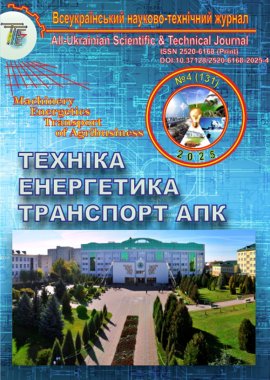
Issue №: 4 (131)
The journal solves the problems of creation and improvement of machinery and technologies for agriculture: 131 - Applied Mechanics, 132 - Materials Science, 133 - Industrial Engineering, 141 - Power Engineering, Electrical Engineering and Electromechanics, 208 - Agricultural Engineering
OPTIMIZATION OF AGRICULTURAL EQUIPMENT DESIGN PROCESSES
Serhii BURLAKA – Doctor of Philosophy in Industrial Mechanical Engineering, Associate Professor of the Department of Engineering Mechanics and Technological Processes in the Agricultural and Industrial Complex of Vinnytsia National Agrarian University (3 Sonyachna St., Vinnytsia, Ukraine, 21008, e-mail: ipserhiy@gmail.com , https://orcid.org/0000-0002-4079-4867).
The article is devoted to a comprehensive study and improvement of agricultural machinery design processes in the era of digital transformation of the agricultural industry. In the context of global challenges–rapid growth in global food demand, limited natural resources, climate change, and increasingly stringent environmental regulations–the effectiveness of agricultural mechanization is determined not only by the reliability and durability of machines, but also by the speed of their development, flexibility of adaptation to local soil and climatic conditions, and minimal resource and energy consumption. Traditional sequential design methods based on empirical calculations, manual drafting, and multiple physical prototyping are gradually losing their relevance due to excessive labor intensity, long development cycles (from 24 to 36 months), and significant financial costs associated with numerous iterative refinements.
The paper systematizes modern digital tools and approaches that form a new paradigm of concurrent engineering. These include PLM systems for comprehensive product life-cycle management; parametric and generative modeling in Siemens NX and Autodesk Fusion 360; multiphysics analysis, including the finite element method (FEM), computational fluid dynamics (CFD), and kinematic modeling in ANSYS, Abaqus, and Adams; topological and parametric optimization; artificial intelligence algorithms, in particular genetic, evolutionary, and neural networks; digital twin and virtual prototyping technologies; and additive manufacturing methods (SLM, FDM) for the rapid creation of functional assemblies.
A universal integrated optimization methodology is proposed, covering the full cycle–from the formulation of the technical task to validation in both virtual and real environments. The key principles include: early-stage parameterization to create flexible models with variable geometric, material, and loading parameters; automated multivariate assessment according to criteria of mass, strength, stiffness, vibroacoustic characteristics, and energy consumption; topological optimization considering real manufacturing constraints (additive, foundry, welding); global optimization using genetic algorithms with a multicomponent fitness function; virtual field testing in detailed models of soil and climatic zones of Ukraine, such as chernozems, podzols, and chestnut soils; and feedback via IoT technologies to collect real-life operational data and further refine the models.
1. Kostromskyi, M. V. (2012). Suchasnyi stan tekhnichnoho zabezpechennia ahrarnoho sektoru ekonomiky Ukrainy [Current state of technical support of the agrarian sector of the economy of Ukraine]. Efektyvna ekonomika, (12). URL: http://www.economy.nayka.com.ua/?op=1&z=2446 [in Ukrainian].
2. Kravchuk, V. I. (2025). Digital twins in agricultural engineering. Agrarna nauka. [in English].
3. State Standard of Ukraine. (2013). DSTU 7352:2013. Agricultural machinery. General safety requirements. Derzhspozhyvstandart of Ukraine. [in Ukrainian].
4. Siemens Digital Industries Software. (2024). Siemens NX 2306: Design Space Exploration Module. Siemens. URL: https://www.plm.automation.siemens.com/global/en/products/nx/ [in English].
5. ANSYS Inc. (2025). ANSYS 2025 R1: Topology optimization guide. ANSYS. https://doi.org/10.1234/ansys.topo.2025 [in English].
6. Honcharuk, I., Kupchuk, I., Yaropud, V., Kravets, R., Burlaka, S., Hraniak, V., Poberezhets, J., & Rutkevych, V. (2022). Mathematical modeling and creation of algorithms for analyzing the ranges of the amplitude-frequency response of a vibrating rotary crusher in the software Mathcad. Przegląd Elektrotechniczny, 98(9), 14–20. DOI: https://doi.org/10.15199/48.2022.09.03 [in English].
7. Kumar, R., & Singh, S. (2024). DEM simulation for cultivator blade optimization. Journal of Terramechanics, 111, 45–58. DOI: https://doi.org/10.1016/j.jterra.2024.01.003 [in English].
8. Park, J., & Kim, K. (2025). Neural network-assisted parametric optimization in tractor design. Engineering Optimization, 57(2), 234–249. DOI: https://doi.org/10.1080/0305215X.2024.2301456 [in English].
9. Yaropud, V., Aliiev, E., Mazur, I., & Burlaka, S. (2023). Simulating the process of operation of vortex layer electromagnetic apparatus with ferromagnetic working elements. Przegląd Elektrotechniczny, 99(9), 64–71. DOI: https://doi.org/10.15199/48.2023.09.11 [in English].
10. Rutkevych, V., Kupchuk, I., Yaropud, V., Hraniak, V., & Burlaka, S. (2022). Numerical simulation of the liquid distribution problem by an adaptive flow distributor. Przegląd Elektrotechniczny, 98(2), 64–69. DOI: https://doi.org/10.15199/48.2022.10.10 [in English].
About the journal
G8 – Materials Science
G9 – Applied Mechanics
G10 – Metallurgy
G11 – Mechanical Engineering (by specializations)
The journal "Engineering, Energy, Transport AIC" is indexed according to the following databases and catalogs:


The All-Ukrainian scientific journal “Technology, energy, agriculture transport AIC” is an open-access scientific publication that publishes the results of original research, theoretical and applied developments, as well as scientific papers in the fields of engineering sciences, energy systems, and transport technologies of the agro-industrial complex.
The main objective of the scientific journal “Technology, energy, agriculture transport AIC” is to disseminate the results of modern scientific research and to promote the development of technical, energy, and transport solutions for the agro-industrial complex through the publication of scientific materials characterized by scientific novelty and practical significance in the field of design and modernization of machinery, equipment, and technologies.
The journal’s activities are focused on supporting the development of engineering science, stimulating the implementation of innovative approaches into industrial practice, as well as ensuring effective exchange of scientific achievements among researchers, educators, engineers, and other specialists in relevant fields.
Objectives of the Journal
To achieve its defined objective, the journal ensures the implementation of the following key tasks:
· publication of the results of fundamental and applied research covering the fields of applied mechanics, mechanical engineering, materials science, energy systems, electrical engineering, electromechanics, and transport systems of the agro-industrial sector;
· promotion of the implementation of advanced technical and technological developments aimed at improving the efficiency of machinery, equipment, and production processes;
· creation of conditions for active scientific exchange among research institutions, higher education institutions, industrial enterprises, and other interested organizations;
· support for the development of interdisciplinary research and expansion of cooperation among specialists in various fields of science and technology;
· promotion of the improvement of the scientific and technical level of research related to the design, modernization, and operation of technical equipment used in agro-industrial production;
· dissemination of information on modern achievements in science and technology and the implementation of innovative technologies in the fields of technical support, energy, and transport;
· development of a scientific information environment that facilitates effective scientific communication and the integration of national research into the international scientific community.
Publication frequency: 4 issues per year
Languages of publication: Ukrainian, English
Editor-in-Chief: Vitalii YAROPUD
State Registration: Decision of the National Council of Ukraine on Television and Radio Broadcasting № 1337 and № 1180. Media Identifier: R30-05173
EDRPOU Code: 00497236
Publisher ROR: https://ror.org/05m3ysc06
Publisher DOI prefix: 10.37128 ISSN (print): 2520-6168
The scientific journal is included in Category “B” of the List of Scientific Professional Publications of Ukraine in which the results of dissertation research for obtaining the degrees of Doctor and Candidate of Sciences may be published in the following specialties: G8 – Materials Science; G9 – Applied Mechanics; G10 – Metallurgy; G11 – Mechanical Engineering (by specializations). (Order of the Ministry of Education and Science of Ukraine dated June 11, 2026 №928
Technology, energy, agriculture transport AIC is a scholarly professional journal with a long-standing history and stable academic tradition, reflecting the evolution of engineering and technical sciences within the agro-industrial sector of Ukraine.
The journal was founded in 1997 under the title Bulletin of Vinnytsia State Agricultural Institute. According to the Resolution of the Presidium of the Higher Attestation Commission of Ukraine dated September 11, 1997, the publication obtained the status of a professional scientific journal, which enabled the publication of the main results of doctoral and candidate dissertations in technical sciences. From its inception, the journal positioned itself as an academic platform for addressing current issues of mechanization, electrification, and technical support of agricultural production. During 2001–2014, the journal was published under the title Proceedings of Vinnytsia National Agrarian University. Series: Technical Sciences (State Registration Certificate of Print Media KV No. 16644-5116 PR dated April 30, 2010). Throughout this period, a systematic approach to the selection and peer review of scientific manuscripts was established, the thematic scope of publications was expanded, and continuity of scientific directions as well as the development of sectoral engineering schools was ensured. Since 2015, the journal has been published under its current title, Technology, energy, agriculture transport AIC (State Registration Certificate No. 21906-11806 R dated March 12, 2016). The change of title reflected the expansion of the journal’s thematic coverage and its orientation toward interdisciplinary research in mechanical engineering, energy systems, electrical engineering, transport technologies, automation, and digital solutions for the agro-industrial complex.
