

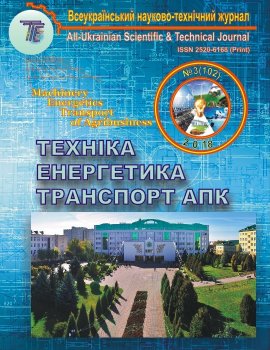
Issue №: 3(102)
The journal addresses the problems of creating and improving machinery and technologies for agriculture, food and processing industries, mechanical engineering, energy and transport.
UNIVERSAL ENERGY SAVING PASTEERING EQUIPMENT FOR MANUFACTURE OF LIQUID PRODUCTS
Mayboroda Yuri Vasilievich – PhD, Associate Professor of Head Department of Oil and Cheese Production of the Institute of Food Resources of the National Academy of Sciences (4, Sverstiuka St., Kiev, 02660, Ukraine, email: mayyura@ipr.net.ua).
Zozulyak Igor Anatolievich – PhD, Senior Lecturer of the Department of Processes and Equipment for Processing and Food Productions Named After Prof. P.S. Bernik of the Vinnytsia National Agrarian University (3, Solnechnaya St., Vinnitsa, 21008, Ukraine, email: zozulak @vsau.vin.ua).
High temperature pasteurization in a stream at 108 °C simultaneously with a maximum bactericidal effect allows to ensure the characteristic of traditional oils of taste and smell. Plate heat exchangers that are widely used in the processing industry were not suitable for the heat treatment of dairy products in high temperature. The formation of a layer of coagulated protein on the heat exchange surface leads to a decrease in the thermal productivity of the apparatus and a violation of the technological regime. The need to disassemble the package of plates for cleaning the surface of the heat exchange negatively affects the continuity of the process and the mandatory requirement of reliable tightness of the channel system. The diverse design of the scraper-lamellar pasteurization apparatus optimally combines the advantages of plate and scraping heat exchangers. In developing a constructive solution, the experience gained during the design of plate scraper oil-forming was used. Application of scrapers in the annular passage of the product between the steam plates is aimed at preventing the formation of a protein bite on the working surface of the heat-exchange plate. For the purpose of economical use of heat resources during the heating stages of cream before pasteurization, the recuperative heat of pasteurized cream is used. For this purpose, the high-temperature pasteurizer is equipped with a plate heat exchanger-recuperator, the main element of which is the plate of mesh-flow type Р-0.26 produced by Alfa-laval.
[1] Vyshemirskiy, F. A. (1971). Faktory povysheniya kachestva slivochnogo masla [Factors improving the quality of butter]. Moscow : TSNIIITEI [in Russian].
[2] Vyshemirskiy, F. A., Vasilisin, S. V. (1972). Vliyaniye teplovoy obrabotki slivok na izmeneniye ikh sostava i vyrazhennosti privkusa pasterizatsii [The effect of heat treatment of cream on the change in their composition and intensity of pasteurization flavor], 9, 77 – 101. Moscow : Trudy VNIIITEI [in Russian].
[3] Kacherauskis, D., Deksnis, A. (1971). Vliyaniye temperatury pasterizatsii slivok na svoystva masla, vyrabatyvayemogo nepreryvnym sbivaniyem [The effect of cream pasteurization temperature on the properties of butter produced by continuous churning], VI, 7 – 20. Trudy Litovskogo filiala VNIIMS, [in Russian].
[4] Sviderskiy, V.V., Vorob'yeva, N.I. (1973). Kinetika obrazovaniya otlozheniy v plastinchatykh pasterizatorakh dlya moloka [The kinetics of the formation of deposits in plate pasteurizers for milk], 6. Pishchevaya tekhnologiya – Food technology [in Russian].
[5] Pat. 19630U Ukraína, MPK F28D11/00 F28C3/00 / Teploobmínniy aparat [Heat exchanger] / Êres'ko G.A., Êroshenko S.Í., Kimachins'kiy S.Í.(Ukraína); zaiavnyk ta patentovlasnyk Vinnitskii natsionalnyi agrarnyi universitet; zayavl. 17.07.2006; opubl.15.12.2006, Byul. №12 [in Ukrainian].
[6] Yeres'ko, G. Yeroshenko, S. (2010). Teplovyye i energeticheskiye kharakteristiki plastinchatogo skrebkovogo pasterizatora [Thermal and energy characteristics of a plate scraper pasteurizer], 8, 32 – 34. Molochnaya promyshlennost' – Milk industry [in Russian].
[7] Êroshenko, S.Í., Mayboroda, YU.V. (2013). Konstruktivní osoblivostí skrebkovikh pasterizatsíynikh aparatív [Structural features of scraping pasteurization machines], 6, 56 – 59. Vísnik agrarnoí nauki – Bulletin of Agrarian Science [in Ukrainian].
[8] Êroshenko, S.Í. Mayboroda, YU.V. (2011). Yeksperimental'ne doslídzhennya íntensifíkovanogo konvektivnogo teploobmínu v kanalakh plastinchastogo rekuperatora [Experimental study of intensified convective heat exchange in channels of a plate recuperator], 5, 32 – 34. Visnik agrarnoí nauki – Bulletin of Agrarian Science [in Ukrainian].
About the journal
G8 – Materials Science
G9 – Applied Mechanics
G10 – Metallurgy
G11 – Mechanical Engineering (by specializations)
The journal "Engineering, Energy, Transport AIC" is indexed according to the following databases and catalogs:


The All-Ukrainian scientific journal “Technology, energy, agriculture transport AIC” is an open-access scientific publication that publishes the results of original research, theoretical and applied developments, as well as scientific papers in the fields of engineering sciences, energy systems, and transport technologies of the agro-industrial complex.
The main objective of the scientific journal “Technology, energy, agriculture transport AIC” is to disseminate the results of modern scientific research and to promote the development of technical, energy, and transport solutions for the agro-industrial complex through the publication of scientific materials characterized by scientific novelty and practical significance in the field of design and modernization of machinery, equipment, and technologies.
The journal’s activities are focused on supporting the development of engineering science, stimulating the implementation of innovative approaches into industrial practice, as well as ensuring effective exchange of scientific achievements among researchers, educators, engineers, and other specialists in relevant fields.
Objectives of the Journal
To achieve its defined objective, the journal ensures the implementation of the following key tasks:
· publication of the results of fundamental and applied research covering the fields of applied mechanics, mechanical engineering, materials science, energy systems, electrical engineering, electromechanics, and transport systems of the agro-industrial sector;
· promotion of the implementation of advanced technical and technological developments aimed at improving the efficiency of machinery, equipment, and production processes;
· creation of conditions for active scientific exchange among research institutions, higher education institutions, industrial enterprises, and other interested organizations;
· support for the development of interdisciplinary research and expansion of cooperation among specialists in various fields of science and technology;
· promotion of the improvement of the scientific and technical level of research related to the design, modernization, and operation of technical equipment used in agro-industrial production;
· dissemination of information on modern achievements in science and technology and the implementation of innovative technologies in the fields of technical support, energy, and transport;
· development of a scientific information environment that facilitates effective scientific communication and the integration of national research into the international scientific community.
Publication frequency: 4 issues per year
Languages of publication: Ukrainian, English
Editor-in-Chief: Vitalii YAROPUD
State Registration: Decision of the National Council of Ukraine on Television and Radio Broadcasting № 1337 and № 1180. Media Identifier: R30-05173
EDRPOU Code: 00497236
Publisher ROR: https://ror.org/05m3ysc06
Publisher DOI prefix: 10.37128 ISSN (print): 2520-6168
The scientific journal is included in Category “B” of the List of Scientific Professional Publications of Ukraine in which the results of dissertation research for obtaining the degrees of Doctor and Candidate of Sciences may be published in the following specialties: G8 – Materials Science; G9 – Applied Mechanics; G10 – Metallurgy; G11 – Mechanical Engineering (by specializations). (Order of the Ministry of Education and Science of Ukraine dated June 11, 2026 №928
Technology, energy, agriculture transport AIC is a scholarly professional journal with a long-standing history and stable academic tradition, reflecting the evolution of engineering and technical sciences within the agro-industrial sector of Ukraine.
The journal was founded in 1997 under the title Bulletin of Vinnytsia State Agricultural Institute. According to the Resolution of the Presidium of the Higher Attestation Commission of Ukraine dated September 11, 1997, the publication obtained the status of a professional scientific journal, which enabled the publication of the main results of doctoral and candidate dissertations in technical sciences. From its inception, the journal positioned itself as an academic platform for addressing current issues of mechanization, electrification, and technical support of agricultural production. During 2001–2014, the journal was published under the title Proceedings of Vinnytsia National Agrarian University. Series: Technical Sciences (State Registration Certificate of Print Media KV No. 16644-5116 PR dated April 30, 2010). Throughout this period, a systematic approach to the selection and peer review of scientific manuscripts was established, the thematic scope of publications was expanded, and continuity of scientific directions as well as the development of sectoral engineering schools was ensured. Since 2015, the journal has been published under its current title, Technology, energy, agriculture transport AIC (State Registration Certificate No. 21906-11806 R dated March 12, 2016). The change of title reflected the expansion of the journal’s thematic coverage and its orientation toward interdisciplinary research in mechanical engineering, energy systems, electrical engineering, transport technologies, automation, and digital solutions for the agro-industrial complex.
