

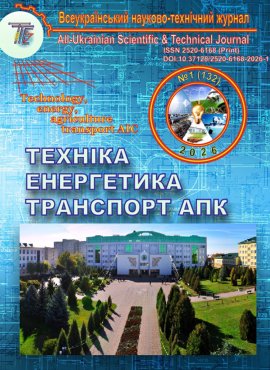
Issue №: 1 (132)
The journal presents the results of scientific research and addresses current issues in the development and improvement of agricultural equipment and technologies, particularly in the design, production, and operation of machines and technical systems in the agro-industrial complex, including aspects of their efficient functioning.
ANALYTICAL STUDIES OF THE STRUCTURAL AND OPERATING PARAMETERS OF THE COLLECTOR OF AN ADAPTIVE MILKING MACHINE
Elchyn ALIIEV – Doctor of Technical Sciences, Senior Researcher, Professor of the Department of Technical Systems Engineering of Dnipro State Agrarian and Economic University (Dnipro, Serhiy Efremov St., 25, e-mail: aliev@meta.ua, https://orcid.org/0000-0003-4006-8803).
Volodymyr GOVORUKHA – Doctor of Physical and Mathematical Sciences, Professor, Head of the Department of Higher Mathematics, Physics and General Engineering Disciplines of Dnipro State Agrarian and Economic University (Dnipro, Serhiy Efremov St., 25, e-mail: hovorukha.v.b@dsau.dp.ua, https://orcid.org/0000-0002-0936-9272).
Оlexander TOLSTENKO – Candidate of Technical Sciences, Associate Professor, Associate Professor of the Department of Technical Systems Engineering of Dnipro State Agrarian and Economic University (Dnipro, Serhiy Efremov St., 25, e-mail: tolstenko.o.v@dsau.dp.ua, https://orcid.org/0000-0003-4752-5704).
The paper addresses the problem of improving the efficiency of machine milking by enhancing the design of the milking machine collector with due consideration of the physiological characteristics of animals. It is shown that most commercial collectors operate under fixed regimes and do not provide individual adaptation of vacuum parameters to variations in milk flow intensity, which may result in incomplete milk extraction, longer milking time, and negative effects on udder health.
The purpose of the study is to develop the design of an adaptive milking machine collector and to analytically substantiate its structural and operating parameters that ensure stable transportation of the milk–air mixture and optimal milking conditions. The object of the research is the operation process of the collector as part of a two-stroke milking machine, while the subject of the research is the relationships between its geometric parameters and operating modes.
An adaptive collector design with additional air chambers, a membrane–valve mechanism, and an adjustable throttle channel is proposed. Using analytical, computational-graphical, and physical–mathematical methods, the relationships between the throttle orifice diameter and air flow rate, the diameter of the milk hose outlet and the parameters of the milk–air mixture, as well as between the operating parameters of the milking machine and the volume of the collector milk chamber, were established.
Rational values of the design parameters were substantiated: throttle channel diameter of 1.1–2.7 mm, milk hose outlet diameter of 8–16 mm, and milk chamber volume of 121 cm³. Pulsograms of the milking machine operation with the developed collector were constructed, and the durations of the operating strokes and vacuum pressure levels were determined. The obtained results confirm the feasibility of using an adaptive milking collector to increase milking speed, stabilize the vacuum regime, and improve the operating conditions of milking installations.
1. Kaskous, S., Pfaffl, M. W. (2023). Milking machine settings and liner design are important to improve milking efficiency and lactating animal welfare: Technical note. AgriEngineering, 5(3), 1314–1326. https://doi.org/10.3390/agriengineering5030083 [in English].
2. Romero, G., Bueso-Ródenas, J., Alejandro, M., Moya, F., Díaz, J. R. (2021). Effect of vacuum level and pulsation parameters on milking efficiency and animal welfare of Murciano-Granadina goats milked in mid-line and low-line milking machines. Animals, 12(1), 40. https://doi.org/10.3390/ani12010040 [in English].
3. Medvedskyi, O., Achkevych, O., Achkevych, V. (2019). Dynamics of the vacuummetric pressure of the dairy chamber of the collector of milking machine. Scientific Horizons, 22(5), 51–57. https://doi.org/10.33249/2663-2144-2019-78-5-51-57 [in English].
4. Reinemann, D. J., van den Borne, B. H. P., Hogeveen, H., Wiedemann, M., Paulrud, C. O. (2021). Effects of flow-controlled vacuum on milking performance and teat condition in a rotary milking parlor. Journal of Dairy Science, 104(6), 6820–6831. https://doi.org/10.3168/jds.2020-19418 [in English].
5. Besier, J., Bruckmaier, R. M. (2016). Vacuum levels and milk-flow-dependent vacuum drops affect machine milking performance and teat condition in dairy cows. Journal of Dairy Science, 99(4), 3096–3102. https://doi.org/10.3168/jds.2015-10340 [in English].
6. Golub, G., Medvedskyi, O., Achkevych, V., Achkevych, O. (2018). Establishing rational structural-technological parameters of the milking machine collector. Eastern-European Journal of Enterprise Technologies, 1(1(91)), 12–17. https://doi.org/10.15587/1729-4061.2018.121537 [in English].
7. Aliiev, E., Paliy, A., Kis, V., Paliy, A., Petrov, R., Plyuta, L., Chekan, O., Musiienko, O., Ukhovskyi, V., Korniienko, L. (2022). Establishing the influence of technical and technological parameters of milking equipment on the efficiency of machine milking. Eastern-European Journal of Enterprise Technologies, 1(1(115)), 44–55. https://doi.org/10.15587/1729-4061.2022.251172 [in English].
8. Aliiev, E., Paliy, A., Dudin, V., Kis, V., Paliy, A., Ostapenko, V., Levchenko, I., Prihodko, M., Korg, O., Kladnytska, L. (2022). Establishing an interconnection between the technical and technological parameters of milking equipment based on the movement of a milk-air mixture in a milking machine. Eastern-European Journal of Enterprise Technologies, 2(1(116)), 35–46. https://doi.org/10.15587/1729-4061.2022.253978 [in English].
9. Roşca, R., Cărlescu, P., Vlahidis, V. (2025). Development and laboratory testing of a bucket milking machine with flow-controlled vacuum, based on an NI data acquisition system. Proceedings, 117(1), 3. https://doi.org/10.3390/proceedings2025117003 [in English].
10. Dmytriv, V. T., Dmytriv, I. V., Yatsunskyi, P. P. (2019). Experimental pulse generator combined with the milking machine collector. INMATEH – Agricultural Engineering, 59(3), 219–226. https://doi.org/10.35633/INMATEH-59-24 [in English].
11. Lis, S., Tomasik, M., Juszka, H. (2018). The design of a prototype system which controls the flow of milk in the collector’s column of an autonomous milking apparatus. BIO Web of Conferences, 10, 02016. https://doi.org/10.1051/bioconf/20181002016 [in English].
12. Yatsunskyi, P. P. (2022). The results of research pneumatic electromagnetic pulsator combined with collector. Mokslas – Lietuvos Ateitis, 14, Article e15162. https://doi.org/10.3846/mla.2022.15162 [in English].
13. Fenenko, A. I. (2008). Mechanization of milking cows: Theory and practice. Kyiv: Agrarna Nauka. [in English].
14. International Organization for Standardization. (2007). ISO 5707:2007 Milking machine installations–Construction and performance. ISO. [in English].
15. Shevchenko, I. A., & Aliiev, E. B. (2013). Scientific and methodological recommendations on multi-criteria production control of milking units. Accent Invest-Trade. [in English].
About the journal
G8 – Materials Science
G9 – Applied Mechanics
G10 – Metallurgy
G11 – Mechanical Engineering (by specializations)
The journal "Engineering, Energy, Transport AIC" is indexed according to the following databases and catalogs:


The All-Ukrainian scientific journal “Technology, energy, agriculture transport AIC” is an open-access scientific publication that publishes the results of original research, theoretical and applied developments, as well as scientific papers in the fields of engineering sciences, energy systems, and transport technologies of the agro-industrial complex.
The main objective of the scientific journal “Technology, energy, agriculture transport AIC” is to disseminate the results of modern scientific research and to promote the development of technical, energy, and transport solutions for the agro-industrial complex through the publication of scientific materials characterized by scientific novelty and practical significance in the field of design and modernization of machinery, equipment, and technologies.
The journal’s activities are focused on supporting the development of engineering science, stimulating the implementation of innovative approaches into industrial practice, as well as ensuring effective exchange of scientific achievements among researchers, educators, engineers, and other specialists in relevant fields.
Objectives of the Journal
To achieve its defined objective, the journal ensures the implementation of the following key tasks:
· publication of the results of fundamental and applied research covering the fields of applied mechanics, mechanical engineering, materials science, energy systems, electrical engineering, electromechanics, and transport systems of the agro-industrial sector;
· promotion of the implementation of advanced technical and technological developments aimed at improving the efficiency of machinery, equipment, and production processes;
· creation of conditions for active scientific exchange among research institutions, higher education institutions, industrial enterprises, and other interested organizations;
· support for the development of interdisciplinary research and expansion of cooperation among specialists in various fields of science and technology;
· promotion of the improvement of the scientific and technical level of research related to the design, modernization, and operation of technical equipment used in agro-industrial production;
· dissemination of information on modern achievements in science and technology and the implementation of innovative technologies in the fields of technical support, energy, and transport;
· development of a scientific information environment that facilitates effective scientific communication and the integration of national research into the international scientific community.
Publication frequency: 4 issues per year
Languages of publication: Ukrainian, English
Editor-in-Chief: Vitalii YAROPUD
State Registration: Decision of the National Council of Ukraine on Television and Radio Broadcasting № 1337 and № 1180. Media Identifier: R30-05173
EDRPOU Code: 00497236
Publisher ROR: https://ror.org/05m3ysc06
Publisher DOI prefix: 10.37128 ISSN (print): 2520-6168
The scientific journal is included in Category “B” of the List of Scientific Professional Publications of Ukraine in which the results of dissertation research for obtaining the degrees of Doctor and Candidate of Sciences may be published in the following specialties: G8 – Materials Science; G9 – Applied Mechanics; G10 – Metallurgy; G11 – Mechanical Engineering (by specializations). (Order of the Ministry of Education and Science of Ukraine dated June 11, 2026 №928
Technology, energy, agriculture transport AIC is a scholarly professional journal with a long-standing history and stable academic tradition, reflecting the evolution of engineering and technical sciences within the agro-industrial sector of Ukraine.
The journal was founded in 1997 under the title Bulletin of Vinnytsia State Agricultural Institute. According to the Resolution of the Presidium of the Higher Attestation Commission of Ukraine dated September 11, 1997, the publication obtained the status of a professional scientific journal, which enabled the publication of the main results of doctoral and candidate dissertations in technical sciences. From its inception, the journal positioned itself as an academic platform for addressing current issues of mechanization, electrification, and technical support of agricultural production. During 2001–2014, the journal was published under the title Proceedings of Vinnytsia National Agrarian University. Series: Technical Sciences (State Registration Certificate of Print Media KV No. 16644-5116 PR dated April 30, 2010). Throughout this period, a systematic approach to the selection and peer review of scientific manuscripts was established, the thematic scope of publications was expanded, and continuity of scientific directions as well as the development of sectoral engineering schools was ensured. Since 2015, the journal has been published under its current title, Technology, energy, agriculture transport AIC (State Registration Certificate No. 21906-11806 R dated March 12, 2016). The change of title reflected the expansion of the journal’s thematic coverage and its orientation toward interdisciplinary research in mechanical engineering, energy systems, electrical engineering, transport technologies, automation, and digital solutions for the agro-industrial complex.
