

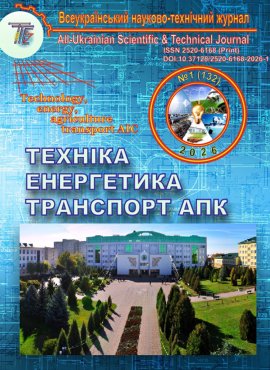
Issue №: 1 (132)
The journal presents the results of scientific research and addresses current issues in the development and improvement of agricultural equipment and technologies, particularly in the design, production, and operation of machines and technical systems in the agro-industrial complex, including aspects of their efficient functioning.
AUTOMATED DUAL-CHANNEL CONTROL OF INTERMITTENT DIAMOND GRINDING BASED ON THERMAL AND VIBRATION STATES
Oleh IVANOV – Candidate of Technical Sciences, Associate Professor of the Department of Construction and Vo cational Education,Poltava State Agrarian University,1/3 Skovorody Street, Poltava, 36003, Ukraine, e-mail: oleg.ivanov@pdau.edu.ua, https://orcid.org/0000-0002-1761-9913).
Taras LAPENKO – Candidate of Technical Sciences, Associate, Professor of the Department of Agroengineering and Automotive Transport,Poltava State Agrarian University,1/3 Skovorody Street, Poltava, 36003, Ukraine, e-mail: taras.lapenko@pdau.edu.ua https://orcid.org/0000-0001-8055-6698).
Oleksandr DIDENKO – Postgraduate Student, Poltava State Agrarian University (1/3 Skovorody Street, Poltava, 36003, Ukraine E-mail: oleksandr.didenko@pdau.edu.ua, https://orcid.org/0009-0008-5479-1123).
This paper investigates the thermal behavior of intermittent diamond grinding under conditions of automated control of the tool–workpiece contact structure and energy input intensity. The grinding process is modeled as a closed nonlinear dynamic system with logical switching, in which contact intermittency is formed in real time based on the thermal state of the grinding zone and adaptive correction of the normal grinding force.
Numerical simulations show that in the absence of control the contact-zone temperature increases monotonically and, for the adopted parameters, approaches a steady-state value of approximately 76 °C, exceeding acceptable thermal limits. Implementation of a single-channel temperature-based control results in the formation of a stable thermal limit cycle between 45 °C and 58 °C, with a temperature oscillation amplitude of 12–13 °C and an average cycle period of 4–5 s. In this mode, the mean process temperature is reduced by approximately 10–12% compared to uncontrolled grinding; however, the temperature remains above 90% of the upper admissible limit for 20–25% of the total processing time.
The proposed dual-channel control strategy, combining temperature-based contact intermittency with adaptive adjustment of the grinding force, leads to a pronounced modification of the thermal dynamics. Peak temperatures are reduced by 3–4 °C relative to the single-channel mode, the thermal cycle amplitude decreases to 6–8 °C, and the mean temperature is further reduced by 5–8%. The fraction of time during which the temperature remains close to the upper allowable limit is more than halved and does not exceed 8–10%.
Quantitative analysis of the contact time structure reveals that the contact duty ratio decreases from 0.60–0.65 in the temperature-controlled mode to 0.3–0.4 under dual-channel control, while the switching frequency is reduced from 0.35–0.40 Hz to 0.25–0.30 Hz. This indicates the formation of a less intensive and more uniformly distributed energy input over time. The results demonstrate that adaptive contact intermittency, treated as an active control variable rather than a fixed kinematic feature, provides an effective means of reducing thermal loading and improving thermal stability in intermittent diamond grinding without the use of external cooling.
1. Brinksmeier, E., Aurich, J. C., Govekar, E., Heinzel, C., Hoffmeister, H.-W., Klocke, F., Peters, J., Rentsch, R., Stephenson, D. J., Uhlmann, E., Weinert, K., & Wittmann, M. (2006). Advances in modeling and simulation of grinding processes. CIRP Annals – Manufacturing Technology, 55(2), 667–696. https://doi.org/10.1016/j.cirp.2006.10.003 [in English].
2. Guo, C., & Malkin, S. (1999). Thermal analysis of grinding. Journal of Manufacturing Science and Engineering, 121(3), 493–501. https://doi.org/10.1115/1.2830378 [in English].
3. Novikov, F. (2023). Optimisation of interrupted grinding parameters according to the temperature criterion. Cutting & Tools in Technological Systems, 98, 59–72. https://doi.org/10.20998/2078-7405.2023.98.07 [in English].
4. Tawakoli, T., Westkämper, E., & Rabiey, M. (2007). Dry grinding by special conditioning. International Journal of Advanced Manufacturing Technology, 33, 419–424. https://doi.org/10.1007/s00170-006-0465-2 [in English].
5. Klocke, F., Brinksmeier, E., & Weinert, K. (2005). Capability profile of hard cutting and grinding processes. CIRP Annals – Manufacturing Technology, 54(2), 22–45. https://doi.org/10.1016/S0007-8506(07)60018-3 [in English].
6. Yan, Y., Xu, J., & Wiercigroch, M. (2016). Regenerative chatter in self-interrupted plunge grinding. Meccanica, 51, 3185–3202. https://doi.org/10.1007/s11012-016-0457-3 [in English].
7. Dimla, D. E., & Lister, P. M. (2000). On-line metal cutting tool condition monitoring. International Journal of Machine Tools and Manufacture, 40(5), 739–768. https://doi.org/10.1016/S0890-6955(99)00051-6 [in English].
8. Aurich, J. C., Herzenstiel, P., Sudermann, H., & Magg, T. (2008). High-performance dry grinding using a grinding wheel with defined grain pattern. CIRP Annals – Manufacturing Technology, 57(1), 357–362. https://doi.org/10.1016/j.cirp.2008.03.120 [in English]
About the journal
G8 – Materials Science
G9 – Applied Mechanics
G10 – Metallurgy
G11 – Mechanical Engineering (by specializations)
The journal "Engineering, Energy, Transport AIC" is indexed according to the following databases and catalogs:


The All-Ukrainian scientific journal “Technology, energy, agriculture transport AIC” is an open-access scientific publication that publishes the results of original research, theoretical and applied developments, as well as scientific papers in the fields of engineering sciences, energy systems, and transport technologies of the agro-industrial complex.
The main objective of the scientific journal “Technology, energy, agriculture transport AIC” is to disseminate the results of modern scientific research and to promote the development of technical, energy, and transport solutions for the agro-industrial complex through the publication of scientific materials characterized by scientific novelty and practical significance in the field of design and modernization of machinery, equipment, and technologies.
The journal’s activities are focused on supporting the development of engineering science, stimulating the implementation of innovative approaches into industrial practice, as well as ensuring effective exchange of scientific achievements among researchers, educators, engineers, and other specialists in relevant fields.
Objectives of the Journal
To achieve its defined objective, the journal ensures the implementation of the following key tasks:
· publication of the results of fundamental and applied research covering the fields of applied mechanics, mechanical engineering, materials science, energy systems, electrical engineering, electromechanics, and transport systems of the agro-industrial sector;
· promotion of the implementation of advanced technical and technological developments aimed at improving the efficiency of machinery, equipment, and production processes;
· creation of conditions for active scientific exchange among research institutions, higher education institutions, industrial enterprises, and other interested organizations;
· support for the development of interdisciplinary research and expansion of cooperation among specialists in various fields of science and technology;
· promotion of the improvement of the scientific and technical level of research related to the design, modernization, and operation of technical equipment used in agro-industrial production;
· dissemination of information on modern achievements in science and technology and the implementation of innovative technologies in the fields of technical support, energy, and transport;
· development of a scientific information environment that facilitates effective scientific communication and the integration of national research into the international scientific community.
Publication frequency: 4 issues per year
Languages of publication: Ukrainian, English
Editor-in-Chief: Vitalii YAROPUD
State Registration: Decision of the National Council of Ukraine on Television and Radio Broadcasting № 1337 and № 1180. Media Identifier: R30-05173
EDRPOU Code: 00497236
Publisher ROR: https://ror.org/05m3ysc06
Publisher DOI prefix: 10.37128 ISSN (print): 2520-6168
The scientific journal is included in Category “B” of the List of Scientific Professional Publications of Ukraine in which the results of dissertation research for obtaining the degrees of Doctor and Candidate of Sciences may be published in the following specialties: G8 – Materials Science; G9 – Applied Mechanics; G10 – Metallurgy; G11 – Mechanical Engineering (by specializations). (Order of the Ministry of Education and Science of Ukraine dated June 11, 2026 №928
Technology, energy, agriculture transport AIC is a scholarly professional journal with a long-standing history and stable academic tradition, reflecting the evolution of engineering and technical sciences within the agro-industrial sector of Ukraine.
The journal was founded in 1997 under the title Bulletin of Vinnytsia State Agricultural Institute. According to the Resolution of the Presidium of the Higher Attestation Commission of Ukraine dated September 11, 1997, the publication obtained the status of a professional scientific journal, which enabled the publication of the main results of doctoral and candidate dissertations in technical sciences. From its inception, the journal positioned itself as an academic platform for addressing current issues of mechanization, electrification, and technical support of agricultural production. During 2001–2014, the journal was published under the title Proceedings of Vinnytsia National Agrarian University. Series: Technical Sciences (State Registration Certificate of Print Media KV No. 16644-5116 PR dated April 30, 2010). Throughout this period, a systematic approach to the selection and peer review of scientific manuscripts was established, the thematic scope of publications was expanded, and continuity of scientific directions as well as the development of sectoral engineering schools was ensured. Since 2015, the journal has been published under its current title, Technology, energy, agriculture transport AIC (State Registration Certificate No. 21906-11806 R dated March 12, 2016). The change of title reflected the expansion of the journal’s thematic coverage and its orientation toward interdisciplinary research in mechanical engineering, energy systems, electrical engineering, transport technologies, automation, and digital solutions for the agro-industrial complex.
