

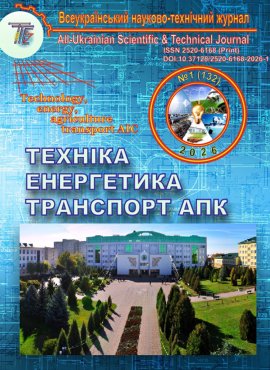
Issue №: 1 (132)
The journal presents the results of scientific research and addresses current issues in the development and improvement of agricultural equipment and technologies, particularly in the design, production, and operation of machines and technical systems in the agro-industrial complex, including aspects of their efficient functioning.
INFLUENCE OF THERMO-OXIDATION AND VIBRATION STRENGTHENING METHODS ON THE FRACTURE RESISTANCE OF HARD ALLOYS
Tomas ŪKSAS – Junior Researcher of the Agriculture Academy of Vytautas Magnus University (Studentų Str. 15A, Akademija, LT-53362 Akademija, Kaunas district, Kaunas, Lithuania, e-mail: tomas.uksas@vdu.lt, https://orcid.org/0000-0003-1915-5830).
Krzysztof MUDRYK – Doctor of Engineering Sciences, Professor of the Faculty of Production and Power Engineering, University of Agriculture in Krakow (30-149 Krakow, Poland, e-mail: krzysztof.mudryk@ur.krakow.pl, https://orcid.org/0000-0002-6212-6958).
This article examines the influence of thermo-oxidative and vibration strengthening methods on the resistance of hard alloys to brittle fracture. Cemented carbides based on tungsten carbide with a cobalt binder (WC-Co) are widely used in mining, drilling, and cutting tools operating under conditions of high loads and dynamic impacts. Under such operating conditions, the reliability and durability of hard-alloy tools depend not only on hardness and wear resistance but also on the ability of the material to resist crack initiation and propagation.
The theoretical basis of the research is the Griffith–Orowan brittle fracture theory, which relates the strength of brittle materials to the effective surface energy and the critical length of defects present in the material. Particular attention is given to the role of the cobalt binder phase in the fracture mechanism of WC–Co alloys. It is assumed that the main contribution to the fracture energy is associated with the plastic deformation of the cobalt phase located near the crack tip. Consequently, changes in the structural state of the binder phase during post-sintering treatments may significantly influence the mechanical properties of the alloy.
The experimental results demonstrate that both thermo-oxidative and vibration treatments lead to an increase in the strength characteristics of WC–Co alloys. The strengthening effect is mainly associated with structural and mechanical changes occurring in the cobalt binder phase, which increases the ability of the material to absorb deformation energy near the crack tip.
The obtained results confirm the effectiveness of combined strengthening technologies for improving the reliability and durability of hard-alloy tools. These findings may be useful for optimizing technological processes in the production of cemented carbide components intended for operation under severe loading conditions.
1. Exner, H. E. (1979). Physical and chemical nature of cemented carbides. International Metals Reviews, 24(1), 149–173. https://doi.org/10.1179/imtr.1979.24.1.149 [in English].
2. Gurland, J., & Roebuck, B. (1991). Hardness and fracture toughness of WC–Co cemented carbides. Materials Science and Engineering A, 105–106, 1–12. https://doi.org/10.1016/0921-5093(88)90352-6 [in English].
3. Kaletnik, H.M., Yaropud, V.M. (2021). Fizyko-matematychna modelʹ ventylyatsiynoyi systemy nahnitannya chystoho povitrya u tvarynnytsʹkykh prymishchennyakh [Physico-mathematical model of the ventilation system for injecting clean air in livestock premises]. Tekhnika, enerhetyka, transport APK, 3 (114), 4–15. https://doi.org/10.37128/2520-6168-2021-3-1. [in Ukrainian].
4. Kaletnik, G.M., Yaropud, V.M. (2021). Theoretical studies of pneumatic losses of the air heat exchanger of the indirect-evaporative type of livestock premises [Teoretychni doslidzhennya pnevmovtrat povitryanoho teploobminnyka pobichno-vyparnoho typu tvarynnytsʹkykh prymishchenʹ]. Machinery & Energetics, 12 (4), 35–41. http://dx.doi.org/10.31548/machenergy2021.04.035. [in Ukrainian].
5. Roebuck, B., & Almond, E. A. (1988). Deformation and fracture processes in WC–Co hardmetals. International Materials Reviews, 33(2), 90–110. https://doi.org/10.1179/imr.1988.33.2.90 [in English].
6. Fang, Z. Z., Wang, X., Ryu, T., Hwang, K. S., & Sohn, H. Y. (2009). Synthesis, sintering, and mechanical properties of nanocrystalline cemented carbides. International Journal of Refractory Metals and Hard Materials, 27(2), 288–299. https://doi.org/10.1016/j.ijrmhm.2008.09.005 [in English].
7. Lu, X., Fang, Z. Z., Sohn, H. Y., & Koopman, M. (2011). Effect of heat treatment on microstructure and mechanical properties of WC–Co cemented carbides. International Journal of Refractory Metals and Hard Materials, 29(3), 327–332. https://doi.org/10.1016/j.ijrmhm.2010.11.006 [in English].
8. Zhang, L., Chen, X., & Liu, Y. (2018). Influence of thermal oxidation on mechanical properties of cemented carbides. Materials Science and Engineering A, 709, 165–172. https://doi.org/10.1016/j.msea.2017.10.067 [in English].
9. Torres, Y., Llanes, L., & Anglada, M. (2003). Residual stresses and fracture toughness in WC-Co cemented carbides. Acta Materialia, 51(15), 4349–4359. https://doi.org/10.1016/S1359-6454(03)00237-8 [in English].
10. Mari, D., Llanes, L., Nebel, C., & Anglada, M. (1996). Fracture toughness of WC–Co cemented carbides. Journal of Materials Science, 31, 289–296. https://doi.org/10.1007/BF00356727 [in English].
11. Kovyazin, O.S., Dolgikh, D.O. (2013). Obgruntuvannya konstruktsiyi gruntovoho teploobminnyka [Ground heat exchanger construction justification]. Bulletin of KhNUTSG named after P. Vasylenko, 132, 167. [in Ukrainian].
12. Kovyazin, O.S. (2018). Obgruntuvannya diametra obsadnoyi truby gruntovoho teploobminnyka ta podachi povitrya v nʹoho [Justification of the diameter of the casing pipe of the soil heat exchanger and air supply to it]. Bulletin of the National Technical University «KhPI». Series: Energy and heat engineering processes and equipment, 12 (1288). 10.20998/2078-774X.2018.12.13. [in Ukrainian].
13. Upadhyaya, G. S. (1998). Cemented tungsten carbides: Production, properties, and testing. Materials Science and Engineering A, 249(1–2), 242–247. https://doi.org/10.1016/S0921-5093(98)00514-4 [in English].
14. Zhang, X., Fang, Z. Z., Koopman, M., & Wang, H. (2013). Effect of cobalt content on fracture toughness of WC–Co cemented carbides. Materials Science and Engineering A, 559, 567–573. https://doi.org/10.1016/j.msea.2012.08.066 [in English].
15. Hussainova, I., Antonov, M., Pirso, J., & Viljus, M. (2013). Fracture resistance of cemented carbides under impact loading. Wear, 301(1–2), 168–175. https://doi.org/10.1016/j.wear.2012.12.012 [in English].
16. Huang, S. G., Vanmeensel, K., Mohrbacher, H., Woydt, M., & Vleugels, J. (2007). Microstructure and mechanical properties of WC–Co cemented carbides. International Journal of Refractory Metals and Hard Materials, 25(4), 312–317. https://doi.org/10.1016/j.ijrmhm.2006.07.004 [in English].
17. Llanes, L., Torres, Y., & Anglada, M. (2002). On the fatigue crack growth behavior of WC–Co cemented carbides. Acta Materialia, 50(9), 2381–2393. https://doi.org/10.1016/S1359-6454(02)00072-6 [in English].
18. García, J., Collado Ciprés, V., Blomqvist, A., & Kaplan, B. (2019). Cemented carbide microstructures: A review. International Journal of Refractory Metals and Hard Materials, 80, 40–68. https://doi.org/10.1016/j.ijrmhm.2018.12.004 [in English].
About the journal
G8 – Materials Science
G9 – Applied Mechanics
G10 – Metallurgy
G11 – Mechanical Engineering (by specializations)
The journal "Engineering, Energy, Transport AIC" is indexed according to the following databases and catalogs:


The All-Ukrainian scientific journal “Technology, energy, agriculture transport AIC” is an open-access scientific publication that publishes the results of original research, theoretical and applied developments, as well as scientific papers in the fields of engineering sciences, energy systems, and transport technologies of the agro-industrial complex.
The main objective of the scientific journal “Technology, energy, agriculture transport AIC” is to disseminate the results of modern scientific research and to promote the development of technical, energy, and transport solutions for the agro-industrial complex through the publication of scientific materials characterized by scientific novelty and practical significance in the field of design and modernization of machinery, equipment, and technologies.
The journal’s activities are focused on supporting the development of engineering science, stimulating the implementation of innovative approaches into industrial practice, as well as ensuring effective exchange of scientific achievements among researchers, educators, engineers, and other specialists in relevant fields.
Objectives of the Journal
To achieve its defined objective, the journal ensures the implementation of the following key tasks:
· publication of the results of fundamental and applied research covering the fields of applied mechanics, mechanical engineering, materials science, energy systems, electrical engineering, electromechanics, and transport systems of the agro-industrial sector;
· promotion of the implementation of advanced technical and technological developments aimed at improving the efficiency of machinery, equipment, and production processes;
· creation of conditions for active scientific exchange among research institutions, higher education institutions, industrial enterprises, and other interested organizations;
· support for the development of interdisciplinary research and expansion of cooperation among specialists in various fields of science and technology;
· promotion of the improvement of the scientific and technical level of research related to the design, modernization, and operation of technical equipment used in agro-industrial production;
· dissemination of information on modern achievements in science and technology and the implementation of innovative technologies in the fields of technical support, energy, and transport;
· development of a scientific information environment that facilitates effective scientific communication and the integration of national research into the international scientific community.
Publication frequency: 4 issues per year
Languages of publication: Ukrainian, English
Editor-in-Chief: Vitalii YAROPUD
State Registration: Decision of the National Council of Ukraine on Television and Radio Broadcasting № 1337 and № 1180. Media Identifier: R30-05173
EDRPOU Code: 00497236
Publisher ROR: https://ror.org/05m3ysc06
Publisher DOI prefix: 10.37128 ISSN (print): 2520-6168
The scientific journal is included in Category “B” of the List of Scientific Professional Publications of Ukraine in which the results of dissertation research for obtaining the degrees of Doctor and Candidate of Sciences may be published in the following specialties: G8 – Materials Science; G9 – Applied Mechanics; G10 – Metallurgy; G11 – Mechanical Engineering (by specializations). (Order of the Ministry of Education and Science of Ukraine dated June 11, 2026 №928
Technology, energy, agriculture transport AIC is a scholarly professional journal with a long-standing history and stable academic tradition, reflecting the evolution of engineering and technical sciences within the agro-industrial sector of Ukraine.
The journal was founded in 1997 under the title Bulletin of Vinnytsia State Agricultural Institute. According to the Resolution of the Presidium of the Higher Attestation Commission of Ukraine dated September 11, 1997, the publication obtained the status of a professional scientific journal, which enabled the publication of the main results of doctoral and candidate dissertations in technical sciences. From its inception, the journal positioned itself as an academic platform for addressing current issues of mechanization, electrification, and technical support of agricultural production. During 2001–2014, the journal was published under the title Proceedings of Vinnytsia National Agrarian University. Series: Technical Sciences (State Registration Certificate of Print Media KV No. 16644-5116 PR dated April 30, 2010). Throughout this period, a systematic approach to the selection and peer review of scientific manuscripts was established, the thematic scope of publications was expanded, and continuity of scientific directions as well as the development of sectoral engineering schools was ensured. Since 2015, the journal has been published under its current title, Technology, energy, agriculture transport AIC (State Registration Certificate No. 21906-11806 R dated March 12, 2016). The change of title reflected the expansion of the journal’s thematic coverage and its orientation toward interdisciplinary research in mechanical engineering, energy systems, electrical engineering, transport technologies, automation, and digital solutions for the agro-industrial complex.
