

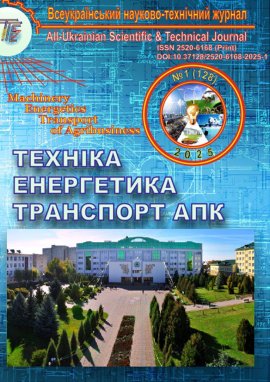
Issue №: 1 (128)
The journal solves the problems of creation and improvement of machinery and technologies for agriculture: 131 - Applied Mechanics, 132 - Materials Science, 133 - Industrial Engineering, 141 - Power Engineering, Electrical Engineering and Electromechanics, 208 - Agricultural Engineering.
RESULTS OF LABORATORY STUDIES ON THE PHYSICO-MECHANICAL PROPERTIES OF CASTOR FRUITS AND SEEDS
Elchyn ALIIEV – Doctor of Technical Sciences, Senior Researcher, Professor of the Departments of Mechanization of Production Processes in Animal Husbandry of Dnipro State Agrarian and Economic University (St. S. Efremova, 25, Dnipro, Ukraine, 49000, e-mail: aliev@meta.ua, https://orcid.org/0000-0003-4006-8803).
Valentyn HOLOVCHENKO – Recipient of the Third Educational and Scientific Level, Junior Research Associate of the Department of Technical Systems Engineering of Dnipro State Agrarian and Economic University (St. S. Efremova, 25, Dnipro, Ukraine, 49000, e-mail: golovchenkov@i.ua, https://orcid.org/0009-0007-9719-126X).
The aim of the study is to investigate the physicomechanical properties of castor fruits and seeds (Ricinus communis L.) to substantiate the design and technological parameters of machines and equipment intended for their extraction and cleaning.
Laboratory research on specialized equipment was conducted to determine the primary physical-mechanical properties of castor bean fruits and their components (segments, seeds, and capsule particles). These properties include geometric dimensions (length L and width B), mass M, bulk ρb and true ρd densities, angle of repose φ, friction coefficients (sliding μ' and static μ), and terminal velocity V. It was found that seeds exhibit the highest true density (567 ± 54 kg/m³) and the lowest friction coefficients, contributing to their superior flowability and mobility in technological processes. Fruits have the largest mass (1.18 ± 0.13 g) and terminal velocity (11.75 ± 1.43 m/s), influencing their cleaning and sorting methods. Capsule particles have the lowest density (101 ± 17 kg/m³) and terminal velocity (3.21 ± 0.51 m/s), allowing for effective separation using aerodynamic techniques. The results were applied in numerical modeling for a castor bean seed cleaning machine.
Rheological analysis of the compression behavior of castor bean fruits and seeds revealed a pronounced nonlinear dependence on time and absolute deformation. The deformation process of fruits involves multiple stages: an initial linear increase in force within elastic deformation, capsule cracking (Ff1 = 63.67 ± 3.52 N, Δxf1 = 3.32 ± 0.75 mm), slowing of force growth in the plastic phase, a sharp drop during capsule rupture (Ff2 = 172.96 ± 9.55 N, Δxf2 = 7.19 ± 0.79 mm), followed by a smooth increase in force during internal compression. A similar pattern is observed for seeds, but rupture (Fs2 = 48.91 ± 8.34 N, Δxs2 = 2.4 ± 0.62 mm) is accompanied by a sharp force decrease without a distinct plastic deformation phase. Statistical analysis confirmed that the force and deformation distributions conform to the normal distribution law.
1. Janiszewska, D., Olchowski, R., Nowicka, A., Zborowska, M., Marszałkiewicz, K., Shams, M., Giannakoudakis, D.A., Anastopoulos, I., & Barczak, M. (2021). Activated biochars derived from wood biomass liquefaction residues for effective removal of hazardous hexavalent chromium from aquatic environments. GCB Bioenergy, 13: 1247–1259. DOI: https://doi.org/10.1111/gcbb.12839. [in English].
2. Wydra, S., Hüsing, B., Köhler, J., Schwarz, A., Schirrmeister, E., & Voglhuber-Slavinsky, A. (2021). Transition to the bioeconomy – Analysis and scenarios for selected niches. J. Clean. Prod, 294, 126092. DOI: https://doi.org/10.1016/j.jclepro.2021.126092. [in English].
3. Park, K., Sanjaya, S.A., Quach, T., & Cahoon, E.B. (2021). Toward sustainable production of value-added bioenergy and industrial oils in oilseed and biomass feedstocks. GCB Bioenergy, 13: 1610–1623. DOI: https://doi.org/10.1111/gcbb.12883. [in English].
4. Román-Figueroa, C., Cea, M., Paneque, M., & González, M.E. (2020). Oil Content and Fatty Acid Composition in Castor Bean Naturalized Accessions under Mediterranean Conditions in Chile. Agronomy, 10: 1145. DOI: https://doi.org/10.3390/agronomy10081145. [in English].
5. Gelfand, I., Sahajpal, R., Zhang, X., Izaurralde, R.C., Gross, K.L., & Robertson, G.P. (2013). Sustainable bioenergy production from marginal lands in the US Midwest. Nature, 493: 514–517. DOI: https://doi.org/10.1038/nature11811. [in English].
6. Von Cossel, M., Lewandowski, I., Elbersen, B., Staritsky, I., Van Eupen, M., Iqbal, Y., Mantel, S., Scordia, D., Testa, G., & Cosentino, S.L. (2019). Marginal Agricultural Land Low-Input Systems for Biomass Production. Energies, 12: 3123. DOI: https://doi.org/10.3390/en12163123. [in English].
7. D’Avino, L., Di Bene, C., Farina, R., & Razza, F. (2020). Introduction of Cardoon (Cynara cardunculus L.) in a Rainfed Rotation to Improve Soil Organic Carbon Stock in Marginal Lands. Agronomy, 10, 946. DOI: https://doi.org/10.3390/agronomy10070946. [in English].
8. Zanetti, F., Monti, A., & Berti, M.T. (2013). Challenges and opportunities for new industrial oilseed crops in EU-27: A review. Ind. Crops Prod., 50: 580–595. DOI: https://doi.org/10.1016/j.indcrop.2013.08.030. [in English].
9. Alexopoulou, E., Papatheohari, Y., Zanetti, F., Tsiotas, K., Papamichael, I., Christou, M., Namatov, I., & Monti, A. (2015). Comparative studies on several castor (Ricinus communis L.) hybrids: Growth, yields, seed oil and biomass characterization. Ind. Crops Prod., 75: 8–13. DOI: https://doi.org/10.1016/j.indcrop.2015.07.015. [in English].
10. Odinets, S.I. (2017). Peculiarities of pigmentation of collection samples of castor oil. Scientific and technical bulletin of the Institute of Oilseeds of the NAAS, 24: 29-38. https://bulletin.imk.zp.ua/pdf/2017/24/Odinets_24.pdf. [in Ukrainian].
11. Vedmedeva, K.V., Kavyazina, M.Yu., & Makhova, T.V. (2018). Evaluation of castor oilseed samples by economic and valuable characteristics. Scientific and Technical Bulletin of the Institute of Oilseeds of the NAAS, 26: 39–48. https://bulletin.imk.zp.ua/pdf/2018/26/Vedmedeva2_26.pdf. [in Ukrainian].
12. Carrino, L., Visconti, D., Fiorentino, N., & Fagnano, M. (2020). Biofuel Production with Castor Bean: A Win–Win Strategy for Marginal Land. Agronomy, 10: 1690. DOI: https://doi.org/10.3390/agronomy10111690. [in English].
13. Bateni, H., & Karimi, K. (2016). Biodiesel production from castor plant integrating ethanol production via a biorefinery approach. Chem. Eng. Res. Des., 107: 4–12. DOI: https://doi.org/10.1016/j.cherd.2015.08.014. [in English].
14. Anjani, K. (2012). Castor genetic resources: A primary gene pool for exploitation. Ind. Crops Prod., 35: 1–14. DOI: https://doi.org/10.1016/j.indcrop.2011.06.011. [in English].
15. Vallejos, M., Rondanini, D., & Wassner, D.F. (2011). Water relationships of castor bean (Ricinus communis L.) seeds related to final seed dry weight and physiological maturity. Eur. J. Agron., 35: 93–101. DOI: https://doi.org/10.1016/j.eja.2011.04.003. [in English].
16. Koutroubas, S.D., Papakosta, D.K., & Doitsinis, A. (1999). Adaptation and yielding ability of castor plant (Ricinus communis L.) genotypes in a Mediterranean climate. Eur. J. Agron., 11: 227–237. DOI: https://doi.org/10.1016/S1161-0301(99)00034-9. [in English].
17. Aliiev, E. B. (2019). Physical and mathematical models of the processes of precision separation of sunflower seed material: monograph. Zaporizhzhia: STATUS. 196 p. https://aliev.in.ua/doc/knigi/kniga_4.pdf. [in Ukrainian].
18. Didur, V.V. (2020). Mechanical and technological foundations of deep processing of castor seeds in the conditions of a small-scale enterprise: dissertation ... Dr. Tech. Sciences: 05.05.11. Melitopol. 504 p. http://www.tsatu.edu.ua/nauka/wp-content/uploads/sites/49/dyssertacyja-dydur-vv_.pdf. [in Ukrainian].
19. Yang, L., Chen, H., Xiao, J., Fan, Y., Song, S., Zhang, Y., & Liu, X. (2021). Research on Structural–Mechanical Properties during the Castor Episperm Breaking Process. Processes, 9: 1777. https://doi.org/10.3390/pr9101777. [in English].
20. Aliiev, E.B., & & Vedmedeva, K.V. (2024). Quantitative phenotyping of sunflower genotypes: monograph. Dnipro: LIRA. 204 p. https://aliev.in.ua/doc/knigi/kniga_8.pdf. [in Ukrainian].
21. Aliiev, E.B., Mykolenko, S.Yu., & Dudin, V.Yu. Patent of Ukraine for a utility model 151728, IPC (2006) G01N 3/44 (2006.01), G01N 19/00, G01B 3/00. Device for automatic determination of structural and mechanical properties of food masses. Applicant: Dnipro State Agrarian and Economic University, No. u202106596. Appl. 08.09.2022. Publ. 07.09.2022, Bull. № 36. [in Ukrainian].
About the journal
G8 – Materials Science
G9 – Applied Mechanics
G10 – Metallurgy
G11 – Mechanical Engineering (by specializations)
The journal "Engineering, Energy, Transport AIC" is indexed according to the following databases and catalogs:


The All-Ukrainian scientific journal “Technology, energy, agriculture transport AIC” is an open-access scientific publication that publishes the results of original research, theoretical and applied developments, as well as scientific papers in the fields of engineering sciences, energy systems, and transport technologies of the agro-industrial complex.
The main objective of the scientific journal “Technology, energy, agriculture transport AIC” is to disseminate the results of modern scientific research and to promote the development of technical, energy, and transport solutions for the agro-industrial complex through the publication of scientific materials characterized by scientific novelty and practical significance in the field of design and modernization of machinery, equipment, and technologies.
The journal’s activities are focused on supporting the development of engineering science, stimulating the implementation of innovative approaches into industrial practice, as well as ensuring effective exchange of scientific achievements among researchers, educators, engineers, and other specialists in relevant fields.
Objectives of the Journal
To achieve its defined objective, the journal ensures the implementation of the following key tasks:
· publication of the results of fundamental and applied research covering the fields of applied mechanics, mechanical engineering, materials science, energy systems, electrical engineering, electromechanics, and transport systems of the agro-industrial sector;
· promotion of the implementation of advanced technical and technological developments aimed at improving the efficiency of machinery, equipment, and production processes;
· creation of conditions for active scientific exchange among research institutions, higher education institutions, industrial enterprises, and other interested organizations;
· support for the development of interdisciplinary research and expansion of cooperation among specialists in various fields of science and technology;
· promotion of the improvement of the scientific and technical level of research related to the design, modernization, and operation of technical equipment used in agro-industrial production;
· dissemination of information on modern achievements in science and technology and the implementation of innovative technologies in the fields of technical support, energy, and transport;
· development of a scientific information environment that facilitates effective scientific communication and the integration of national research into the international scientific community.
Publication frequency: 4 issues per year
Languages of publication: Ukrainian, English
Editor-in-Chief: Vitalii YAROPUD
State Registration: Decision of the National Council of Ukraine on Television and Radio Broadcasting № 1337 and № 1180. Media Identifier: R30-05173
EDRPOU Code: 00497236
Publisher ROR: https://ror.org/05m3ysc06
Publisher DOI prefix: 10.37128 ISSN (print): 2520-6168
The scientific journal is included in Category “B” of the List of Scientific Professional Publications of Ukraine in which the results of dissertation research for obtaining the degrees of Doctor and Candidate of Sciences may be published in the following specialties: G8 – Materials Science; G9 – Applied Mechanics; G10 – Metallurgy; G11 – Mechanical Engineering (by specializations). (Order of the Ministry of Education and Science of Ukraine dated June 11, 2026 №928
Technology, energy, agriculture transport AIC is a scholarly professional journal with a long-standing history and stable academic tradition, reflecting the evolution of engineering and technical sciences within the agro-industrial sector of Ukraine.
The journal was founded in 1997 under the title Bulletin of Vinnytsia State Agricultural Institute. According to the Resolution of the Presidium of the Higher Attestation Commission of Ukraine dated September 11, 1997, the publication obtained the status of a professional scientific journal, which enabled the publication of the main results of doctoral and candidate dissertations in technical sciences. From its inception, the journal positioned itself as an academic platform for addressing current issues of mechanization, electrification, and technical support of agricultural production. During 2001–2014, the journal was published under the title Proceedings of Vinnytsia National Agrarian University. Series: Technical Sciences (State Registration Certificate of Print Media KV No. 16644-5116 PR dated April 30, 2010). Throughout this period, a systematic approach to the selection and peer review of scientific manuscripts was established, the thematic scope of publications was expanded, and continuity of scientific directions as well as the development of sectoral engineering schools was ensured. Since 2015, the journal has been published under its current title, Technology, energy, agriculture transport AIC (State Registration Certificate No. 21906-11806 R dated March 12, 2016). The change of title reflected the expansion of the journal’s thematic coverage and its orientation toward interdisciplinary research in mechanical engineering, energy systems, electrical engineering, transport technologies, automation, and digital solutions for the agro-industrial complex.
