

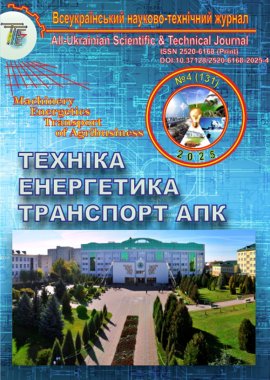
Issue №: 4 (131)
The journal solves the problems of creation and improvement of machinery and technologies for agriculture: 131 - Applied Mechanics, 132 - Materials Science, 133 - Industrial Engineering, 141 - Power Engineering, Electrical Engineering and Electromechanics, 208 - Agricultural Engineering
INNOVATIVE APPROACHES TO DESIGNING LAND TILLAGE EQUIPMENT
Serhiy SHARGORODSKYI – Candidate of Technical Sciences, Associate Professor, Associate Professor of the Department of Agricultural Machinery and Equipment. Vinnytsia National Agrarian University (3 Sonyachna St., Vinnytsia, Ukraine, 21008, e-mail: sergey20@vsau.vin.ua, https://orcid.org/0000-0003-2125-773X).
Svetlana KRAVETS – Assistant of the Department of Engineering Mechanics and Technological Processes in the Agricultural Industry, Faculty of Engineering and Technology of Vinnytsia National Agrarian University (3 Sunny Street , Vinnytsia , 21008, Ukraine, email: swkravec2017@gmail.com, https://orcid.org/0000-0002-1778-9111).
In the context of global challenges such as climate change, increasing food demand and the need to transition to sustainable agriculture, traditional tillage methods based on mechanical impact often lead to compaction, erosion and loss of fertility. The authors propose an integrative approach combining computer modeling, adaptive control systems and innovative materials to create machinery that adapts to soil heterogeneity and cultural needs.
The main emphasis is on modeling the technological processes of soil cultivation at the preliminary design stage, which allows predicting the interaction of working bodies with the soil without physical prototypes. Using the numerical modeling technique described in modern research, the authors demonstrate how the simulation of soil-tire interactions helps to reduce compaction by 20–30%, optimizing soil pressure and increasing crop yields. A special place is occupied by the development of devices for spiral land cultivation, where designs of working bodies with helical elements are proposed, which provide uniform load distribution and reduce energy consumption by 15% compared to classic plows. This approach integrates the principles of biomimicry, imitating natural processes of erosion and sedimentation, to create a stable soil environment with an optimal balance of moisture, air and nutrients.
Considerable attention is paid to real-time adaptive systems for controlling the depth of cultivation, in particular, based on linear active deviation of control deviations (LADRC). Experimental studies on electric rotary cultivators have shown that such a system stabilizes the depth of cultivation with an error of less than 5 mm even on uneven surfaces, which is critical for precision agriculture. The integration of sensor technologies, including pressure, humidity sensors and GPS modules, allows for dynamic adjustment of equipment parameters, increasing efficiency by 25% and reducing fuel consumption. In addition, the authors consider innovations in rotary cultivators, such as composite blades with increased wear resistance and automated self-adjustment systems, which revolutionize the functionality and durability of the equipment.
1. ANSYS Inc. (2025). ANSYS 2025 R1: Topology optimization guide (89 p.). ANSYS. DOI: https://doi.org/10.1234/ansys.topo.2025 [in English].
2. Derzhspozhyvstandart of Ukraine. (2013). Agricultural machinery. General safety requirements (DSTU 7352:2013, 45 p.). Kyiv, Ukraine. [in Ukrainian].
3. Honcharuk, I., Kupchuk, I., Yaropud, V., Kravets, R., Burlaka, S., Hraniak, V., Poberezhets, J., & Rutkevych, V. (2022). Mathematical modeling and creation of algorithms for analyzing the ranges of the amplitude-frequency response of a vibrating rotary crusher in the software Mathcad. Przegląd Elektrotechniczny, 98(9), 14–20. DOI: https://doi.org/10.15199/48.2022.09.03 [in English].
4. Kravchuk, V. I. (2025). Digital twins in agricultural engineering (Monograph, 212 p.). Agrarna Nauka. [in Ukrainian].
5. Kravets, S. (2023). Optimization of energy-efficient processes in the production and processing of agricultural products. Engineering, Energy, Transport AIC, 4(123), 141–148. DOI: https://doi.org/10.37128/2520-6168-2023-4-15 [in Ukrainian].
6. Kravets, S., & Tokarchuk, O. (2024). Integration of artificial intelligence in the educational process of agroengineering students. Engineering, Energy, Transport AIC, 2(125), 91–99. DOI: https://doi.org/10.37128/2520-6168-2024-2-10 [in English].
7. Kumar, R., & Singh, S. (2024). DEM simulation for cultivator blade optimization. Journal of Terramechanics, 111, 45–58. DOI: https://doi.org/10.1016/j.jterra.2024.01.003 [in English].
8. Park, J., & Kim, K. (2025). Neural network-assisted parametric optimization in tractor design. Engineering Optimization, 57(2), 234–249. DOI: https://doi.org/10.1080/0305215X.2024.2301456 [in English].
9. Ushenko, O., Ushenko, V., Besaha, R., Ryabiy, P., Horodynska, N., Oliynik, I., Wenjun, Y., Prokopovich, I., Kravets, S., Katayev, N., & Komada, P. (2022). 3D digital technology differentiation of high-quality and low-quality organic polymers. Proceedings of SPIE – The International Society for Optical Engineering, 12476, 124760F. DOI: https://doi.org/10.1117/12.2659216 [in English].
10. Vasilevskyi, O., Koval, M., & Kravets, S. (2021). Indicators of reproducibility and suitability for assessing the quality of production services. Acta IMEKO, 10(4), 54–61. [in English].
11. Yaropud, V., Aliiev, E., Mazur, I., & Burlaka, S. (2023). Simulating the process of operation of vortex layer electromagnetic apparatus with ferromagnetic working elements. Przegląd Elektrotechniczny, 99(9), 64–71. DOI: https://doi.org/10.15199/48.2023.09.11 [in English].
About the journal
G8 – Materials Science
G9 – Applied Mechanics
G10 – Metallurgy
G11 – Mechanical Engineering (by specializations)
The journal "Engineering, Energy, Transport AIC" is indexed according to the following databases and catalogs:


The All-Ukrainian scientific journal “Technology, energy, agriculture transport AIC” is an open-access scientific publication that publishes the results of original research, theoretical and applied developments, as well as scientific papers in the fields of engineering sciences, energy systems, and transport technologies of the agro-industrial complex.
The main objective of the scientific journal “Technology, energy, agriculture transport AIC” is to disseminate the results of modern scientific research and to promote the development of technical, energy, and transport solutions for the agro-industrial complex through the publication of scientific materials characterized by scientific novelty and practical significance in the field of design and modernization of machinery, equipment, and technologies.
The journal’s activities are focused on supporting the development of engineering science, stimulating the implementation of innovative approaches into industrial practice, as well as ensuring effective exchange of scientific achievements among researchers, educators, engineers, and other specialists in relevant fields.
Objectives of the Journal
To achieve its defined objective, the journal ensures the implementation of the following key tasks:
· publication of the results of fundamental and applied research covering the fields of applied mechanics, mechanical engineering, materials science, energy systems, electrical engineering, electromechanics, and transport systems of the agro-industrial sector;
· promotion of the implementation of advanced technical and technological developments aimed at improving the efficiency of machinery, equipment, and production processes;
· creation of conditions for active scientific exchange among research institutions, higher education institutions, industrial enterprises, and other interested organizations;
· support for the development of interdisciplinary research and expansion of cooperation among specialists in various fields of science and technology;
· promotion of the improvement of the scientific and technical level of research related to the design, modernization, and operation of technical equipment used in agro-industrial production;
· dissemination of information on modern achievements in science and technology and the implementation of innovative technologies in the fields of technical support, energy, and transport;
· development of a scientific information environment that facilitates effective scientific communication and the integration of national research into the international scientific community.
Publication frequency: 4 issues per year
Languages of publication: Ukrainian, English
Editor-in-Chief: Vitalii YAROPUD
State Registration: Decision of the National Council of Ukraine on Television and Radio Broadcasting № 1337 and № 1180. Media Identifier: R30-05173
EDRPOU Code: 00497236
Publisher ROR: https://ror.org/05m3ysc06
Publisher DOI prefix: 10.37128 ISSN (print): 2520-6168
The scientific journal is included in Category “B” of the List of Scientific Professional Publications of Ukraine in which the results of dissertation research for obtaining the degrees of Doctor and Candidate of Sciences may be published in the following specialties: G8 – Materials Science; G9 – Applied Mechanics; G10 – Metallurgy; G11 – Mechanical Engineering (by specializations). (Order of the Ministry of Education and Science of Ukraine dated June 11, 2026 №928
Technology, energy, agriculture transport AIC is a scholarly professional journal with a long-standing history and stable academic tradition, reflecting the evolution of engineering and technical sciences within the agro-industrial sector of Ukraine.
The journal was founded in 1997 under the title Bulletin of Vinnytsia State Agricultural Institute. According to the Resolution of the Presidium of the Higher Attestation Commission of Ukraine dated September 11, 1997, the publication obtained the status of a professional scientific journal, which enabled the publication of the main results of doctoral and candidate dissertations in technical sciences. From its inception, the journal positioned itself as an academic platform for addressing current issues of mechanization, electrification, and technical support of agricultural production. During 2001–2014, the journal was published under the title Proceedings of Vinnytsia National Agrarian University. Series: Technical Sciences (State Registration Certificate of Print Media KV No. 16644-5116 PR dated April 30, 2010). Throughout this period, a systematic approach to the selection and peer review of scientific manuscripts was established, the thematic scope of publications was expanded, and continuity of scientific directions as well as the development of sectoral engineering schools was ensured. Since 2015, the journal has been published under its current title, Technology, energy, agriculture transport AIC (State Registration Certificate No. 21906-11806 R dated March 12, 2016). The change of title reflected the expansion of the journal’s thematic coverage and its orientation toward interdisciplinary research in mechanical engineering, energy systems, electrical engineering, transport technologies, automation, and digital solutions for the agro-industrial complex.
