

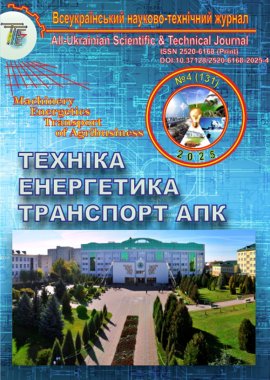
Issue №: 4 (131)
The journal solves the problems of creation and improvement of machinery and technologies for agriculture: 131 - Applied Mechanics, 132 - Materials Science, 133 - Industrial Engineering, 141 - Power Engineering, Electrical Engineering and Electromechanics, 208 - Agricultural Engineering
MATHEMATICAL MODELING OF THE COMBUSTION PROCESS OF A TRI-FUEL MIXTURE IN A DIESEL ENGINE
Tetyana BORETSKA– Head of the Scientific and Organizational Department of the Scientific and Research Part of the Vinnytsia National Agrarian University (3 Sonyachna St., Vinnytsia, Ukraine, 21008, e-mail: ipserhiy@gmail.com, https://orcid.org/0000-0002-7966-228X).
Mykola ZHARSKY– postgraduate student of Vinnytsia National Agrarian University (3 Sonyachna St., Vinnytsia, Ukraine, 21008, e-mail: ipserhiy@gmail.com, https://orcid.org/0009-0005-8184-4583).
The article is dedicated to the analysis and mathematical modeling of the combustion process of three-fuel mixtures consisting of conventional diesel fuel, biodiesel (for example, based on rapeseed oil or waste), and bioethanol in diesel internal combustion engines. In the context of global environmental challenges, such as reducing harmful emissions and depleting fossil fuel resources, the authors examine the potential of these mixtures to improve engine efficiency and reduce dependence on imported oil. In particular, optimal component proportions are discussed, for example, 70% diesel fuel, 20-25% biodiesel, and 5-10% bioethanol, which allow achieving a balance between performance, economy, and environmental friendliness. Studies show that such mixtures can reduce soot emissions by 15-20%, nitrogen oxides by 25-30%, and carbon dioxide by 10-15%, depending on engine operating modes and specific physical properties of the fuel.
The work provides an overview of key experimental and theoretical studies conducted from 2008 to 2024. In particular, data from Romanian scientists at the Transilvania University of Cluj-Napoca are analyzed, who studied the physical characteristics of mixtures, such as density (0.841-0.852 kg/dm³), viscosity (2.756 mm²/s for the B25M70E5 mixture), and surface tension (up to 0.03465 N/m), as well as their impact on fuel atomization in injectors. Experiments using high-speed cameras confirmed that biodiesel additives increase the spray angle (up to 0.055 rad), while bioethanol accelerates evaporation due to its lower boiling point. In addition, the article references models from the journal Processes (2022), where a combined kinetic mechanism with 430 reactions was developed for simulating oxidation and emission formation, demonstrating a decrease in cylinder pressure by 4.31% and temperature by 1.23% with increasing ethanol content.
The mathematical apparatus of modeling is based on conservation equations for mass, momentum, energy, and species, taking into account turbulence (k-ε and k-ζ-f models), atomization (KIVA 3V), evaporation, and chemical reactions. Adapted thermodynamic models are described, such as the Wiebe function for the heat release curve (x = 1 - exp(C φ^{m+1})), with division into ignition and diffusion combustion phases, as well as gas dynamics equations for predicting parameters such as BSFC (with an error of about 1.12%). Simulations in AVL-Fire software and CFD tools confirm an increase in heat release rate due to prolonged ignition delay, but also highlight risks, such as deteriorated mixing at low loads.
The modeling results demonstrate practical value: for BE10-BE20 mixtures, BSFC increases by 18.64%, but BTE by 2.09%, with significant reductions in NOx emissions (by 29.32%), CO (by 39.57%), and soot (by 15.95%). The authors emphasize that three-fuel mixtures are suitable for implementation in agricultural machinery and transport without significant engine modifications, but recommend additional tests for material durability due to the possible impact of bioethanol on elastomers. Overall, the article contributes to the development of sustainable energy technologies, offering tools for optimizing fuel systems and reducing environmental impact.
1. Barabás, I., Todoruț, A., & Băldean, D. (2008). Research on the use of biodiesel–diesel–ethanol blends in diesel engines. Technical University of Cluj-Napoca. URL: https://users.utcluj.ro/~ibarabas/idei1098/pdf/faza_2008_eng.pdf [in English].
2. Hossain, F. M., Nabi, M. N., & Brown, R. J. (2022). Investigation of diesel–ethanol and diesel–ethanol–methyl ester blends in a constant-speed diesel engine for optimal performance and emission characteristics. Processes, 10(9), Article 1689. DOI: https://doi.org/10.3390/pr10091689 [in English].
3. Mrad, N., Al-Mosabeeh, A., Al-Samhan, M., & Al-Shamary, A. (2024). A mathematical modeling of a compression ignition engine fueled with biodiesel. Combustion Engines, 195(4), 3–14. DOI: https://doi.org/10.19206/CE-195445 [in English].
4. Reşitoğlu, İ. A., Altinişik, K., & Keskin, A. (2013). Biodiesel applications in diesel engines: Simulation of biofuels combustion. In Biofuels (Chap. 5, pp. 1–25). IntechOpen. DOI: https://doi.org/10.5772/53888 [in English].
5. Razzaq, L., Farooq, M., Mujtaba, M. A., Sher, F., Farhan, M., Hassan, M. T., Soudagar, M. E. M., Atabani, A. E., Kalam, M. A., & Imran, M. (2020). Modeling viscosity and density of ethanol–diesel–biodiesel ternary blends for sustainable environment. Sustainability, 12(12), Article 5186. DOI: https://doi.org/10.3390/su12125186 [in English].
6. Barabás, I., & Todoruț, A. (2009). Key fuel properties of biodiesel–diesel fuel–ethanol blends. SAE Technical Paper, 2009-01-1810. DOI: https://doi.org/10.4271/2009-01-1810 [in English].
7. Chen, G., Shen, Y., Zhang, Q., Yao, M., Zheng, Z., & Liu, H. (2024). Density prediction model of binary or ternary diesel fuel blends with biodiesel and ethanol for compression-ignition engine calculations. Journal of Energy Engineering, 150(2). DOI: https://doi.org/10.1061/JLEED9.EYENG-5385 [in English].
About the journal
G8 – Materials Science
G9 – Applied Mechanics
G10 – Metallurgy
G11 – Mechanical Engineering (by specializations)
The journal "Engineering, Energy, Transport AIC" is indexed according to the following databases and catalogs:


The All-Ukrainian scientific journal “Technology, energy, agriculture transport AIC” is an open-access scientific publication that publishes the results of original research, theoretical and applied developments, as well as scientific papers in the fields of engineering sciences, energy systems, and transport technologies of the agro-industrial complex.
The main objective of the scientific journal “Technology, energy, agriculture transport AIC” is to disseminate the results of modern scientific research and to promote the development of technical, energy, and transport solutions for the agro-industrial complex through the publication of scientific materials characterized by scientific novelty and practical significance in the field of design and modernization of machinery, equipment, and technologies.
The journal’s activities are focused on supporting the development of engineering science, stimulating the implementation of innovative approaches into industrial practice, as well as ensuring effective exchange of scientific achievements among researchers, educators, engineers, and other specialists in relevant fields.
Objectives of the Journal
To achieve its defined objective, the journal ensures the implementation of the following key tasks:
· publication of the results of fundamental and applied research covering the fields of applied mechanics, mechanical engineering, materials science, energy systems, electrical engineering, electromechanics, and transport systems of the agro-industrial sector;
· promotion of the implementation of advanced technical and technological developments aimed at improving the efficiency of machinery, equipment, and production processes;
· creation of conditions for active scientific exchange among research institutions, higher education institutions, industrial enterprises, and other interested organizations;
· support for the development of interdisciplinary research and expansion of cooperation among specialists in various fields of science and technology;
· promotion of the improvement of the scientific and technical level of research related to the design, modernization, and operation of technical equipment used in agro-industrial production;
· dissemination of information on modern achievements in science and technology and the implementation of innovative technologies in the fields of technical support, energy, and transport;
· development of a scientific information environment that facilitates effective scientific communication and the integration of national research into the international scientific community.
Publication frequency: 4 issues per year
Languages of publication: Ukrainian, English
Editor-in-Chief: Vitalii YAROPUD
State Registration: Decision of the National Council of Ukraine on Television and Radio Broadcasting № 1337 and № 1180. Media Identifier: R30-05173
EDRPOU Code: 00497236
Publisher ROR: https://ror.org/05m3ysc06
Publisher DOI prefix: 10.37128 ISSN (print): 2520-6168
The scientific journal is included in Category “B” of the List of Scientific Professional Publications of Ukraine in which the results of dissertation research for obtaining the degrees of Doctor and Candidate of Sciences may be published in the following specialties: G8 – Materials Science; G9 – Applied Mechanics; G10 – Metallurgy; G11 – Mechanical Engineering (by specializations). (Order of the Ministry of Education and Science of Ukraine dated June 11, 2026 №928
Technology, energy, agriculture transport AIC is a scholarly professional journal with a long-standing history and stable academic tradition, reflecting the evolution of engineering and technical sciences within the agro-industrial sector of Ukraine.
The journal was founded in 1997 under the title Bulletin of Vinnytsia State Agricultural Institute. According to the Resolution of the Presidium of the Higher Attestation Commission of Ukraine dated September 11, 1997, the publication obtained the status of a professional scientific journal, which enabled the publication of the main results of doctoral and candidate dissertations in technical sciences. From its inception, the journal positioned itself as an academic platform for addressing current issues of mechanization, electrification, and technical support of agricultural production. During 2001–2014, the journal was published under the title Proceedings of Vinnytsia National Agrarian University. Series: Technical Sciences (State Registration Certificate of Print Media KV No. 16644-5116 PR dated April 30, 2010). Throughout this period, a systematic approach to the selection and peer review of scientific manuscripts was established, the thematic scope of publications was expanded, and continuity of scientific directions as well as the development of sectoral engineering schools was ensured. Since 2015, the journal has been published under its current title, Technology, energy, agriculture transport AIC (State Registration Certificate No. 21906-11806 R dated March 12, 2016). The change of title reflected the expansion of the journal’s thematic coverage and its orientation toward interdisciplinary research in mechanical engineering, energy systems, electrical engineering, transport technologies, automation, and digital solutions for the agro-industrial complex.
