

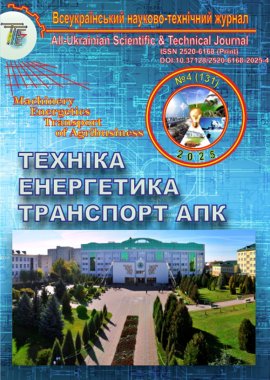
Issue №: 4 (131)
The journal solves the problems of creation and improvement of machinery and technologies for agriculture: 131 - Applied Mechanics, 132 - Materials Science, 133 - Industrial Engineering, 141 - Power Engineering, Electrical Engineering and Electromechanics, 208 - Agricultural Engineering
RESULTS OF STUDIES ON THE INFLUENCE OF KEY PARAMETERS ON THE TRANSVERSE UNIFORMITY OF WORKING FLUID DISTRIBUTION BY A BOOM SPRAYER
Dmytro MAKARENKO – Candidate of Technical Sciences, Associate Professor, Associate Professor of the Department of Operation of Machine and Tractor Park of Dnipro State Agrarian and Economic University (Dnipro, Serhiy Efremov St., 25, e-mail: makarenko.d.o@dsau.dp.ua, https://orcid.org/0000-0002-3166-6249).
Elchyn ALIIEV – Doctor of Technical Sciences, Senior Researcher, Professor of the Department of Technical Systems Engineering of Dnipro State Agrarian and Economic University (St. S. Efremova, 25, Dnipro, Ukraine, 49000, e-mail: aliev@meta.ua, https://orcid.org/0000-0003-4006-8803).
Viacheslav SAKHNO – Candidate of Physical and Mathematical Sciences, Associate Professor of the Department of Higher Mathematics, Physics and General Engineering Disciplines ((Dnipro, Serhiy Efremov St., 25, e-mail: sakhno1960@gmail.com, https://orcid.org/0000-0002-2314-4547)
Valerii KOVAL – postgraduate student of the EІP «Industrial Mechanical Engineering» of the Dnipro State Agrarian and Economic University (Dnipro, Serhiy Yefremov St., 25, e-mail: koval.v.o@dsau.dp.ua, https://orcid.org/0009-0002-0736-0343).
Ensuring uniform transverse distribution of spray liquid during crop protection treatments is a key factor determining the effectiveness of pesticide application and reducing losses of active ingredients. Non-uniform application leads to untreated zones and local overdosing, which negatively affects both crop yield and environmental safety. This article presents the results of experimental research on the influence of boom height and operating pressure in the supply line on the uniformity of spray distribution when using flat-fan nozzles.
The experiments were conducted on a test bench manufactured in accordance with relevant standards (ISO) for evaluating distribution uniformity. Boom height was varied within the range of 0,15-0,9 m, while the operating pressure was adjusted between 0,2 and 0,6 MPa. The collected data were processed using the least squares method, with determination of mean values, variances, standard deviations, and coefficients of variation. Regression models were developed in the Wolfram Mathematica environment, and corresponding response surface plots were generated to identify optimal operating zones for the sprayer.
The experimental results showed that at boom heights below 0,4 m, the coefficient of variation reached 30-75%, exceeding agronomic requirements several times. Increasing the height to approximately 0,6 m significantly reduced distribution non-uniformity for all pressure levels studied. Using the constructed response surfaces, optimal combinations of parameters that provide the highest level of spray uniformity were identified.
Practical recommendations were formulated for field application: a boom height of 0,7-0,8 m is advisable at 0,2 MPa; 0,5-0,7 m at 0,3 MPa; and approximately 0,5 m at 0,6 MPa. The findings can be used to improve spraying guidelines and enhance the efficiency of pesticide application. The article also outlines prospects for future research aimed at further optimization of structural and operational parameters of boom sprayers.
1. Oerke, E.-C. (2006). Crop losses to pests. The Journal of Agricultural Science, 144(1), 31–43. DOI: https://doi.org/10.1017/S0021859605005708 [in English].
2. Kravchuk, V. I., & Voitiuk, D. H. (Eds.). (2010). Mashyny dlia khimichnoho zakhystu roslyn [Machines for chemical plant protection]. UkrNDIPVT im. L. Pohoriloho. [in Ukrainian].
3. Spraying Systems Co. (2021). Spray application & technology handbook. TeeJet Technologies. URL: https://www.teejet.com/knowledge-center/spray-application-and-technology [in English].
4. van de Zande, J. C., Stallinga, H., Michielsen, J. M. G. P., & van Velde, P. (2005). Effect of sprayer speed on spray drift. Annual Review of Agricultural Engineering, 4(1), 129–142. [in English].
5. Nuyttens, D., Baetens, K., De Schampheleire, M., & Sonck, B. (2007). Effect of nozzle type, size and pressure on spray droplet characteristics. Biosystems Engineering, 97(3), 333–345. DOI: https://doi.org/10.1016/j.biosystemseng.2007.03.001 [in English].
6. Moreno Ruiz, J. R. (2014). Indoor spray measurement of spray drift potential using a spray drift test bench: Effect of drift-reducing nozzle types, spray boom height, nozzle spacing and forward speed (Report №. 583). Plant Research International. URL: https://edepot.wur.nl/328840 [in English].
7. Hilz, E., & Vermeer, A. W. P. (2013). Spray drift review: The extent to which a formulation can contribute to spray drift reduction. Crop Protection, 44, 75–83. DOI: https://doi.org/10.1016/j.cropro.2012.10.020 [in English].
8. de Jong, A., Michielsen, J. M. G. P., Stallinga, H., & van de Zande, J. C. (2000). Effect of sprayer boom height on spray drift. Mededelingen – Universiteit Gent, Faculteit Landbouwkundige en Toegepaste Biologische Wetenschappen, 62(5b), 919–930. [in English].
9. Balsari, P., Gil, E., Marucco, P., van de Zande, J. C., Nuyttens, D., Herbst, A., & Gallart, M. (2017). Field-crop-sprayer potential drift measured using test bench: Effects of boom height and nozzle type. Biosystems Engineering, 154, 3–13. DOI: https://doi.org/10.1016/j.biosystemseng.2016.10.015
10. Holterman, H. J., van de Zande, J. C., & van Velde, P. (2018). Optimizing sprayer boom design for bed-grown crops. In International Advances in Pesticide Application (pp. 123–130). Association of Applied Biologists. URL: https://edepot.wur.nl/466805 [in English].
11. Nuyttens, D., De Schampheleire, M., Steurbaut, W., Baetens, K., Verboven, P., Nicolai, B., & Sonck, B. (2006). Experimental study of factors influencing the risk of drift from field sprayers. Part 2: Spray application technique. Aspects of Applied Biology, 77(2), 331–339. [in English].
12. Melezhyk, O. I. (2009). Pokrashchennia dyspersnosti rozpylennia pestytsydiv [Improving the dispersion of pesticide spraying] (Candidate of Technical Sciences dissertation). Dnipropetrovsk State Agrarian University. [in English].
13. Liao, J., Luo, X., Wang, P., Zhou, Z., O’Donnell, C. C., Zang, Y., & Hewitt, A. J. (2020). Analysis of the influence of different parameters on droplet characteristics and droplet size classification categories for air induction nozzle. Agronomy, 10(2), 256. DOI: https://doi.org/10.3390/agronomy10020256 [in English].
14. Ukrainian Research and Training Center of Standardization, Certification and Quality. (2019). DSTU ISO 5682-2:2019. Equipment for plant protection. Spraying equipment. Part 2: Test methods for hydraulic sprayers. UkrNDNC. [in Ukrainian].
15. Kyselov, O. V., Komarova, I. B., Milko, D. O., & Bakardzhiiev, R. O. (2017). Statistical processing and presentation of experimental research results (based on the experience of writing dissertations). STATUS. [in Ukrainian]
16. Wolfram, S. (2023). An elementary introduction to the Wolfram Language (3rd ed.). Wolfram Research. URL: https://www.wolfram.com/language/elementary-introduction/3rd-ed/ [in English].
About the journal
G8 – Materials Science
G9 – Applied Mechanics
G10 – Metallurgy
G11 – Mechanical Engineering (by specializations)
The journal "Engineering, Energy, Transport AIC" is indexed according to the following databases and catalogs:


The All-Ukrainian scientific journal “Technology, energy, agriculture transport AIC” is an open-access scientific publication that publishes the results of original research, theoretical and applied developments, as well as scientific papers in the fields of engineering sciences, energy systems, and transport technologies of the agro-industrial complex.
The main objective of the scientific journal “Technology, energy, agriculture transport AIC” is to disseminate the results of modern scientific research and to promote the development of technical, energy, and transport solutions for the agro-industrial complex through the publication of scientific materials characterized by scientific novelty and practical significance in the field of design and modernization of machinery, equipment, and technologies.
The journal’s activities are focused on supporting the development of engineering science, stimulating the implementation of innovative approaches into industrial practice, as well as ensuring effective exchange of scientific achievements among researchers, educators, engineers, and other specialists in relevant fields.
Objectives of the Journal
To achieve its defined objective, the journal ensures the implementation of the following key tasks:
· publication of the results of fundamental and applied research covering the fields of applied mechanics, mechanical engineering, materials science, energy systems, electrical engineering, electromechanics, and transport systems of the agro-industrial sector;
· promotion of the implementation of advanced technical and technological developments aimed at improving the efficiency of machinery, equipment, and production processes;
· creation of conditions for active scientific exchange among research institutions, higher education institutions, industrial enterprises, and other interested organizations;
· support for the development of interdisciplinary research and expansion of cooperation among specialists in various fields of science and technology;
· promotion of the improvement of the scientific and technical level of research related to the design, modernization, and operation of technical equipment used in agro-industrial production;
· dissemination of information on modern achievements in science and technology and the implementation of innovative technologies in the fields of technical support, energy, and transport;
· development of a scientific information environment that facilitates effective scientific communication and the integration of national research into the international scientific community.
Publication frequency: 4 issues per year
Languages of publication: Ukrainian, English
Editor-in-Chief: Vitalii YAROPUD
State Registration: Decision of the National Council of Ukraine on Television and Radio Broadcasting № 1337 and № 1180. Media Identifier: R30-05173
EDRPOU Code: 00497236
Publisher ROR: https://ror.org/05m3ysc06
Publisher DOI prefix: 10.37128 ISSN (print): 2520-6168
The scientific journal is included in Category “B” of the List of Scientific Professional Publications of Ukraine in which the results of dissertation research for obtaining the degrees of Doctor and Candidate of Sciences may be published in the following specialties: G8 – Materials Science; G9 – Applied Mechanics; G10 – Metallurgy; G11 – Mechanical Engineering (by specializations). (Order of the Ministry of Education and Science of Ukraine dated June 11, 2026 №928
Technology, energy, agriculture transport AIC is a scholarly professional journal with a long-standing history and stable academic tradition, reflecting the evolution of engineering and technical sciences within the agro-industrial sector of Ukraine.
The journal was founded in 1997 under the title Bulletin of Vinnytsia State Agricultural Institute. According to the Resolution of the Presidium of the Higher Attestation Commission of Ukraine dated September 11, 1997, the publication obtained the status of a professional scientific journal, which enabled the publication of the main results of doctoral and candidate dissertations in technical sciences. From its inception, the journal positioned itself as an academic platform for addressing current issues of mechanization, electrification, and technical support of agricultural production. During 2001–2014, the journal was published under the title Proceedings of Vinnytsia National Agrarian University. Series: Technical Sciences (State Registration Certificate of Print Media KV No. 16644-5116 PR dated April 30, 2010). Throughout this period, a systematic approach to the selection and peer review of scientific manuscripts was established, the thematic scope of publications was expanded, and continuity of scientific directions as well as the development of sectoral engineering schools was ensured. Since 2015, the journal has been published under its current title, Technology, energy, agriculture transport AIC (State Registration Certificate No. 21906-11806 R dated March 12, 2016). The change of title reflected the expansion of the journal’s thematic coverage and its orientation toward interdisciplinary research in mechanical engineering, energy systems, electrical engineering, transport technologies, automation, and digital solutions for the agro-industrial complex.
